 Back
BackCell Membrane Structure and Transport Study Guide
Study Guide - Smart Notes
 Tailored notes based on your materials, expanded with key definitions, examples, and context.
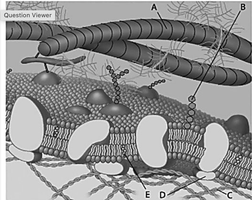
Q2. In the figure, which component represents a peripheral membrane protein?
Background
Topic: Cell Membrane Structure
This question tests your understanding of the different types of proteins associated with the cell membrane, specifically the distinction between peripheral and integral membrane proteins.
Key Terms:
Peripheral membrane protein: Proteins that are attached to the exterior or interior surfaces of the membrane but do not penetrate the hydrophobic core.
Integral membrane protein: Proteins that span the membrane and are embedded within the lipid bilayer.
Phospholipid bilayer: The fundamental structure of the cell membrane, consisting of two layers of phospholipids.
Step-by-Step Guidance
Examine the diagram and identify the phospholipid bilayer, which forms the basic structure of the membrane.
Look for proteins that are embedded within the bilayer (these are integral proteins) and those that are attached to the surface (these are peripheral proteins).
Peripheral proteins are typically found on the inner or outer surface of the membrane and do not span the entire bilayer.
Compare the labeled components in the diagram to determine which one is only associated with the surface and not embedded within the membrane.
Try solving on your own before revealing the answer!
Final Answer: Component B represents a peripheral membrane protein.
Peripheral proteins are attached to the membrane surface, unlike integral proteins that span the bilayer.
Q36. The cell is in an _____ solution.
Background
Topic: Osmosis and Tonicity
This question tests your ability to interpret the effects of different solute concentrations on cells and identify the type of solution (hypotonic, hypertonic, or isotonic) based on water movement.
Key Terms:
Hypotonic solution: Lower solute concentration outside the cell; water enters the cell.
Hypertonic solution: Higher solute concentration outside the cell; water leaves the cell.
Isotonic solution: Equal solute concentration inside and outside; no net water movement.
Step-by-Step Guidance
Observe the diagram and note the relative concentrations of solutes in the extracellular fluid and cytoplasm.
Determine whether water is moving into or out of the cell based on the direction of solute and water movement.
If the extracellular fluid has a higher solute concentration than the cytoplasm, the solution is hypertonic.
If the extracellular fluid has a lower solute concentration, the solution is hypotonic.

Try solving on your own before revealing the answer!
Final Answer: The cell is in a hypertonic solution.
Water leaves the cell, causing it to shrink, which is characteristic of a hypertonic environment.
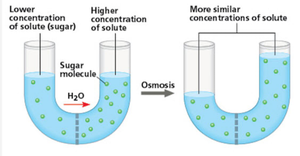
Q38. You know that this cell is in a(n) _____ solution because it _____
Background
Topic: Osmosis and Cell Response
This question tests your understanding of how cells respond to different osmotic environments, specifically hypertonic and hypotonic solutions.
Key Terms:
Hypertonic solution: Causes cells to lose water and shrink.
Hypotonic solution: Causes cells to gain water and swell.
Lysis: Cell bursting due to excess water intake.
Step-by-Step Guidance
Examine the diagram and note the direction of water movement relative to the cell.
If water is moving out of the cell, the cell is in a hypertonic solution.
If water is moving into the cell, the cell is in a hypotonic solution.
Identify the effect on the cell: shrinking (hypertonic) or swelling/lysis (hypotonic).
Try solving on your own before revealing the answer!
Final Answer: The cell is in a hypertonic solution because it lost water.
Cells lose water and shrink in hypertonic environments.
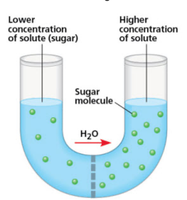
Q41. There is more solute in the left arm of the tube than in the right arm of the tube. What happens to water movement?
Background
Topic: Osmosis and Selectively Permeable Membranes
This question tests your understanding of how water moves across a membrane in response to solute concentration differences.
Key Terms:
Osmosis: Movement of water across a selectively permeable membrane toward higher solute concentration.
Free water: Water not bound to solute molecules and available for osmosis.
Step-by-Step Guidance
Identify which side of the U-tube has a higher solute concentration.
Recall that water moves toward the side with higher solute concentration to dilute it.
Consider the effect of water clustering around solute molecules, reducing free water on that side.
Predict the direction of net water movement based on these principles.
Try solving on your own before revealing the answer!
Final Answer: Water will move toward the side with higher solute concentration.
This is because osmosis drives water to dilute the more concentrated solution.
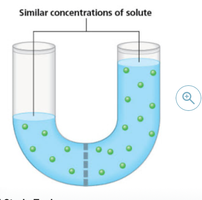
Q44. If the pores in the selectively permeable membrane became larger, but still not large enough to let the sugar pass through, what would happen during osmosis in the U-shaped tube compared to what is shown in the figure?
Background
Topic: Membrane Permeability and Osmosis
This question tests your understanding of how the size of membrane pores affects the rate and extent of osmosis.
Key Terms:
Osmosis: Movement of water across a membrane toward higher solute concentration.
Membrane pores: Openings that allow water (but not solute) to pass through.
Step-by-Step Guidance
Consider how increasing pore size affects the rate at which water can move across the membrane.
Recall that the solute (sugar) still cannot cross, so the direction of osmosis remains unchanged.
Think about whether the final equilibrium will be different or just reached faster.
Analyze how the speed of osmosis might change, but not the final water levels.
Try solving on your own before revealing the answer!
Final Answer: The final water levels would be the same, but equilibrium would be reached faster.
Larger pores allow water to move more quickly, but the solute still cannot cross, so the overall result does not change.
