Back
BackLEC 7: Cell Structure and Function: Prokaryotic and Eukaryotic Cells
Study Guide - Smart Notes
 Tailored notes based on your materials, expanded with key definitions, examples, and context.
Cell Structure and Function
Basic Features of All Cells
All cells, whether prokaryotic or eukaryotic, share several fundamental features that are essential for life. These include:
Plasma membrane: A selective barrier that encloses the cell, regulating the passage of materials in and out.
Cytosol: The semifluid substance within the cell in which organelles and other components are suspended.
Chromosomes: Structures that carry genetic information in the form of DNA.
Ribosomes: Complexes that synthesize proteins by translating genetic information.
Prokaryotic Cells
Characteristics of Prokaryotic Cells
Prokaryotic cells are structurally simpler than eukaryotic cells and are found in domains Bacteria and Archaea. Key features include:
No nucleus: Genetic material is located in an unbound region called the nucleoid.
No membrane-bound organelles: Cellular functions occur in the cytoplasm or at the plasma membrane.
Cell wall: Provides structural support and protection.
Fimbriae: Hair-like appendages for attachment.
Flagella: Structures for motility.
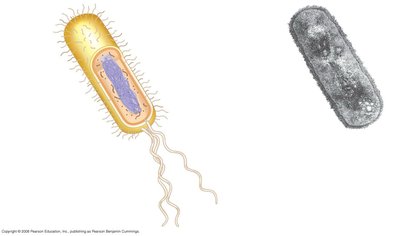
Prokaryotic Cell Structure
Cytoplasm: The interior of the cell, containing cytosol and all cellular components.
Cytosol: The fluid portion of the cytoplasm, excluding organelles and other structures.
Capsule: An additional protective layer outside the cell wall in some bacteria.
Eukaryotic Cells
Origin of Eukaryotes and the Endosymbiont Hypothesis
Eukaryotic cells are characterized by the presence of membrane-bound organelles, including a nucleus. The most recent common ancestor of eukaryotes likely arose about 2.1 billion years ago. The endosymbiont hypothesis proposes that mitochondria and chloroplasts originated from free-living prokaryotes that were engulfed by ancestral eukaryotic cells, leading to a mutually beneficial relationship.
Membrane folding: Increased surface area for metabolic processes.
Endosymbiosis: Aerobic bacteria became mitochondria; photosynthetic bacteria became chloroplasts.
Evidence for Endosymbiosis
Mitochondria and chloroplasts have their own circular DNA, similar to prokaryotes.
They possess ribosomes that resemble prokaryotic ribosomes (70S) rather than eukaryotic ribosomes (80S).
Genes are organized like those in prokaryotes.
Ribosomes: Prokaryotic vs. Eukaryotic
Ribosomes are complexes of protein and RNA that synthesize proteins. They differ in size and composition between prokaryotes and eukaryotes:
Type | rRNA Components | Protein Components | Total Size |
|---|---|---|---|
Prokaryotic (70S) | 16S, 23S, 5S | 34 (large), 21 (small) | 70S |
Eukaryotic (80S) | 18S, 28S, 5.8S, 5S | 49 (large), 33 (small) | 80S |
Additional info: rRNA does not code for protein; it is a structural and catalytic component of the ribosome.
Eukaryotic Cell Structure
Membrane-Bound Organelles
Eukaryotic cells contain a variety of organelles, each with specialized functions. Not all eukaryotic cells have every organelle (e.g., some lack flagella or chloroplasts).
Nucleus
Endoplasmic reticulum (ER)
Golgi apparatus
Lysosomes
Vacuoles
Mitochondria
Chloroplasts (in plants and algae)
Peroxisomes
The Endomembrane System
The endomembrane system is a group of organelles in eukaryotic cells that work together to modify, package, and transport lipids and proteins. It includes:
Nuclear envelope
Endoplasmic reticulum (ER)
Golgi apparatus
Lysosomes
Vacuoles
Vesicles
Plasma membrane
Organelles such as mitochondria, chloroplasts, and peroxisomes are not part of the endomembrane system.
The Nucleus
The nucleus is the control center of the cell, storing genetic information and coordinating activities such as growth and reproduction.
Stores DNA and is the site of transcription (RNA synthesis).
Contains multiple linear chromosomes.
The nuclear envelope is a double membrane that separates the nucleoplasm from the cytoplasm and is continuous with the ER.
Nuclear pores regulate the movement of substances in and out of the nucleus.
Nuclear lamina provides structural support, composed of lamin proteins.
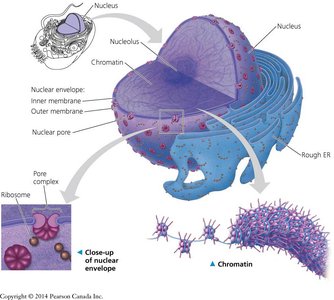
Chromatin and DNA Packaging
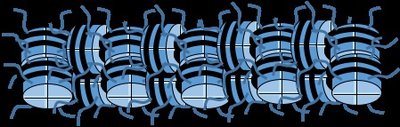
Chromatin is a complex of DNA and proteins (mainly histones) that packages DNA into a compact, organized structure. This packaging:
Organizes the nucleus
Protects DNA from damage
Facilitates segregation during cell division
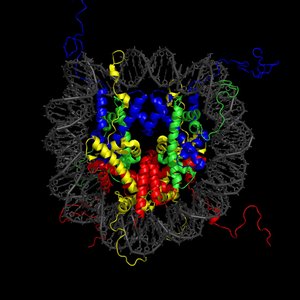
DNA wraps around a histone octamer (2 each of H2A, H2B, H3, H4) to form a nucleosome. Histone H1 helps further package nucleosomes into a 30 nm fiber.
Nucleolus
The nucleolus is a prominent sub-compartment of the nucleus (not membrane-bound) where ribosomal RNA (rRNA) is synthesized and ribosome subunits are assembled. Ribosomal proteins are imported from the cytoplasm, and rRNA is transcribed and processed here.
Produces 18S, 5.8S, and 28S rRNAs
Assembles large and small ribosomal subunits
Endoplasmic Reticulum (ER)
The ER is a network of membranes involved in protein and lipid synthesis. There are two types:
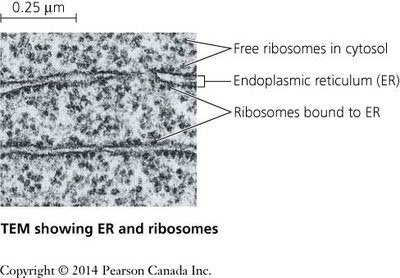
Rough ER (rER): Studded with ribosomes; site of protein synthesis and quality control for proteins destined for the endomembrane system.
Smooth ER (sER): Lacks ribosomes; involved in lipid synthesis, detoxification, ion storage, and carbohydrate metabolism.
Golgi Apparatus
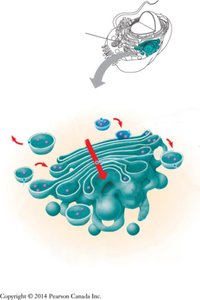
The Golgi apparatus is the cell's shipping and receiving center, consisting of flattened sacs called cisternae. It modifies, sorts, and packages proteins and lipids for delivery to various destinations.
Cis face: Receiving side (faces the ER)
Trans face: Shipping side (faces the plasma membrane)
Modifies ER products (e.g., glycosylation, phosphorylation)
Sorts and packages materials into vesicles
Lysosomes
Lysosomes are membrane-bound sacs containing hydrolytic enzymes that digest macromolecules. They function as the cell's digestive system, breaking down food particles, damaged organelles, and cellular debris.
Enzymes work best at acidic pH (~5)
Involved in autophagy (self-digestion of cellular components)
Defects in lysosomal enzymes can cause diseases (e.g., Tay Sachs disease)
Vacuoles
Vacuoles are large vesicles with diverse functions, especially prominent in plant and fungal cells.
Food vacuoles: Formed by phagocytosis
Contractile vacuoles: Pump excess water out of cells (in protists)
Central vacuole: Stores water and organic compounds, maintains turgor pressure in plant cells
Mitochondria and Chloroplasts
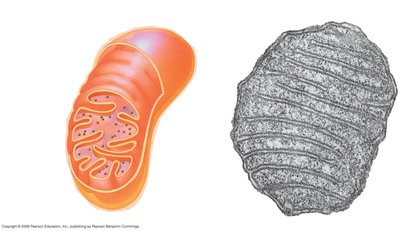
Both mitochondria and chloroplasts are double-membrane-bound organelles with their own DNA and ribosomes. They are central to energy metabolism:
Mitochondria: Site of ATP production via cellular respiration
Chloroplasts: Site of photosynthesis in plants and algae
Peroxisomes
Peroxisomes are single-membrane-bound organelles that carry out oxidation reactions, producing hydrogen peroxide (H2O2) as a by-product. They contain catalase to break down H2O2, protecting the cell from oxidative damage.
Breakdown of fatty acids
Detoxification of harmful substances
Summary Table: Animal vs. Plant Cell Structures
Structure | Animal Cell | Plant Cell |
|---|---|---|
Nucleus | Yes | Yes |
Plasma membrane | Yes | Yes |
Cell wall | No | Yes |
Chloroplast | No | Yes |
Central vacuole | No | Yes |
Lysosome | Yes | Rare |
Centrosome | Yes | No |