 Back
BackCell Structure, Function, and Mitosis Study Guide
Study Guide - Smart Notes
 Tailored notes based on your materials, expanded with key definitions, examples, and context.
Q1. True or False: Eukaryotic cells use DNA as their genetic material; prokaryotic cells use RNA.
Background
Topic: Cell Types and Genetic Material
This question tests your understanding of the differences between prokaryotic and eukaryotic cells, specifically regarding their genetic material.
Key Terms:
Eukaryotic cells: Cells with a nucleus and membrane-bound organelles.
Prokaryotic cells: Cells without a nucleus or membrane-bound organelles.
Genetic material: The molecules (DNA or RNA) that carry genetic information.
Step-by-Step Guidance
Recall what type of genetic material is found in eukaryotic cells (think about the nucleus and chromosomes).
Recall what type of genetic material is found in prokaryotic cells (consider bacteria and archaea).
Compare the statements to what you know about DNA and RNA in both cell types.
Try solving on your own before revealing the answer!
Final Answer: False
Eukaryotic and prokaryotic cells both use DNA as their genetic material. Prokaryotes do not use RNA as their main genetic material.
Q2. True or False: Both prokaryotic and eukaryotic cells have ribosomes, which synthesize the cell's proteins.
Background
Topic: Ribosomes and Protein Synthesis
This question tests your knowledge of the structures shared by all cells and the function of ribosomes.
Key Terms:
Ribosomes: Molecular machines that synthesize proteins by translating mRNA.
Step-by-Step Guidance
Think about the basic structures found in all living cells.
Recall the function of ribosomes and whether both cell types need to make proteins.
Try solving on your own before revealing the answer!
Final Answer: True
Both prokaryotic and eukaryotic cells have ribosomes for protein synthesis.
Q3. True or False: Both prokaryotic and eukaryotic cells can have cell walls.
Background
Topic: Cell Walls in Different Cell Types
This question tests your understanding of which cells have cell walls and their function.
Key Terms:
Cell wall: A rigid structure outside the plasma membrane that provides support and protection.
Step-by-Step Guidance
Recall which types of cells have cell walls (think about plants, fungi, bacteria, and archaea).
Consider whether all eukaryotes have cell walls, or just some.
Try solving on your own before revealing the answer!
Final Answer: True
Both prokaryotic cells (like bacteria) and some eukaryotic cells (like plants and fungi) can have cell walls.
Q4. True or False: Both prokaryotic and eukaryotic cells have nuclei.
Background
Topic: Cellular Structures—Nucleus
This question tests your understanding of the defining features of prokaryotic and eukaryotic cells.
Key Terms:
Nucleus: A membrane-bound organelle that contains the cell's DNA in eukaryotes.
Step-by-Step Guidance
Recall the definition of a prokaryotic cell and whether it contains a nucleus.
Recall the definition of a eukaryotic cell and its nucleus.
Try solving on your own before revealing the answer!
Final Answer: False
Only eukaryotic cells have a nucleus; prokaryotic cells do not.
Q5. True or False: Eukaryotic cells have many membrane-bound organelles; prokaryotic cells do not.
Background
Topic: Membrane-Bound Organelles
This question tests your understanding of the differences in cell structure between prokaryotes and eukaryotes.
Key Terms:
Membrane-bound organelles: Structures within eukaryotic cells surrounded by membranes (e.g., nucleus, mitochondria, ER).
Step-by-Step Guidance
List examples of membrane-bound organelles in eukaryotic cells.
Consider whether prokaryotic cells have similar structures.
Try solving on your own before revealing the answer!
Final Answer: True
Eukaryotic cells have many membrane-bound organelles; prokaryotic cells lack these structures.
Q6. A biologist grinds up plant leaf cells and centrifuges the mixture to separate the organelles based on how heavy they are. One set of heavier organelles can produce ATP in the light. A lighter set of organelles can produce ATP in the light and the dark. The heavier organelles are _____, and the lighter organelles are _____.
Background
Topic: Organelle Function and Cell Fractionation
This question tests your understanding of the functions of mitochondria and chloroplasts, and how organelles can be separated by centrifugation.
Key Terms:
ATP: The main energy currency of the cell.
Chloroplast: Organelle in plant cells that produces ATP during photosynthesis (in the light).
Mitochondrion: Organelle that produces ATP in both light and dark (cellular respiration).
Step-by-Step Guidance
Recall which organelle is responsible for photosynthesis and produces ATP only in the light.
Recall which organelle produces ATP in both light and dark conditions.
Think about which organelle is heavier and would pellet first during centrifugation.
Try solving on your own before revealing the answer!
Final Answer: Chloroplasts (heavier), mitochondria (lighter)
Chloroplasts produce ATP in the light; mitochondria produce ATP in both light and dark.
Q7. For each organelle, identify if it is found in plant cells, animal cells, or both.
Background
Topic: Organelle Distribution in Cell Types
This question tests your knowledge of which organelles are present in plant cells, animal cells, or both.
Key Terms:
Cytoskeleton, cell wall, central vacuole, ribosome, mitochondria, Golgi apparatus, plasma membrane: Know which cell types contain each.
Step-by-Step Guidance
List each organelle and recall its function.
Determine if the organelle is unique to plants, animals, or found in both.
For example, cell wall and central vacuole are unique to plants, while mitochondria and ribosomes are found in both.
Try solving on your own before revealing the answer!
Final Answer:
Cytoskeleton: both
Cell wall: plant
Central vacuole: plant
Ribosome: both
Mitochondria: both
Golgi apparatus: both
Plasma membrane: both
Q8. For each cellular function, identify the organelle or structure responsible.
Background
Topic: Organelle Functions
This question tests your ability to match cell functions to the correct organelle.
Key Terms:
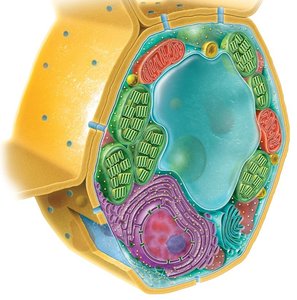
Smooth ER, rough ER, lysosome, nucleus, peroxisome, Golgi apparatus, ribosome, cytoskeleton, cell wall, plasma membrane: Know the main function of each.
Step-by-Step Guidance
Read each function and recall which organelle performs it.
For example, lipid synthesis is done by the smooth ER, while protein synthesis is done by ribosomes.
Use the diagram of the plant cell to help visualize the organelles.
Try solving on your own before revealing the answer!
Final Answer:
Synthesize/process lipids: smooth ER
Ribosomes associated: rough ER
Break down molecules: lysosome
Nucleic acid synthesis: nucleus
Harmful reactions: peroxisome
Modify proteins: Golgi apparatus
Peptide bonds: ribosome
Structural support/movement: cytoskeleton
Structural support (carbohydrates): cell wall
Semi-permeable barrier: plasma membrane
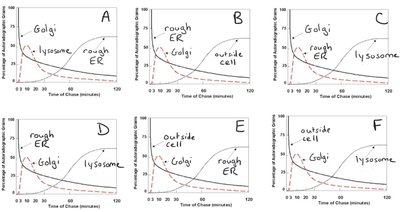
Q9. Pulse-chase experiment: Which figure shows the expected results for a cell that synthesizes and exports proteins? Which for a cell that ingests and breaks down foreign materials?
Background
Topic: Protein Trafficking and Pulse-Chase Experiments
This question tests your understanding of how proteins move through the cell and how pulse-chase experiments track their movement.
Key Terms:
Pulse-chase experiment: A method to track the movement of molecules through a cell over time.
Exported proteins: Proteins synthesized in the rough ER, processed in the Golgi, and sent outside the cell.
Lysosome: Organelle involved in breaking down ingested materials.
Step-by-Step Guidance
Look at the graphs and identify which show movement from rough ER to Golgi to outside the cell (exported proteins).
Identify which show movement from rough ER to Golgi to lysosome (ingestion and breakdown).
Match the correct graph to each scenario.
Try solving on your own before revealing the answer!
Final Answer:
Exports proteins: B
Ingests/breaks down: D
Q10. A diploid cell with 10 pairs of chromosomes undergoes mitosis. What is true of the cells produced by mitosis? (Choose all that apply.)
Background
Topic: Mitosis and Chromosome Number
This question tests your understanding of the outcome of mitosis in terms of chromosome number and genetic identity.
Key Terms:
Diploid: Two sets of chromosomes (2n).
Mitosis: Cell division that produces genetically identical cells.
Step-by-Step Guidance
Recall what happens to chromosome number during mitosis.
Consider whether the daughter cells are genetically identical or different.
Think about whether the cells are diploid or haploid after mitosis.
Try solving on your own before revealing the answer!
Final Answer:
They are genetically identical to the parent cell.
They are genetically identical to each other.
They will have 10 pairs of chromosomes.
They are diploid cells.
Q11. Which statement about the relationship between chromosomes, genes, chromatin, and sister chromatids is correct?
Background
Topic: Chromosome Structure
This question tests your understanding of the organization of genetic material in the cell.
Key Terms:
Chromosome: A structure made of DNA and proteins that contains genes.
Gene: A segment of DNA that codes for a protein or RNA.
Chromatin: The complex of DNA and proteins in the nucleus.
Sister chromatids: Identical copies of a chromosome connected by a centromere.
Step-by-Step Guidance
Review the definitions of each term.
Consider how many genes are typically found on a chromosome.
Eliminate statements that are incorrect based on your knowledge.
Try solving on your own before revealing the answer!
Final Answer:
A single chromosome typically contains many genes.
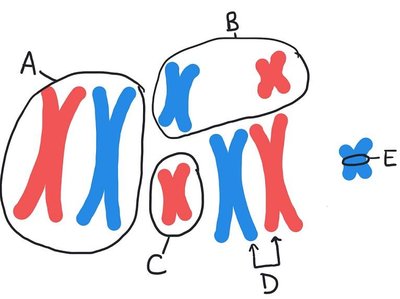
Q12. In the diagram, identify the structures: A = replicated pair of homologous chromosomes, E = centromere, C = single pair of sister chromatids.
Background
Topic: Chromosome Structure and Mitosis
This question tests your ability to identify chromosome structures during cell division.
Key Terms:
Homologous chromosomes: Chromosomes with the same genes but possibly different alleles.
Sister chromatids: Identical copies of a chromosome.
Centromere: The region where sister chromatids are joined.
Step-by-Step Guidance
Look at the diagram and identify the labeled structures based on their appearance and position.
Recall the definitions of homologous chromosomes, sister chromatids, and centromere.
Try solving on your own before revealing the answer!
Final Answer:
A: replicated pair of homologous chromosomes
E: centromere
C: single pair of sister chromatids
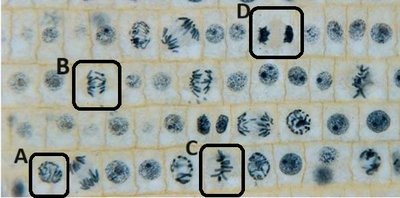
Q13. In the onion root tip image, identify the stage of mitosis for cells A, B, C, and D, and the features that support your conclusion.
Background
Topic: Mitosis Stages
This question tests your ability to recognize the stages of mitosis in plant cells using a microscope image.
Key Terms:
Prophase: Chromosomes condense.
Metaphase: Chromosomes align at the cell center.
Anaphase: Chromosomes separate and move to poles.
Telophase: Chromosomes decondense, nuclei reform.
Step-by-Step Guidance
Examine each labeled cell and note the arrangement and appearance of chromosomes.
Match the observed features to the correct stage of mitosis.
Try solving on your own before revealing the answer!
Final Answer:
A: prophase (chromosomes condensing)
B: anaphase (chromosomes moving to poles)
C: metaphase (chromosomes aligned at center)
D: telophase (two nuclei forming, chromosomes decondensing)
Q14. Place the following events in the correct order, beginning with a cell that has just been produced by mitosis and is in G1 of the cell cycle. (Use letters only.)
Background
Topic: Cell Cycle Events
This question tests your understanding of the sequence of events in the cell cycle and mitosis.
Key Terms:
G1, S, G2, M phase: The main phases of the cell cycle.
Checkpoints: Control points where the cell verifies readiness to proceed.
Step-by-Step Guidance
Start with G1 and follow the logical sequence of cell cycle events (DNA replication, checkpoints, mitosis stages).
Arrange the events in the correct order based on your knowledge of the cell cycle.
Try solving on your own before revealing the answer!
Final Answer:
D-B-G-H-C-E-I-F-J-A
Q15. A diploid cell with 24 pairs of chromosomes goes through mitosis. If a pair of sister chromatids do not separate during anaphase, what impact will this have on the cells produced? (Choose all that are correct.)
Background
Topic: Chromosome Segregation Errors
This question tests your understanding of the consequences of errors during mitosis, specifically nondisjunction.
Key Terms:
Nondisjunction: Failure of sister chromatids to separate properly.
Aneuploidy: Abnormal number of chromosomes in daughter cells.
Step-by-Step Guidance
Recall what happens if sister chromatids do not separate during anaphase.
Consider how this affects the chromosome number in the resulting cells.
Identify which answer choices reflect these outcomes.
Try solving on your own before revealing the answer!
Final Answer:
One will have one extra copy of several genes; the other will be missing one copy of several genes.
One will have one extra copy of one chromosome; the other will be missing a copy of one chromosome.
Q16. Which event would not occur if microtubules were not present during cell division?
Background
Topic: Microtubules and Mitosis
This question tests your understanding of the role of microtubules in chromosome movement during mitosis.
Key Terms:
Microtubules: Cytoskeletal structures that form the mitotic spindle.
Metaphase: Stage where chromosomes align at the cell center, requiring spindle microtubules.
Step-by-Step Guidance
Recall the function of microtubules during mitosis.
Identify which mitotic events depend on microtubules.
Eliminate events that do not require microtubules.
Try solving on your own before revealing the answer!
Final Answer:
The chromosomes could not align at the center of the cell during metaphase.
