Back
BackCellular Organelles: Structure and Function
Study Guide - Smart Notes
 Tailored notes based on your materials, expanded with key definitions, examples, and context.
Cellular Organelles
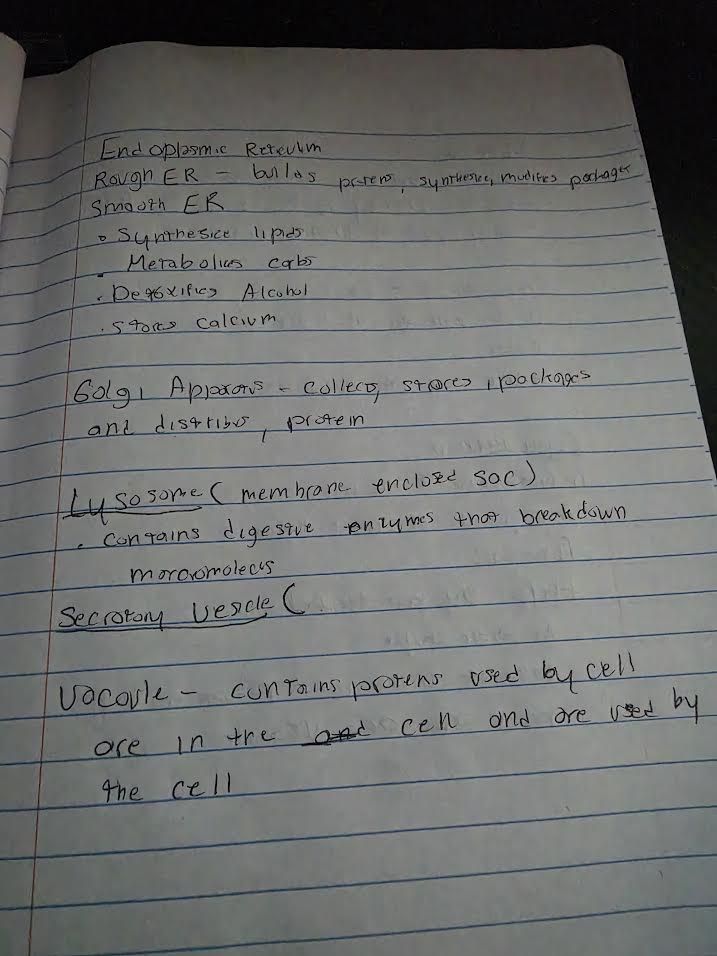
Endoplasmic Reticulum (ER)
The endoplasmic reticulum is a network of membranous tubules within the cytoplasm of eukaryotic cells, crucial for the synthesis and transport of proteins and lipids. It is divided into two types: rough ER and smooth ER.
Rough ER: Studded with ribosomes, it is involved in the synthesis, modification, and packaging of proteins.
Smooth ER: Lacks ribosomes and is involved in various metabolic processes:
Synthesizes lipids
Metabolizes carbohydrates
Detoxifies alcohol
Stores calcium ions
Golgi Apparatus
The Golgi apparatus is a series of flattened membrane sacs that collect, store, package, and distribute proteins and lipids received from the ER. It is essential for modifying, sorting, and shipping cellular products.
Collects, stores, and packages proteins
Distributes proteins to their correct destinations within or outside the cell
Lysosome
Lysosomes are membrane-enclosed sacs containing digestive enzymes. They play a key role in breaking down macromolecules, cellular debris, and foreign substances.
Contains digestive enzymes that break down macromolecules
Membrane-enclosed sac structure
Secretory Vesicle
Secretory vesicles are small membrane-bound compartments that transport molecules, such as proteins, from the Golgi apparatus to the cell membrane for release outside the cell.
Transports proteins and other molecules to the cell membrane
Facilitates exocytosis (release of substances from the cell)
Vacuole
Vacuoles are membrane-bound organelles that store substances such as proteins, ions, and water. In plant cells, the central vacuole maintains cell structure and stores nutrients; in animal cells, vacuoles are smaller and primarily involved in storage and transport.
Contains proteins used by the cell
Stores various substances needed by the cell
Example: In plant cells, the central vacuole stores water and maintains turgor pressure, which is essential for structural support.