 Back
Cellular Respiration and Fermentation: Energy Production in Cells
Study Guide - Smart Notes
 Tailored notes based on your materials, expanded with key definitions, examples, and context.
Chapter 9: Cellular Respiration and Fermentation
Introduction to Cellular Energy Production
Cells require energy to perform essential functions, and this energy is primarily supplied by adenosine triphosphate (ATP). Cellular respiration and fermentation are the main metabolic pathways that harvest energy from high-energy molecules such as glucose. The energy released during these processes is used to synthesize ATP from adenosine diphosphate (ADP) and inorganic phosphate (Pi).
Overview of Cellular Respiration
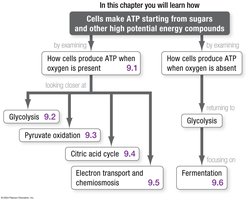
Cellular respiration is a series of metabolic reactions that convert biochemical energy from nutrients into ATP. It consists of four main stages:
Glycolysis: Breakdown of glucose into pyruvate.
Pyruvate Processing: Conversion of pyruvate to acetyl CoA.
Citric Acid Cycle: Oxidation of acetyl CoA to CO2.
Electron Transport and Oxidative Phosphorylation: Production of ATP using a proton gradient generated by electron transport.
Catabolic and Anabolic Pathways
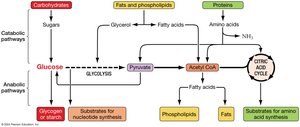
Metabolism is divided into two types of pathways:
Catabolic pathways: Break down molecules to release energy (e.g., cellular respiration).
Anabolic pathways: Use energy to synthesize larger molecules from smaller ones.
Carbohydrates, fats, and proteins can all serve as substrates for cellular respiration, entering the pathway at different points. Intermediates from these pathways are also used for biosynthesis of macromolecules.
9.1 Glycolysis: Oxidizing Glucose to Pyruvate
Glycolysis Pathway
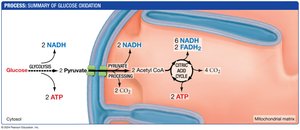
Glycolysis is a sequence of 10 enzyme-catalyzed reactions occurring in the cytosol. It converts one molecule of glucose (6 carbons) into two molecules of pyruvate (3 carbons each). The process can be divided into two phases:
Energy Investment Phase (Steps 1–5): Consumes 2 ATP to phosphorylate glucose and its intermediates.
Energy Payoff Phase (Steps 6–10): Produces 4 ATP (net gain of 2 ATP) and 2 NADH by substrate-level phosphorylation.
Net yield per glucose: 2 ATP, 2 NADH, 2 pyruvate.
Regulation of Glycolysis
Glycolysis is regulated by feedback inhibition, primarily at the enzyme phosphofructokinase. High ATP levels inhibit this enzyme, preventing excessive ATP production and maintaining energy homeostasis.
9.2 Processing Pyruvate to Acetyl CoA
Pyruvate Oxidation
In eukaryotes, pyruvate produced by glycolysis is transported into the mitochondrial matrix, where it is converted to acetyl CoA by the enzyme pyruvate dehydrogenase. This process involves:
Oxidation of one carbon from pyruvate to CO2
Reduction of NAD+ to NADH
Attachment of the remaining two-carbon unit to coenzyme A, forming acetyl CoA
Pyruvate processing is regulated by phosphorylation (inactivation) and dephosphorylation (activation) of pyruvate dehydrogenase, depending on the cell's energy status.
9.3 The Citric Acid Cycle (Krebs Cycle)
Oxidation of Acetyl CoA
The citric acid cycle completes the oxidation of glucose by converting acetyl CoA into CO2. For each acetyl CoA, the cycle produces:
3 NADH
1 FADH2
1 ATP (or GTP)
2 CO2
Since two acetyl CoA molecules are produced per glucose, the cycle turns twice for each glucose molecule. The cycle is regulated by feedback inhibition at several steps, with high levels of ATP and NADH decreasing the cycle's activity.
9.4 Electron Transport Chain and Oxidative Phosphorylation
Electron Transport Chain (ETC)
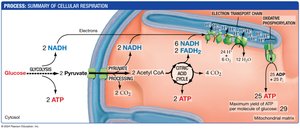
The ETC is a series of protein complexes and mobile carriers located in the inner mitochondrial membrane. NADH and FADH2 donate electrons to the chain, which are ultimately transferred to oxygen, forming water. The energy released during electron transfer is used to pump protons across the membrane, creating a proton gradient (proton-motive force).
ATP Synthase and Chemiosmosis
ATP synthase is a membrane-bound enzyme complex that synthesizes ATP as protons flow back into the mitochondrial matrix through its channel, driven by the proton-motive force. This process is called oxidative phosphorylation and produces the majority of ATP during cellular respiration (about 25–29 ATP per glucose).
9.5 Fermentation
Fermentation Pathways
When oxygen or another suitable electron acceptor is not available, cells use fermentation to regenerate NAD+ from NADH, allowing glycolysis to continue. Fermentation produces much less ATP (2 ATP per glucose) compared to cellular respiration.
Lactic Acid Fermentation: Pyruvate accepts electrons from NADH, forming lactate (in muscle cells).
Alcohol Fermentation: Pyruvate is converted to acetaldehyde, which accepts electrons from NADH to form ethanol (in yeast).
Some organisms can switch between fermentation and aerobic respiration depending on oxygen availability (facultative anaerobes).
Summary Table: ATP Yield from Glucose Oxidation
Stage | ATP Produced | NADH Produced | FADH2 Produced | CO2 Produced |
|---|---|---|---|---|
Glycolysis | 2 | 2 | 0 | 0 |
Pyruvate Processing | 0 | 2 | 0 | 2 |
Citric Acid Cycle | 2 | 6 | 2 | 4 |
Oxidative Phosphorylation | ~25 | 0 | 0 | 0 |
Total | ~29 | 10 | 2 | 6 |
Key Terms and Concepts
ATP (Adenosine Triphosphate): The main energy currency of the cell.
Substrate-level phosphorylation: Direct synthesis of ATP by transferring a phosphate group to ADP from a phosphorylated substrate.
Oxidative phosphorylation: ATP synthesis powered by the transfer of electrons through the ETC and chemiosmosis.
Feedback inhibition: Regulatory mechanism where the end product of a pathway inhibits an upstream process.
Facultative anaerobes: Organisms that can switch between aerobic respiration and fermentation.
Additional info: The study of metabolic reprogramming in cancer cells, such as the use of alternative energy sources like alanine in liver cancer, highlights the importance of understanding cellular respiration pathways for medical research and therapeutic development.
