 Back
BackBio 100 LEC Chapter 9 Modules 1-2
Study Guide - Smart Notes
 Tailored notes based on your materials, expanded with key definitions, examples, and context.
Bio 100 LEC Chapter 9
Chapter 9: Cellular Respiration and Fermentation
Introduction to Cellular Respiration
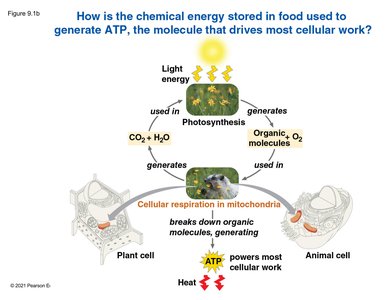
Cellular respiration is a series of metabolic processes by which cells extract energy from organic molecules, primarily glucose, to produce adenosine triphosphate (ATP). This process is central to cellular metabolism and is tightly linked to the flow of energy in biological systems, connecting the catabolic breakdown of food molecules to the anabolic synthesis of ATP.
ATP is the universal energy currency of the cell, driving most cellular work.
Cellular respiration involves a series of enzyme-catalyzed reactions, many of which are regulated to meet cellular energy demands.
It is closely related to photosynthesis, as the products of one process serve as the reactants for the other in the global carbon and energy cycles.
Structure and Function of the Mitochondrion
Mitochondrial Compartmentalization
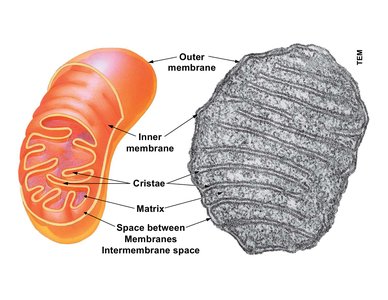
The mitochondrion is the primary site of aerobic cellular respiration in eukaryotic cells. Its structure is specialized to maximize the efficiency of ATP production.
Outer membrane: Contains porins, allowing free passage of ions and small molecules.
Intermembrane space: Chemically similar to the cytosol due to permeability of the outer membrane.
Inner membrane: Highly selective barrier, contains the protein complexes of the electron transport chain and ATP synthase.
Cristae: Infoldings of the inner membrane that increase surface area for oxidative phosphorylation.
Matrix: Contains enzymes for the citric acid cycle and mitochondrial DNA.
Catabolic Pathways and Redox Reactions
Oxidation and Reduction in Cellular Respiration
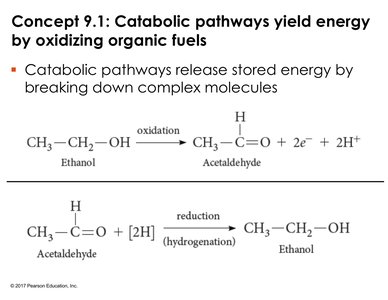
Catabolic pathways release energy by breaking down complex molecules. The transfer of electrons from fuel molecules to electron acceptors is central to energy extraction.
Oxidation: Loss of electrons (often accompanied by loss of protons, i.e., dehydrogenation).
Reduction: Gain of electrons (often accompanied by gain of protons, i.e., hydrogenation).
Oxidation and reduction always occur together (redox reactions).
Enzymes called dehydrogenases facilitate these reactions.
Redox Terminology and Agents
Understanding the terminology of redox reactions is essential for tracking electron flow in metabolism.
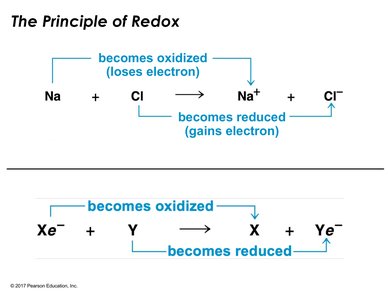
Reducing agent: The electron donor (becomes oxidized).
Oxidizing agent: The electron acceptor (becomes reduced).
Example: In the reaction Na + Cl → Na+ + Cl−, Na is the reducing agent and Cl is the oxidizing agent.
Overview of Cellular Respiration Pathways
Aerobic Respiration and the Overall Equation
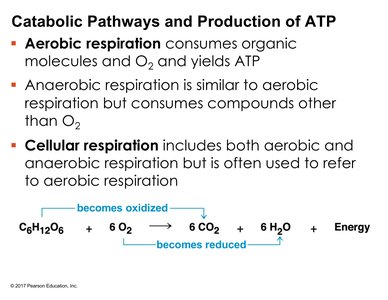
Aerobic respiration is the most efficient catabolic pathway, using oxygen as the final electron acceptor to yield ATP.
Overall equation:
Glucose is oxidized (serves as the reducing agent), and oxygen is reduced (serves as the oxidizing agent).
Energy released is used to synthesize ATP.
Role of Coenzymes: NAD+ and NADH
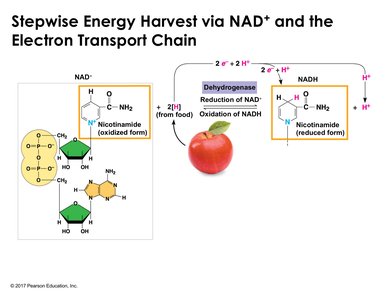
Coenzymes such as NAD+ play a critical role in cellular respiration by shuttling electrons between metabolic pathways and the electron transport chain.
NAD+ (nicotinamide adenine dinucleotide): Electron carrier that is reduced to NADH during catabolic reactions.
NADH: Stores energy and donates electrons to the electron transport chain, facilitating ATP synthesis.
Reduction:
Stepwise Energy Harvest and Importance of Controlled Oxidation
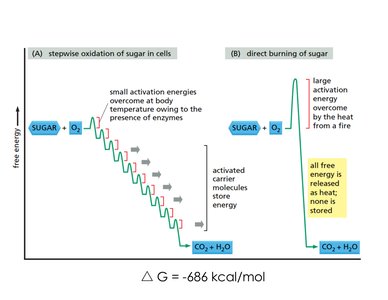
Cells extract energy from glucose in a controlled, stepwise manner to maximize ATP yield and minimize energy loss as heat.
Direct burning of glucose releases energy as heat, which is not usable by cells.
Stepwise oxidation allows energy to be captured in activated carrier molecules (e.g., ATP, NADH).
Overall free energy change: for complete oxidation of glucose.
Stages of Cellular Respiration
Major Stages and Their Locations
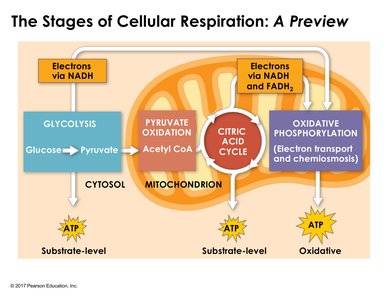
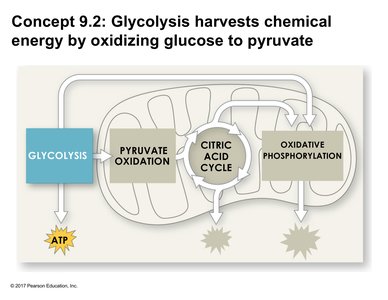
Cellular respiration consists of three main stages, each localized to specific regions of the cell:
Glycolysis: Occurs in the cytosol; glucose is split into two molecules of pyruvate.
Pyruvate Oxidation and Citric Acid Cycle: Occur in the mitochondrial matrix; pyruvate is converted to acetyl CoA, which enters the citric acid cycle.
Oxidative Phosphorylation: Occurs across the inner mitochondrial membrane; includes the electron transport chain and chemiosmosis, producing the majority of ATP.
ATP Synthesis: Substrate-Level vs. Oxidative Phosphorylation
ATP can be generated by two mechanisms during cellular respiration:
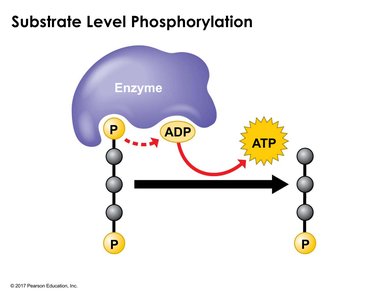
Substrate-level phosphorylation: Direct transfer of a phosphate group from a substrate to ADP, catalyzed by an enzyme.
Oxidative phosphorylation: ATP synthesis powered by the transfer of electrons through the electron transport chain and the resulting proton gradient.
Glycolysis: The First Stage of Cellular Respiration
Overview of Glycolysis
Glycolysis is a ten-step pathway that converts glucose into two molecules of pyruvate, generating ATP and NADH in the process. It does not require oxygen and occurs in the cytosol.
Divided into two phases: Energy investment phase and energy payoff phase.
Net products per glucose: 2 ATP, 2 NADH, 2 pyruvate.
Energy Investment and Payoff Phases
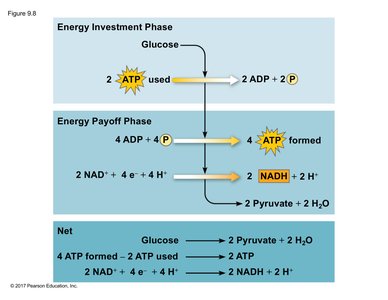
The energy investment phase consumes ATP to phosphorylate glucose and its intermediates, while the energy payoff phase generates ATP and NADH.
Energy investment: 2 ATP used to phosphorylate glucose and fructose-6-phosphate.
Energy payoff: 4 ATP produced (net gain of 2 ATP), 2 NADH produced, 2 pyruvate formed.
Detailed Steps of Glycolysis
Each step of glycolysis is catalyzed by a specific enzyme, with key regulatory and irreversible steps ensuring pathway directionality and control.
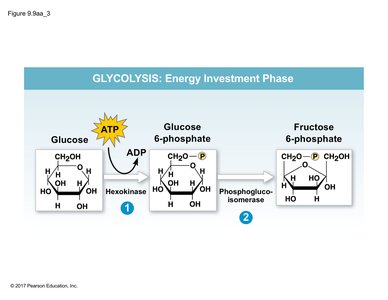
Step 1: Hexokinase phosphorylates glucose to glucose-6-phosphate (uses 1 ATP).
Step 2: Phosphoglucoisomerase converts glucose-6-phosphate to fructose-6-phosphate.
Step 3: Phosphofructokinase (PFK) phosphorylates fructose-6-phosphate to fructose-1,6-bisphosphate (uses 1 ATP); this is the rate-limiting and committed step of glycolysis.
Step 4: Aldolase cleaves fructose-1,6-bisphosphate into two three-carbon sugars: glyceraldehyde-3-phosphate (G3P) and dihydroxyacetone phosphate (DHAP).
Step 5: Isomerase converts DHAP to G3P, so both molecules proceed through glycolysis.
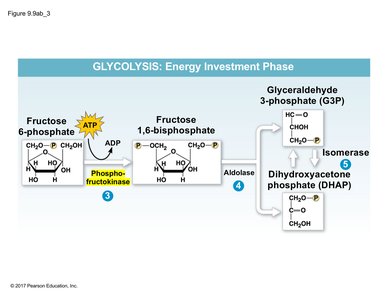
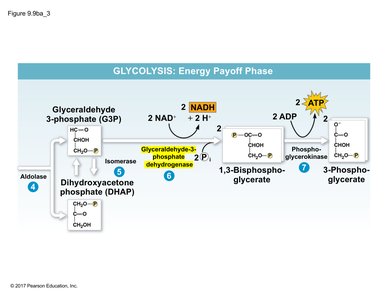
Step 6: Glyceraldehyde-3-phosphate dehydrogenase oxidizes G3P, reducing NAD+ to NADH and adding a phosphate to form 1,3-bisphosphoglycerate.
Step 7: Phosphoglycerate kinase transfers a phosphate to ADP, forming ATP (substrate-level phosphorylation) and 3-phosphoglycerate.
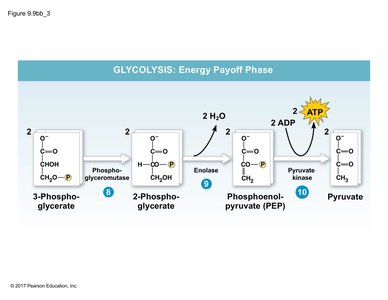
Steps 8-10: 3-phosphoglycerate is converted to 2-phosphoglycerate, then to phosphoenolpyruvate (PEP) by enolase (releasing water), and finally, pyruvate kinase transfers a phosphate from PEP to ADP, yielding ATP and pyruvate.
Summary Table: Glycolysis Inputs and Outputs
Phase | Inputs | Outputs |
|---|---|---|
Energy Investment | Glucose, 2 ATP | 2 ADP, 2 Pi |
Energy Payoff | 4 ADP, 2 NAD+, 4 Pi | 4 ATP, 2 NADH, 2 H+, 2 Pyruvate, 2 H2O |
Net | Glucose, 2 ATP, 2 NAD+ | 2 Pyruvate, 2 ATP, 2 NADH, 2 H+, 2 H2O |
Key Regulatory Enzymes and Control Points
Phosphofructokinase (PFK) as a Regulatory Node
Phosphofructokinase is the main regulatory enzyme of glycolysis, responding to cellular energy status via allosteric regulation and feedback inhibition.
PFK activity is inhibited by high levels of ATP and citrate (signals of energy sufficiency).
PFK is activated by AMP (signal of low energy).
This regulation ensures glycolysis proceeds only when energy is needed.
Conclusion
Cellular respiration is a highly regulated, multi-step process that efficiently extracts energy from organic molecules. Glycolysis is the first stage, providing both ATP and reduced electron carriers for further energy extraction in the mitochondria. Understanding the enzymes, regulation, and compartmentalization of these pathways is essential for grasping how cells meet their energy needs.
