 Back
BackCellular Respiration and Fermentation: Study Notes
Study Guide - Smart Notes
 Tailored notes based on your materials, expanded with key definitions, examples, and context.
Cellular Respiration and Fermentation
Overview of Cellular Respiration
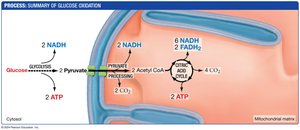
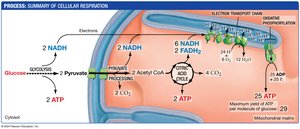
Cellular respiration is a fundamental metabolic pathway in biology, responsible for extracting energy from glucose and other organic molecules to produce ATP, the cell's energy currency. It consists of four main processes: glycolysis, pyruvate processing, the citric acid cycle, and electron transport/oxidative phosphorylation.
Glycolysis: Glucose (a six-carbon sugar) is broken down into two three-carbon pyruvate molecules.
Pyruvate Processing: Each pyruvate is oxidized to form acetyl CoA.
Citric Acid Cycle: Acetyl CoA is further oxidized, releasing CO2 and capturing energy in NADH and FADH2.
Electron Transport and Oxidative Phosphorylation: Electrons from NADH and FADH2 move through the electron transport chain, creating a proton gradient used to synthesize ATP.
Catabolic Pathways and Metabolic Interactions
Cellular respiration is interconnected with other metabolic pathways. Cells utilize carbohydrates first for ATP production, followed by fats and proteins. These macromolecules can be broken down to furnish substrates for cellular respiration.
Fats: Broken down into glycerol (enters glycolysis) and fatty acids (converted to acetyl CoA).
Proteins: Broken down into amino acids; amino groups are removed and excreted, while carbon skeletons enter glycolysis or the citric acid cycle.
Catabolic intermediates are also used in anabolic pathways to synthesize macromolecules such as nucleotides, fatty acids, and amino acids. This organization and regulation of metabolic pathways maintain homeostasis.
Glycolysis
Glycolysis Pathway and Key Points
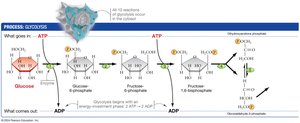
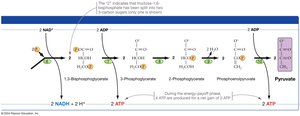
Glycolysis is a sequence of 10 reactions occurring in the cytosol. It is divided into two phases: the energy investment phase and the energy payoff phase.
Energy Investment Phase (Reactions 1–5): 2 ATP are used to phosphorylate glucose and its intermediates.
Energy Payoff Phase (Reactions 6–10): NADH is produced, and ATP is generated by substrate-level phosphorylation.
Net Yield: 2 NADH, 2 ATP, and 2 pyruvate molecules per glucose.
Regulation of Glycolysis
Glycolysis is regulated by feedback inhibition, primarily at the enzyme phosphofructokinase. High ATP levels inhibit this enzyme, preventing excessive ATP production and maintaining energy balance.
Phosphofructokinase: Has two binding sites for ATP—active site (low ATP) and regulatory site (high ATP).
Processing Pyruvate to Acetyl CoA
Pyruvate Processing
Pyruvate produced by glycolysis is transported into mitochondria in eukaryotes, where it is processed by the enzyme pyruvate dehydrogenase. This process involves oxidation of one carbon to CO2, reduction of NAD+ to NADH, and attachment of the remaining two-carbon unit to coenzyme A, forming acetyl CoA.
Location: Mitochondrial matrix in eukaryotes; cytosol in prokaryotes.
Regulation: Feedback inhibition via phosphorylation/dephosphorylation of pyruvate dehydrogenase.
The Citric Acid Cycle
Citric Acid Cycle Overview
The citric acid cycle (Krebs cycle) oxidizes acetyl CoA to CO2 and captures energy in NADH, FADH2, and ATP (or GTP). The cycle operates in the mitochondrial matrix (eukaryotes) or cytosol (prokaryotes) and regenerates oxaloacetate at the end of each turn.
Energy Yield per Glucose: 6 NADH, 2 FADH2, 2 ATP (or GTP), 4 CO2.
Regulation: Feedback inhibition at multiple points; high ATP/NADH levels decrease cycle activity.
Electron Transport Chain and Oxidative Phosphorylation
Electron Transport Chain (ETC)
The ETC consists of four protein complexes and two mobile electron carriers (ubiquinone/Q and cytochrome c). Electrons from NADH and FADH2 are transferred through the chain, ultimately reducing oxygen to water. The energy released is used to pump protons across the mitochondrial membrane, creating a proton gradient.
Redox Potential: Each complex has a different ability to accept electrons.
Proton Gradient: Drives ATP synthesis via chemiosmosis.
ATP Synthase and Chemiosmosis
ATP synthase is a protein complex that synthesizes ATP from ADP and inorganic phosphate, powered by the flow of protons down their gradient. This process is called oxidative phosphorylation.
ATP Yield: About 29 ATP per glucose molecule.
Most ATP is produced during oxidative phosphorylation, not substrate-level phosphorylation.
Aerobic vs. Anaerobic Respiration
Oxygen is the most efficient final electron acceptor for the ETC, enabling maximal ATP production (aerobic respiration). Some prokaryotes use alternative acceptors (e.g., nitrate, sulfate) in anaerobic respiration, which yields less energy.
Fermentation
Fermentation Pathways
When oxygen is unavailable, cells use fermentation to regenerate NAD+ from NADH, allowing glycolysis to continue producing ATP. Fermentation is less efficient than cellular respiration.
Lactic Acid Fermentation: Pyruvate accepts electrons from NADH, forming lactate.
Alcohol Fermentation: Pyruvate is converted to acetaldehyde, which accepts electrons from NADH, forming ethanol.
ATP Yield: 2 ATP per glucose (much less than cellular respiration).
Facultative Anaerobes: Organisms that can switch between fermentation and aerobic respiration depending on oxygen availability.
Summary Table: Cellular Respiration vs. Fermentation
Process | Final Electron Acceptor | ATP Yield per Glucose | Key Products |
|---|---|---|---|
Cellular Respiration (Aerobic) | Oxygen | ~29 | CO2, H2O, ATP |
Cellular Respiration (Anaerobic) | Nitrate, Sulfate, etc. | Variable (less than aerobic) | CO2, ATP, other products |
Fermentation (Lactic Acid) | Pyruvate | 2 | Lactate, ATP |
Fermentation (Alcohol) | Acetaldehyde | 2 | Ethanol, CO2, ATP |
Key Equations
Overall Cellular Respiration:
Glycolysis:
Lactic Acid Fermentation:
Alcohol Fermentation:
Additional info:
Metabolic regulation is essential for maintaining homeostasis and adapting to environmental changes.
Intermediates from catabolic pathways are crucial for biosynthesis of macromolecules.
