 Back
BackCellular Respiration, Cell Cycle, and Meiosis: Core Concepts and Processes
Study Guide - Smart Notes
 Tailored notes based on your materials, expanded with key definitions, examples, and context.
Cellular Respiration and Fermentation
Overview of Catabolic Processes
Catabolic processes are metabolic pathways that break down organic molecules, releasing energy. These processes are essential for cellular function and survival, as they provide ATP, the energy currency of the cell.
Aerobic respiration: Utilizes oxygen as the final electron acceptor.
Anaerobic respiration and fermentation: Do not require oxygen.
Cellular respiration is the process by which cells convert glucose and oxygen into ATP, carbon dioxide, and water. This process is crucial for extracting usable energy from glucose.
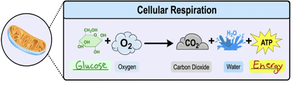
Overall equation:
Redox reaction: Glucose is oxidized (loses electrons), oxygen is reduced (gains electrons).
Stages of Aerobic Cellular Respiration
Glycolysis: Occurs in the cytoplasm; glucose is split into two pyruvate molecules, producing a small amount of ATP and NADH.
Pyruvate Oxidation: Pyruvate is converted to acetyl-CoA, which enters the Krebs cycle.
Krebs Cycle (Citric Acid Cycle): Occurs in the mitochondria; acetyl-CoA is processed, generating NADH, FADH2, and ATP.
Electron Transport Chain & Chemiosmosis: Electrons from NADH and FADH2 are transferred through protein complexes, driving ATP synthesis. Oxygen is the final electron acceptor, forming water.
ATP Production Mechanisms:
Substrate-level phosphorylation: Direct transfer of phosphate to ADP (in glycolysis and Krebs cycle).
Oxidative phosphorylation: ATP synthesis powered by the electron transport chain.
Fermentation and Anaerobic Respiration
When oxygen is unavailable, cells switch to fermentation or anaerobic respiration to regenerate NAD+ and produce ATP.
Fermentation: Uses organic molecules as final electron acceptors; yields little ATP.
Lactic Acid Fermentation: Pyruvate is reduced to lactic acid (occurs in muscle cells, bacteria).
Alcohol Fermentation: Pyruvate is reduced to ethanol and CO2 (occurs in yeast, some bacteria).
Anaerobic Respiration: Uses inorganic molecules (e.g., nitrate, sulfate) as final electron acceptors; more ATP than fermentation, less than aerobic respiration.
Types of Anaerobes:
Obligate anaerobes: Only survive without oxygen.
Facultative anaerobes: Can switch between aerobic and anaerobic metabolism (e.g., yeast, muscle cells).
The Cell Cycle
Introduction to Cell Division
Cell division is the process by which a parent cell divides to produce daughter cells. It is essential for reproduction, growth, and tissue repair.
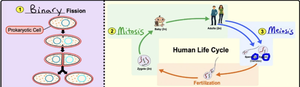
Binary Fission: Prokaryotic cell division (e.g., bacteria, archaea).
Mitosis: Eukaryotic division producing somatic (body) cells; results in genetically identical diploid cells.
Meiosis: Eukaryotic division producing gametes (sperm, eggs); results in haploid cells.
Phases of the Cell Cycle
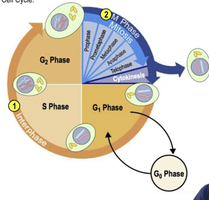
The cell cycle describes the sequence of events from cell formation to division. It consists of interphase and the mitotic (M) phase.
Interphase: Non-dividing phase for cell growth, DNA replication, and organelle production. Subphases: G0, G1, S, G2.
M Phase: Includes mitosis (nuclear division) and cytokinesis (cytoplasmic division).
Cell Cycle Regulation
Cell division is tightly regulated by growth factors and checkpoints to ensure proper division and prevent errors.
Growth factors: Proteins that stimulate cell division.
Checkpoints: G1, S, G2, and M checkpoints monitor and control progression through the cell cycle.
p53 protein: Can trigger DNA repair or apoptosis if errors are detected.
Phases of Mitosis
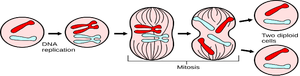
Mitosis is the process of dividing the nucleus and genetic material of a somatic cell, resulting in two genetically identical diploid cells.
Prophase: Chromosomes condense, nucleolus disappears, mitotic spindle forms.
Prometaphase: Nuclear envelope breaks down, spindle attaches to kinetochores.
Metaphase: Chromosomes align at the metaphase plate.
Anaphase: Sister chromatids are pulled apart to opposite poles.
Telophase: Nuclear envelopes reform, chromosomes decondense.
Microtubules: Kinetochore microtubules attach to chromosomes; non-kinetochore microtubules help elongate the cell.
Cancer and Cell Cycle Control
Cancer results from uncontrolled cell division due to mutations in genes regulating the cell cycle.
Malignant tumors: Cancerous, invasive, can metastasize.
Benign tumors: Non-cancerous, localized, slow-growing.
Proto-oncogenes: Stimulate normal cell division; mutations can create oncogenes (promote cancer).
Tumor-suppressor genes: Inhibit cell division; mutations can lead to loss of control (e.g., p53).
Meiosis and Sexual Life Cycles
Genes and Inheritance
A gene is a unit of heredity, located at a specific locus on a chromosome. Genes are passed to offspring via gametes (sperm and eggs).
Asexual vs. Sexual Reproduction
Asexual reproduction: Single parent, genetically identical offspring, no gametes involved.
Sexual reproduction: Two parents, gametes fuse during fertilization, offspring are genetically unique.
Life Cycle of Sexual Reproducers
Sexual life cycles involve both mitosis and meiosis. Meiosis produces haploid gametes; fertilization restores diploidy in the zygote.
Introduction to Meiosis
Meiosis is a two-division process that reduces chromosome number by half, producing four genetically diverse haploid gametes from a diploid germ cell.
Meiosis I (reductional division): Homologous chromosomes separate, producing two haploid cells.
Meiosis II (equational division): Sister chromatids separate, producing four haploid gametes.
Genetic Variation During Meiosis
Meiosis generates genetic diversity through crossing over and independent assortment.
Crossing Over: Homologous chromosomes exchange genetic material during prophase I, forming non-identical sister chromatids.
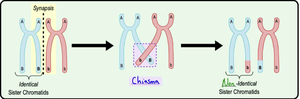
Independent Assortment: Homologous chromosome pairs align randomly during metaphase I, resulting in numerous genetic combinations. The number of possible combinations is , where n is the haploid number.
Nondisjunction
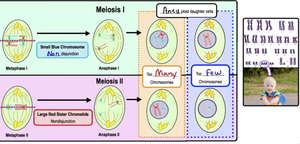
Nondisjunction is an error in meiosis when chromosomes fail to separate properly, resulting in aneuploid cells (cells with abnormal chromosome numbers). This can lead to genetic disorders such as Down syndrome (trisomy 21).
Summary Table: Comparison of Mitosis and Meiosis
Feature | Mitosis | Meiosis |
|---|---|---|
Number of divisions | 1 | 2 |
Number of daughter cells | 2 | 4 |
Genetic identity | Identical | Diverse |
Chromosome number | Diploid (2n) | Haploid (n) |
Role | Growth, repair | Gamete production |
