 Back
Chapter 9 Lecture + Begin Chapter 10
Study Guide - Smart Notes
 Tailored notes based on your materials, expanded with key definitions, examples, and context.
Cellular Respiration: Harvesting Chemical Energy
Anaerobic Conditions and Fermentation
When oxygen is not available, cells must find alternative pathways to regenerate NAD+ and continue ATP production. Glycolysis proceeds as usual, but the electron transport chain cannot oxidize NADH back to NAD+ without O2. If NAD+ is depleted, glycolysis halts. The end of glycolysis is a metabolic branch point, leading to fermentation under anaerobic conditions.
Fermentation: An anaerobic process that regenerates NAD+ from NADH, allowing glycolysis to continue and produce 2 net ATP per glucose molecule.
Low energy yield: Only the ATP from glycolysis is produced; fermentation is a partial catabolism of glucose.
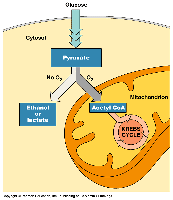
Types of Fermentation
There are two main types of fermentation, each with distinct end products and biological significance.
Alcohol Fermentation: Pyruvate is converted to ethanol and CO2 in a two-step pathway. This process is used by yeast (single-celled fungi) when oxygen is absent.
Lactic Acid Fermentation: Pyruvate is reduced directly by NADH to form lactate, with no release of CO2. This occurs in some bacteria and in muscle cells during intense exercise.
Alcohol Fermentation
Equation:
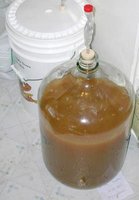
Applications: Brewing, winemaking, and baking.

Lactic Acid Fermentation
Equation:
Applications: Yogurt, sauerkraut, and pickles production; muscle metabolism during anaerobic exercise.

Photosynthesis: Conversion of Light Energy to Chemical Energy
Overview of Photosynthesis
Photosynthesis is the process by which photoautotrophs (plants, green protists, and cyanobacteria) convert light energy into chemical energy, producing organic molecules and oxygen. It is essentially the reverse of aerobic respiration.
General Equation:
Oxygenic photosynthesis: Produces O2 as a byproduct.
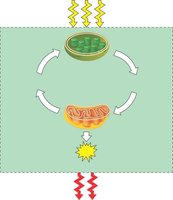
Relationship Between Photosynthesis and Cellular Respiration
Photosynthesis and cellular respiration are interconnected processes within the biosphere. Photosynthesis captures light energy to build organic molecules, while cellular respiration breaks them down to release energy for cellular work.
Stages of Photosynthesis
Oxygenic photosynthesis occurs in two main stages within the chloroplast:
Light Reactions: Harvest light energy to produce ATP and NADPH, releasing O2 from H2O.
Calvin Cycle: Uses ATP and NADPH to fix CO2 into sugars.
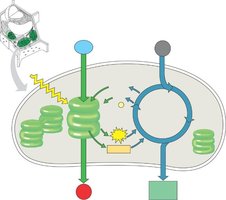
Light Reactions
The light reactions occur in the thylakoid membranes of the chloroplast, where light energy is absorbed by pigments and used to generate ATP and NADPH. Water is split, releasing O2 as a byproduct.
Location: Thylakoid membranes (highly folded to increase surface area).
Products: ATP, NADPH, and O2.
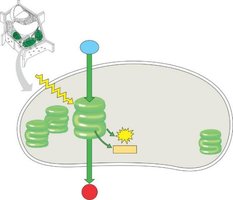
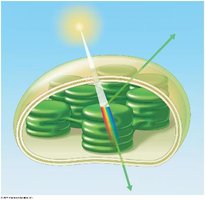
Fates of Light
When light strikes an object, it can be absorbed, transmitted, or reflected. Only absorbed light can be used for photosynthesis.
Absorbed: Light energy is taken up by pigments.
Transmitted: Light passes through the object.
Reflected: Light bounces off the surface.
Pigments in Photosynthesis
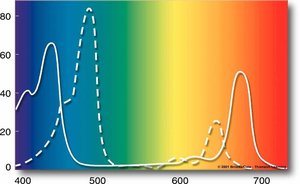
Chlorophylls are the main pigments in oxygenic photosynthesis, appearing green due to their absorption of blue and red wavelengths. They combine with proteins to form photosystems, which are light-collecting complexes in the thylakoid membrane.
Chlorophyll a: The primary pigment in photosystems.
Chlorophyll b: Accessory pigment that broadens the spectrum of absorbed light.
Photosystems and Electron Flow
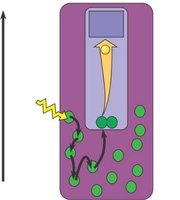
Photosystems are complexes of pigments and proteins that capture light energy and initiate electron transport. There are two types: Photosystem II (PSII) and Photosystem I (PSI). PSII evolved second and begins the process of oxygenic photosynthesis by splitting water and transferring electrons through an electron transport chain.
Photosystem II: Splits water, releases O2, and transfers electrons to the primary electron acceptor.
Photosystem I: Receives electrons and facilitates the production of NADPH.
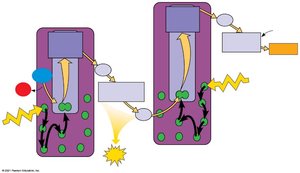
Path of Electrons in Light Reactions
Electrons flow from water through PSII, the first electron transport chain, PSI, the second electron transport chain, and finally to NADP+, forming NADPH. This flow generates a proton gradient used to produce ATP.
Summary Path: H2O → PSII → ETC 1 → PSI → ETC 2 → NADPH
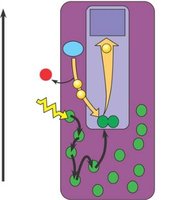
Splitting of Water in Photosystem II
PSII replaces lost electrons by splitting water molecules, releasing O2 and contributing protons (H+) to the proton gradient.
Equation:
Laboratory Applications: Spectroscopy and Absorbance
Electromagnetic Radiation and Visible Light
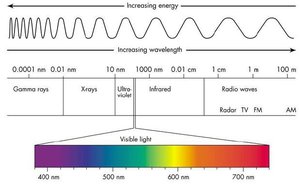
Photosynthetic pigments absorb specific wavelengths of light within the visible spectrum. The energy of light is inversely related to its wavelength.
Visible spectrum: 400–700 nm (violet to red).
Shorter wavelengths: Higher energy (e.g., blue, violet).
Longer wavelengths: Lower energy (e.g., red).
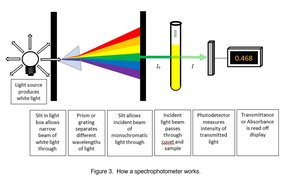
Spectrophotometry
A spectrophotometer measures the absorbance of light by a solution at specific wavelengths, allowing quantification of pigment concentration and analysis of absorption spectra.
How it works: Light passes through a sample; the amount absorbed is measured and related to concentration.
Applications: Determining pigment concentrations, analyzing photosynthetic efficiency.
Beer-Lambert Law
The Beer-Lambert Law states that absorbance increases linearly with the concentration of the absorbing molecule, allowing calculation of concentration from measured absorbance.
Equation:
Where:
= absorbance
= molar absorptivity
= concentration
= path length
Importance of a Blank
A blank contains all components of the experimental sample except the molecule of interest. It is used to set the spectrophotometer to zero absorbance, ensuring accurate measurements.
Procedure: Use a blank every time the wavelength is changed, similar to taring a balance.
Laboratory Graphs
Two key graphs in photosynthesis labs are the standard curve (concentration vs. absorbance) and the absorption spectrum (absorbance vs. wavelength). These graphs are essential for analyzing pigment properties and quantifying concentrations.
Summary Table: Fermentation Types and Applications
Type of Fermentation | End Product(s) | Organisms | Applications |
|---|---|---|---|
Alcohol Fermentation | Ethanol, CO2 | Yeast, some bacteria | Bread, beer, wine |
Lactic Acid Fermentation | Lactate | Some bacteria, muscle cells | Yogurt, pickles, sauerkraut |
