 Back
BackCellular Respiration: Key Concepts and Guided Study
Study Guide - Smart Notes
 Tailored notes based on your materials, expanded with key definitions, examples, and context.
Q14. What are the three steps required to convert pyruvate to acetyl CoA before entering the citric acid cycle?
Background
Topic: Pyruvate Oxidation (Link Reaction)
This question tests your understanding of the preparatory steps that connect glycolysis to the citric acid cycle. Pyruvate, produced in glycolysis, must be converted to acetyl CoA to enter the citric acid cycle. This process occurs in the mitochondria and involves several enzymatic reactions.
Key Terms and Concepts:
Pyruvate: A three-carbon molecule produced from glucose during glycolysis.
Acetyl CoA: A two-carbon molecule attached to coenzyme A, which enters the citric acid cycle.
Decarboxylation: Removal of a carbon dioxide molecule.
Oxidation: Loss of electrons (often associated with loss of hydrogen atoms).
NAD+: Electron carrier that becomes reduced to NADH.
Step-by-Step Guidance
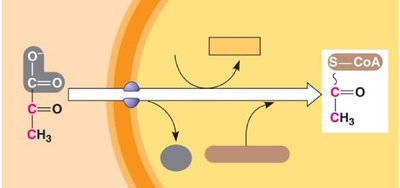
Pyruvate is transported from the cytosol into the mitochondrial matrix by a specific transport protein.
Once inside the mitochondria, pyruvate undergoes decarboxylation, where one carbon atom is removed as CO2.
The remaining two-carbon fragment is oxidized, and the electrons are transferred to NAD+, forming NADH.
The resulting acetyl group is attached to coenzyme A, forming acetyl CoA, which is now ready to enter the citric acid cycle.
Try solving on your own before revealing the answer!
Final Answer:
1. Pyruvate is transported into the mitochondria. 2. Decarboxylation removes CO2. 3. The remaining fragment is oxidized, electrons are transferred to NAD+ (forming NADH), and the acetyl group is attached to CoA, forming acetyl CoA.
This process links glycolysis to the citric acid cycle and is essential for aerobic respiration.
Q21. How does ATP synthase use the flow of hydrogen ions to produce ATP? (Chemiosmosis)
Background
Topic: Chemiosmosis and ATP Synthesis
This question focuses on the mechanism by which ATP is produced during oxidative phosphorylation. Chemiosmosis refers to the movement of hydrogen ions (protons) across a membrane, which drives the synthesis of ATP by ATP synthase.
Key Terms and Concepts:
ATP Synthase: An enzyme that synthesizes ATP from ADP and inorganic phosphate.
Proton Gradient: A difference in concentration of H+ ions across the inner mitochondrial membrane.
Chemiosmosis: The process by which the energy stored in a proton gradient is used to drive cellular work, such as ATP synthesis.
Electron Transport Chain (ETC): Series of protein complexes that transfer electrons and pump protons to create the gradient.
Step-by-Step Guidance
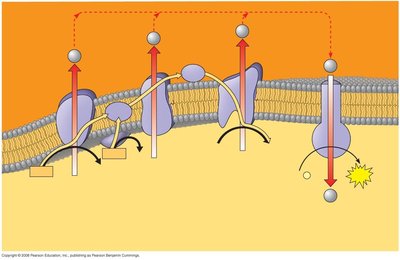
Electrons are passed through the electron transport chain, which is embedded in the inner mitochondrial membrane.
As electrons move through the chain, energy is released and used to pump H+ ions from the mitochondrial matrix to the intermembrane space, creating a proton gradient.
The high concentration of H+ ions in the intermembrane space creates potential energy (proton-motive force).
H+ ions flow back into the matrix through ATP synthase, which harnesses this energy to convert ADP and inorganic phosphate (Pi) into ATP.
Try solving on your own before revealing the answer!
Final Answer:
ATP synthase uses the energy from the flow of H+ ions down their gradient to catalyze the formation of ATP from ADP and Pi. This process is called chemiosmosis and is essential for cellular energy production.
