 Back
BackCentral Dogma, Gene Expression, Mutations, and Evolution: Study Guide
Study Guide - Smart Notes
 Tailored notes based on your materials, expanded with key definitions, examples, and context.
Central Dogma of Molecular Biology
Overview of the Central Dogma
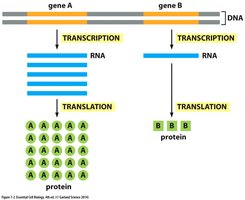
The Central Dogma describes the flow of genetic information within a biological system, from DNA to RNA to protein. This concept is foundational to understanding gene expression and molecular genetics.
DNA serves as the genetic blueprint for all cellular functions.
Transcription is the process by which DNA is copied into pre-mRNA.
RNA Processing includes splicing and modifications to produce mature mRNA.
Translation is the process by which mRNA is decoded to synthesize proteins.
Machinery: RNA polymerase (transcription), ribosomes (translation), and various enzymes.
Locations: Transcription and RNA processing occur in the nucleus; translation occurs in the cytoplasm.
Key Terms and Processes
Transcription: Synthesis of RNA from a DNA template.
Translation: Synthesis of protein from an mRNA template.
Splicing: Removal of introns from pre-mRNA to form mature mRNA.
Ribozymes: RNA molecules with enzymatic activity, often involved in splicing.
Gene Expression
Definition and Measurement
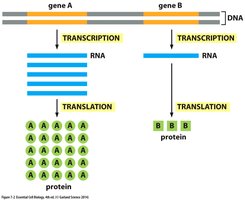
Gene expression refers to the process by which information from a gene is used to synthesize a functional gene product, typically a protein. The level of gene expression can be measured by quantifying mRNA transcripts or protein abundance.
High expression: Large amounts of gene product produced.
Low expression: Small amounts of gene product produced.
Factors Influencing Gene Expression
Environmental factors: Conditions inside or outside the cell can affect gene expression.
Genetic factors: DNA sequence variations can alter expression.
Epigenetic factors: Chemical modifications to DNA or histones that regulate gene activity without changing the DNA sequence.
Mutations
Types of Mutations
Mutations are changes in the DNA sequence that can affect gene expression and protein function.
Silent mutation: Changes a codon but does not alter the amino acid.
Missense mutation: Changes a codon, resulting in a different amino acid.
Nonsense mutation: Changes a codon to a stop codon, terminating translation prematurely.
Frameshift mutation: Insertion or deletion of nucleotides that alters the reading frame.
Examples of Mutation Effects
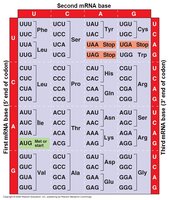
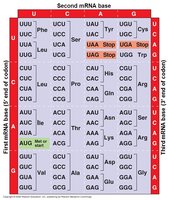
Changing AGC to AGA: Missense mutation (Serine to Arginine).
Changing UAU to UAG: Nonsense mutation (Tyrosine to Stop codon).
Changing UUU to UUC: Silent mutation (Phenylalanine remains unchanged).
Translating mRNA to Amino Acids
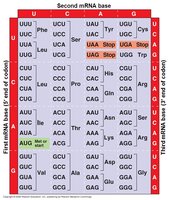
The genetic code is used to translate mRNA sequences into polypeptides.
Example mRNA: CAG AUG ACC CAA GGU AGC UAA CAU
Use the genetic code table to determine the amino acid sequence.
Evolution
Definition and Mechanisms
Evolution is the change in allele frequency in a population over time. It is driven by mechanisms such as mutation, natural selection, genetic drift, and gene flow.
Mutation: Source of genetic variation.
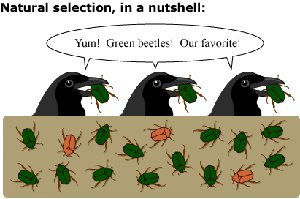
Natural selection: Differential survival and reproduction of individuals with advantageous traits.
Genetic drift: Random changes in allele frequencies.
Gene flow: Movement of alleles between populations.
Natural Selection
The trait must be heritable.
Selective pressure must be applied.
Evolution occurs at the population level, not in individuals.
Application: Antibiotic Resistance
Antibiotic resistance is an example of evolution in action. When antibiotics are applied to a population of bacteria, those with resistance mutations survive and reproduce, increasing the frequency of resistance alleles.
Failure to complete antibiotic courses can lead to increased resistance.
Antimicrobial resistance is a major public health concern.
Summary Table: Types of Mutations
Mutation Type | Effect on Protein | Example |
|---|---|---|
Silent | No change in amino acid | UUU to UUC (both code for Phe) |
Missense | Change in amino acid | AGC to AGA (Ser to Arg) |
Nonsense | Creates stop codon | UAU to UAG (Tyr to Stop) |
Frameshift | Alters reading frame | Insertion or deletion |
Conclusion
Understanding the Central Dogma, gene expression, mutations, and evolution is essential for modern biology. These concepts explain how genetic information is transferred, how traits are expressed, and how populations change over time. Antibiotic resistance is a real-world example of evolution and highlights the importance of responsible medication use. Additional info: Epigenetics is an emerging field that studies heritable changes in gene expression not caused by changes in DNA sequence. It is influenced by environmental and cellular factors and is important in development, disease, and adaptation.
