 Back
BackChapter 1: Themes in the Study of Life – Foundations of Biology
Study Guide - Smart Notes
 Tailored notes based on your materials, expanded with key definitions, examples, and context.
Introduction to Biology
Biology is the scientific study of life. While the definition of "life" is complex, living things are recognized by the processes and characteristics they exhibit. This chapter introduces the foundational theories and themes that unify the study of biology.
The Core Theories of Biology
Cell Theory: All living organisms are composed of cells, and all cells arise from pre-existing cells.
Theory of Homeostasis: All living organisms maintain a relatively stable internal environment despite external changes.
Theory of Evolution: All living organisms share a common ancestor and have adapted over time.
Theme 1: Organization & The Hierarchy of Life
Levels of Biological Organization
Biological systems are organized hierarchically, from the largest scale (biosphere) to the smallest (molecules):
Biosphere: All environments on Earth that support life.
Ecosystems: Communities of living organisms interacting with their physical environment.
Communities: All populations of different species in a given area.
Populations: Groups of individuals of the same species in a specific area.
Organisms: Individual living entities.
Organs: Structures composed of multiple tissues performing specific functions.
Tissues: Groups of similar cells with a common function.
Cells: The fundamental unit of structure and function in living things.
Organelles: Membrane-bound structures within eukaryotic cells.
Molecules: Chemical structures consisting of two or more atoms.
Emergent Properties
Emergent properties arise at each level of biological organization due to the arrangement and interactions of parts. For example, a functioning bicycle emerges only when all parts are correctly assembled.
Systems Biology: Studies the interactions among parts of a biological system to understand how changes affect the whole.
Structure and Function
In biology, structure determines function. Alterations in structure can disrupt or change function, as seen in proteins or anatomical features.
The Cell: The Fundamental Unit of Life
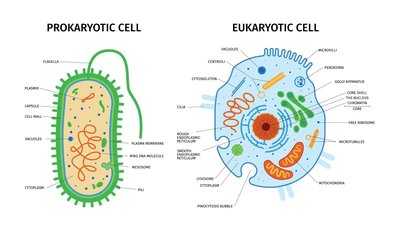
Cells are the smallest units capable of all life processes. All cells share certain features, such as a plasma membrane and genetic material (DNA).
Feature | Prokaryotic Cells | Eukaryotic Cells |
|---|---|---|
Complexity | Simple, generally smaller | Complex, generally larger |
Nucleus | No membrane-bound nucleus (DNA in nucleoid) | DNA enclosed in a membrane-bound nucleus |
Organelles | Lack membrane-enclosed organelles | Contain membrane-enclosed organelles (e.g., mitochondria, chloroplasts) |
Organisms | Unicellular (Bacteria & Archaea) | Unicellular or multicellular (Protists, Fungi, Plants, Animals) |
Theme 2: Information & The Central Dogma
DNA, Genes, and Chromosomes
DNA (Deoxyribonucleic Acid): The hereditary material containing genetic instructions.
Chromosomes: Structures made of DNA and proteins; humans have 46 in somatic cells.
Genes: Segments of DNA that encode proteins and are inherited from parents.
Genome: The complete set of genetic material in an organism.
Genomics vs. Proteomics: Genomics studies whole sets of genes; proteomics studies all proteins encoded by the genome.
The Structure of DNA
DNA is a double helix composed of two complementary strands.
Each strand consists of four nucleotides: Adenine, Thymine, Cytosine, Guanine.
The sequence of nucleotides encodes genetic information.
Gene Expression and the Central Dogma
The Central Dogma describes the flow of genetic information:
Transcription: DNA is transcribed into RNA.
Translation: RNA is translated into a protein.
Protein Folding: The amino acid sequence determines the protein's 3D structure and function.
Theme 3: Energy and Matter
The Flow of Energy vs. The Cycling of Matter
Energy Flows: Enters ecosystems (usually as sunlight), is converted by producers, transferred to consumers, and lost as heat.
Matter Cycles: Nutrients are recycled by decomposers, returning elements to the environment for reuse.
Theme 4: Interactions
Feedback Mechanisms and Homeostasis
Negative Feedback: The accumulation of an end product slows the process (e.g., insulin regulation of blood glucose).
Positive Feedback: The end product accelerates the process (e.g., blood clotting).
Ecosystem Interactions and Global Climate Change
Organisms interact with each other and their environment, affecting and being affected by changes such as climate change.
Human activities (e.g., burning fossil fuels) increase greenhouse gases, leading to global warming and ecosystem disruption.
Theme 5: Evolution & The Diversity of Life
Taxonomy: Classifying the Diversity of Life
Taxonomy organizes species into a hierarchy: Domain, Kingdom, Phylum, Class, Order, Family, Genus, Species.
Mnemonic: Dear King Philip Came Over For Good Soup.
The Three Domains of Life
Bacteria: Single-celled prokaryotes.
Archaea: Single-celled prokaryotes, often extremophiles.
Eukarya: All eukaryotic organisms (plants, fungi, animals, protists).
Natural Selection and Adaptation
Fitness: The ability to survive and reproduce in a specific environment.
Adaptation: Inherited traits that enhance survival and reproduction.
Natural Selection: Individuals with advantageous traits are more likely to survive and reproduce, leading to evolutionary change.
Requirements: Genetic diversity and selective pressure.
Reading Phylogenetic Trees
Phylogenetic trees illustrate evolutionary relationships.
Branch points represent common ancestors; tracing back to a shared node reveals the most recent common ancestor.
The Scientific Method & Types of Data
The Standard Scientific Process
Observation
Questioning
Hypothesis (must be falsifiable)
Prediction (If... then...)
Experimentation/Design
Data Collection & Analysis
Conclusion
Peer Review & Publication
Scientific Data: Qualitative vs. Quantitative
Qualitative Data: Descriptive, non-numerical observations.
Quantitative Data: Numerical measurements or counts.
Inductive vs. Deductive Reasoning
Inductive Reasoning: Specific observations to general principles.
Deductive Reasoning: General premises to specific predictions.
What is a Scientific Theory?
Broader than a hypothesis, generates new hypotheses, and is supported by extensive evidence.
Example: The Theory of Evolution is supported by genetics, fossils, anatomy, and embryology.
