 Back
BackChapter 5: The Structure and Function of Large Biological Molecules
Study Guide - Smart Notes
 Tailored notes based on your materials, expanded with key definitions, examples, and context.
The Molecules of Life
Introduction to Biological Molecules
All living organisms are composed of four major classes of large biological molecules: carbohydrates, lipids, proteins, and nucleic acids. These molecules, known as macromolecules, are typically polymers built from smaller units called monomers. - Molecule: A structure consisting of two or more atoms bonded together. - Macromolecule: Large molecules composed of thousands of covalently connected atoms. - Organic compounds: Carbon-based molecules, often containing other elements such as hydrogen, oxygen, nitrogen, and phosphorus.
Carbon Skeletons and Isomers
Carbon atoms form the backbone of organic molecules, which can be arranged in chains, branches, or rings. - Isomers: Compounds with the same chemical formula but different structural arrangements, resulting in different properties.
Functional Groups
Functional groups are specific groups of atoms within molecules that confer characteristic chemical properties. Common functional groups include: - Hydroxyl group: –OH (found in alcohols) - Carbonyl group: –C=O (found in aldehydes and ketones) - Carboxyl group: –COOH (found in carboxylic acids) - Amino group: –NH2 (found in amines) - Phosphate group: –PO4 (found in nucleotides) - Methyl group: –CH3 - Sulfhydryl group: –SH
Macromolecules: Polymers and Monomers
Polymer Formation and Breakdown
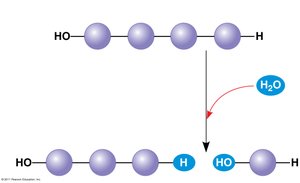
Macromolecules are often polymers, which are long chains of repeating monomers. - Polymer: A long molecule consisting of many similar or identical building blocks (monomers) linked by covalent bonds. - Monomer: The repeating unit that serves as the building block of a polymer. - Dehydration reaction: Joins two monomers by removing a water molecule, forming a new covalent bond. - Hydrolysis: Breaks a polymer into monomers by adding a water molecule, reversing the dehydration reaction. 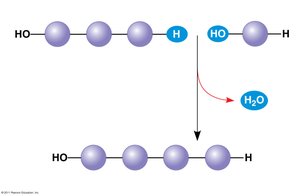
Carbohydrates
Structure and Function
Carbohydrates serve as fuel and building material. They include simple sugars (monosaccharides) and complex polymers (polysaccharides). - Monosaccharides: Single sugar molecules, such as glucose (C6H12O6). - Polysaccharides: Polymers composed of many sugar monomers.
Classification of Monosaccharides
Monosaccharides are classified by: - The location of the carbonyl group (aldose or ketose) - The number of carbons in the carbon skeleton (triose, pentose, hexose) 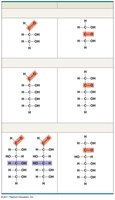
Ring Formation of Sugars
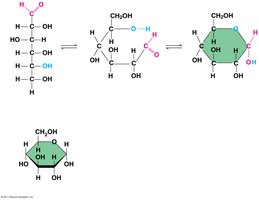
In aqueous solutions, many sugars form ring structures. 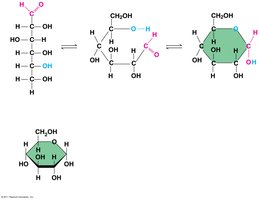
Disaccharides and Glycosidic Linkages
Disaccharides are formed when two monosaccharides are joined by a dehydration reaction, creating a covalent bond called a glycosidic linkage. 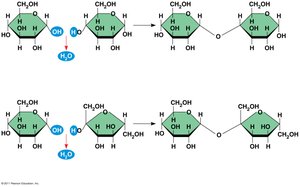
Polysaccharides: Storage and Structural Roles
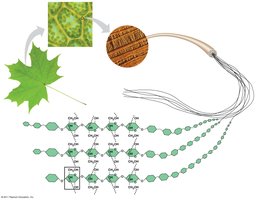
- Starch: Storage polysaccharide in plants, composed entirely of glucose monomers. - Glycogen: Storage polysaccharide in animals, stored mainly in liver and muscle cells. 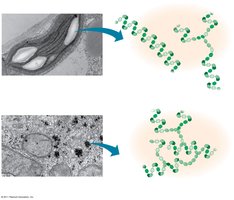
Structural Polysaccharides
- Cellulose: Major component of plant cell walls; polymer of glucose with β glycosidic linkages. - Chitin: Structural polysaccharide in arthropod exoskeletons and fungal cell walls. 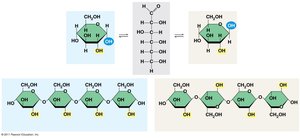

Lipids
Structure and Properties
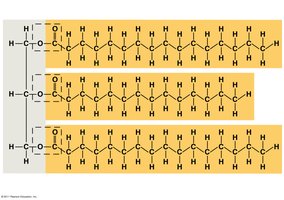
Lipids are hydrophobic molecules that do not form polymers. The most important lipids are fats, phospholipids, and steroids. - Fats: Constructed from glycerol and fatty acids. - Fatty acids: Long hydrocarbon chains with a carboxyl group. 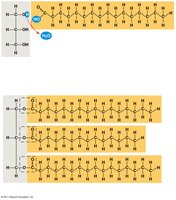
Saturated vs. Unsaturated Fats
- Saturated fatty acids: No double bonds; solid at room temperature. - Unsaturated fatty acids: One or more double bonds; liquid at room temperature. 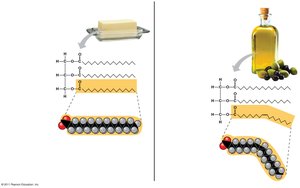
Phospholipids
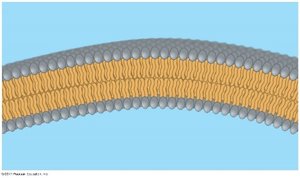
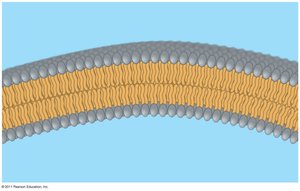
Phospholipids have two fatty acid tails (hydrophobic) and a phosphate group (hydrophilic head). They form bilayers in cell membranes. 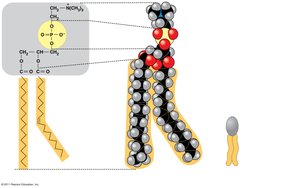
Steroids
Steroids are lipids with a carbon skeleton of four fused rings. Cholesterol is an essential steroid in animal cell membranes. 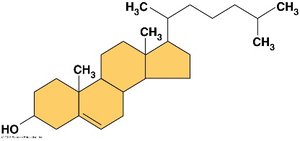
Proteins
Structure and Function
Proteins are biologically functional molecules consisting of one or more polypeptides. They perform a wide range of functions, including enzymatic activity, storage, transport, communication, movement, defense, and structural support.
Types of Proteins and Their Functions
Type | Function | Example |
|---|---|---|
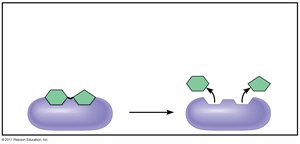
Enzymatic | Selective acceleration of chemical reactions | Digestive enzymes |
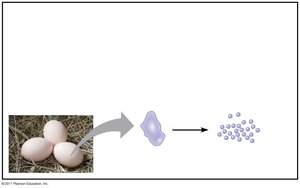
Storage | Storage of amino acids | Casein, ovalbumin |
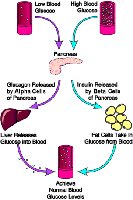
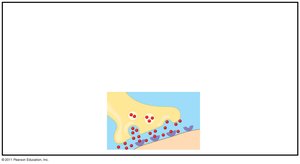
Hormonal | Coordination of activities | Insulin |
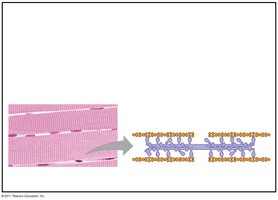
Contractile/Motor | Movement | Actin, myosin |
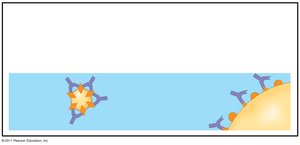
Defensive | Protection against disease | Antibodies |
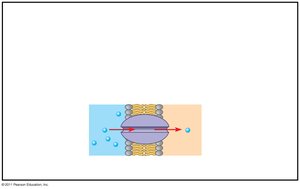
Transport | Transport of substances | Hemoglobin |
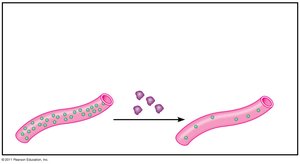
Receptor | Response to chemical stimuli | Receptor proteins |
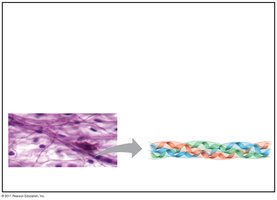
Structural | Support | Collagen, keratin |
Amino Acids and Polypeptides
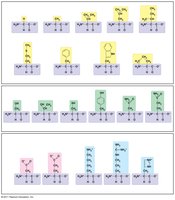
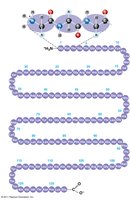
- Amino acids: Organic molecules with amino and carboxyl groups, differing by their side chains (R groups). 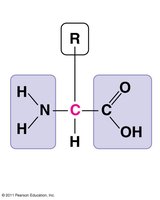
 - Peptide bond: Covalent bond joining amino acids in a polypeptide.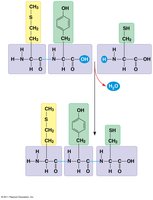
Protein Structure
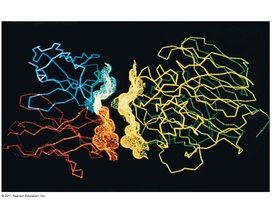
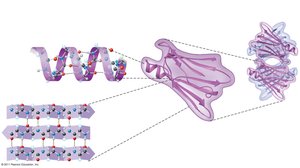
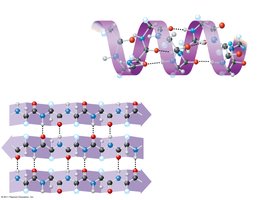
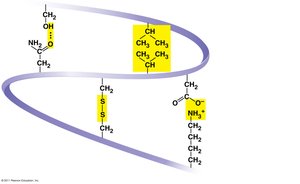
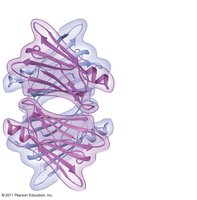
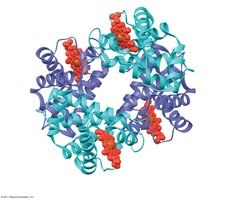
Proteins have four levels of structure: - Primary: Sequence of amino acids. - Secondary: Coils and folds (α helix, β pleated sheet) due to hydrogen bonding. - Tertiary: Three-dimensional folding due to interactions among R groups. - Quaternary: Association of multiple polypeptide chains. 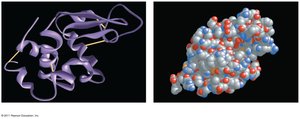

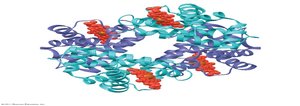
Sickle-Cell Disease: Protein Structure and Function
A single amino acid substitution in hemoglobin can cause sickle-cell disease, affecting protein function and cell shape. 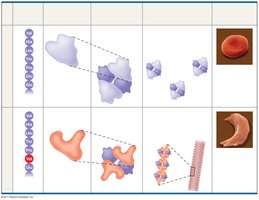
Protein Denaturation and Folding
- Denaturation: Loss of protein structure due to changes in pH, temperature, or other environmental factors. - Chaperonins: Protein molecules that assist in proper folding of other proteins. 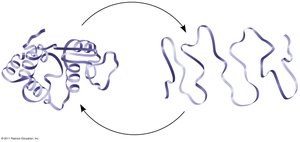
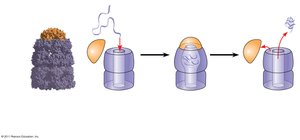
Determining Protein Structure
Methods include X-ray crystallography, NMR spectroscopy, and bioinformatics. 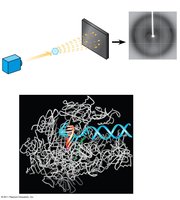
Nucleic Acids
Structure and Function
Nucleic acids store, transmit, and help express hereditary information. - DNA: Deoxyribonucleic acid, stores genetic information. - RNA: Ribonucleic acid, involved in protein synthesis.
Components of Nucleic Acids
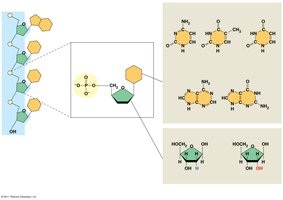
Nucleic acids are polymers called polynucleotides, made of monomers called nucleotides. Each nucleotide consists of: - A nitrogenous base (purine or pyrimidine) - A pentose sugar (ribose or deoxyribose) - One or more phosphate groups 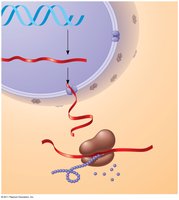
DNA and RNA Structure
- DNA: Double helix with antiparallel strands; base pairing (A-T, G-C) via hydrogen bonds. - RNA: Usually single-stranded; base pairing (A-U, G-C). 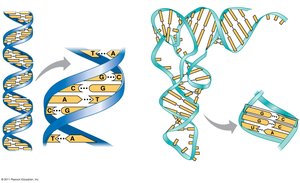
Summary Table: Nitrogenous Bases
Family | Bases | Structure |
|---|---|---|
Pyrimidines | Cytosine, Thymine (DNA), Uracil (RNA) | Single six-membered ring |
Purines | Adenine, Guanine | Six-membered ring fused to a five-membered ring |
Additional info: The chapter covers the structure and function of large biological molecules, including their chemical properties, biological roles, and the importance of their structure in determining function. The notes include expanded academic context and relevant examples for each macromolecule class.
