 Back
BackBio 100 Lec Chapter 5 Part 1
Study Guide - Smart Notes
 Tailored notes based on your materials, expanded with key definitions, examples, and context.
Bio 100 Lec Chapter 5 (Part 1)
Chapter 5: The Structure and Function of Large Biological Molecules
Introduction
This chapter explores the categories, properties, and functions of large biological molecules, focusing on their structural diversity and biological roles. Understanding these molecules is fundamental to cell biology, biochemistry, and physiology.
Macromolecules and Polymers
Concept 5.1: Macromolecules are Polymers Built from Monomers
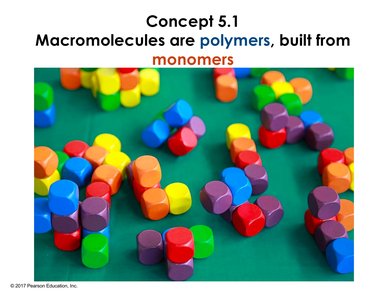
Macromolecules are large biological molecules capable of forming polymers, which are long chains made from repeating subunits called monomers. The three main types of macromolecules are carbohydrates, proteins, and nucleic acids. The diversity in polymer structure arises from the arrangement and organization of monomers.
Monomer: A single subunit that can be joined to others to form a polymer.
Polymer: A long molecule consisting of many similar or identical monomers linked by covalent bonds.
Macromolecule: A large molecule that can generate polymers (carbohydrates, proteins, nucleic acids).
Diversity: Polymers can be linear or branched, and their size and complexity vary.
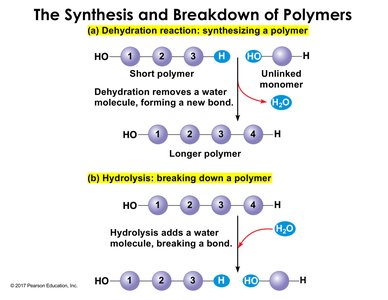
Synthesis and Breakdown of Polymers
The formation and degradation of polymers involve specific chemical reactions:
Dehydration Reaction (Condensation): Joins monomers by removing a water molecule, forming a covalent bond.
Hydrolysis: Breaks polymers into monomers by adding a water molecule, breaking a covalent bond.
Enzymes: Biological catalysts that facilitate these reactions by bringing reactants together.
Equation for Dehydration:
Equation for Hydrolysis:
Diversity of Polymers in Biological Context
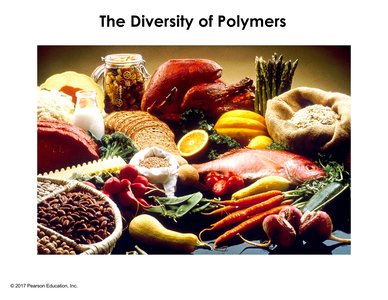
Large biological molecules are found in varying concentrations across cells and species. Their stability and function differ: some provide structural integrity, others serve as energy sources. The diversity of polymers is reflected in the variety of nutrients found in food.
Structural Polymers: Provide support and rigidity (e.g., cellulose).
Energy Storage Polymers: Easily broken down for energy (e.g., starch, glycogen).
Carbohydrates
Concept 5.2: Carbohydrates Serve as Fuel and Building Material
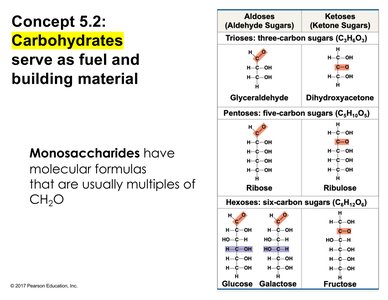
Carbohydrates are macromolecules composed of carbon, hydrogen, and oxygen, typically in a 1:2:1 ratio. They include sugars and their polymers, and are ideal for energy storage due to abundant carbon-hydrogen bonds.
Monosaccharides: Simple sugars (e.g., glucose) with molecular formulas that are multiples of CH2O.
Classification: Based on carbonyl group location (aldose or ketose) and number of carbons (triose, pentose, hexose).
Polysaccharides: Polymers of monosaccharides, serving as energy storage or structural materials.
Type | Example | Formula |
|---|---|---|
Aldose | Glyceraldehyde | C3H6O3 |
Ketose | Dihydroxyacetone | C3H6O3 |
Pentose | Ribose | C5H10O5 |
Hexose | Glucose | C6H12O6 |
Linear and Ring Forms of Glucose
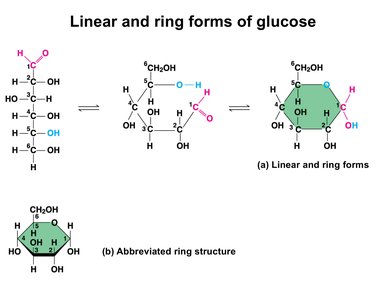
Glucose can exist in both linear and ring forms, especially in aqueous environments. The ring form is predominant in cells and can be either alpha or beta, depending on the orientation of the hydroxyl group at the first carbon.
Alpha Glucose: Hydroxyl group below the plane of the ring.
Beta Glucose: Hydroxyl group above the plane of the ring.
Formation of Disaccharides
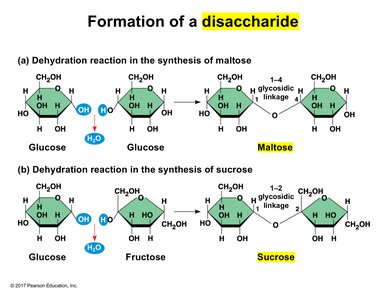
Monosaccharides can be joined to form disaccharides (e.g., maltose, sucrose) via dehydration reactions, resulting in glycosidic linkages. The position of the linkage (e.g., 1-4 or 1-2) depends on the carbon atoms involved.
Maltose: Formed from two glucose molecules (1-4 linkage).
Sucrose: Formed from glucose and fructose (1-2 linkage).
Glycosidic Linkage: Covalent bond joining two monosaccharides.
Polysaccharides: Starch, Glycogen, and Cellulose
Polysaccharides are polymers of monosaccharides linked by glycosidic bonds. Their structure and function depend on the type of linkage and branching.
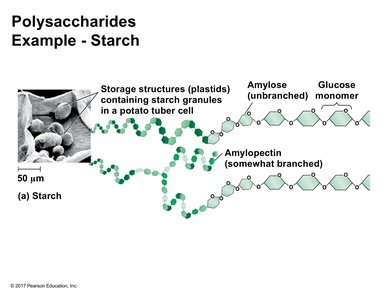
Starch: Energy storage in plants; composed of alpha glucose monomers. Includes amylose (unbranched) and amylopectin (branched).
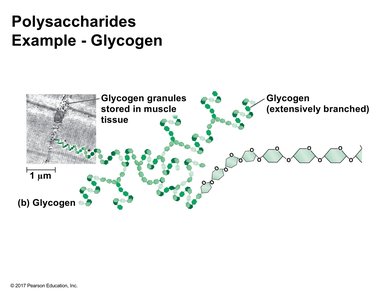
Glycogen: Energy storage in animals; highly branched polymer of glucose, stored in liver and muscle.
Cellulose: Structural component of plant cell walls; composed of beta glucose monomers, forming rigid, linear rods aggregated into microfibrils.
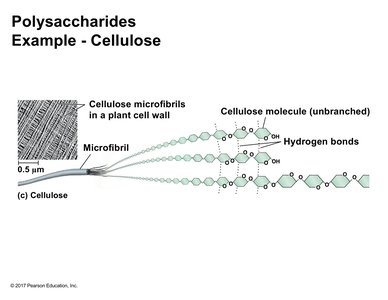
Alpha and Beta Linkages in Glucose Polymers
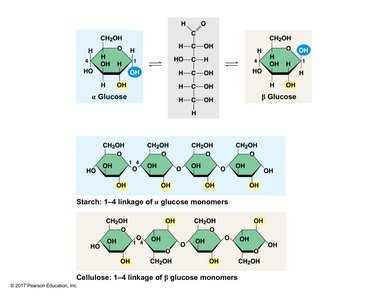
The orientation of glucose monomers (alpha or beta) determines the type of glycosidic linkage and the properties of the resulting polysaccharide. Alpha linkages (as in starch) are digestible by humans, while beta linkages (as in cellulose) are not.
Starch: 1-4 linkage of alpha glucose monomers.
Cellulose: 1-4 linkage of beta glucose monomers.
Digestive Differences: Humans vs. Herbivores
Humans can digest starch (alpha linkages) but not cellulose (beta linkages), so cellulose acts as insoluble fiber. Herbivores, such as cows, rely on symbiotic microbes to hydrolyze cellulose and access its nutrients.
Humans: Digest starch, eliminate cellulose as fiber.
Herbivores: Microbes in digestive tract break down cellulose.

Lipids
Concept 5.3: Lipids are a Diverse Group of Hydrophobic Molecules
Lipids are large biological molecules that are not true polymers. They are defined by their hydrophobic (nonpolar) nature and are insoluble in water. Lipids include fats, oils, phospholipids, steroids, and chlorophyll, each serving distinct biological roles.
Fats and Oils: Energy storage and thermal insulation.
Phospholipids: Structural component of cell membranes.
Steroids: Regulation (hormones, vitamins).
Chlorophyll: Light energy capture in plants.
Structure and Formation of Fats
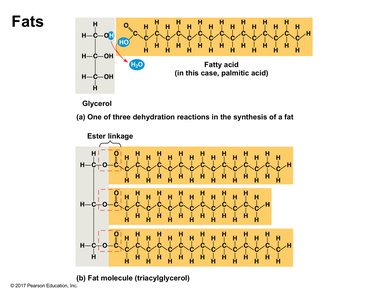
Fats (triacylglycerols) are formed from glycerol and fatty acids via dehydration synthesis, resulting in ester linkages. Glycerol is a three-carbon alcohol, and fatty acids consist of a carboxyl group attached to a hydrocarbon chain. Fats are used for energy storage, cushioning, and insulation.
Glycerol: Three-carbon alcohol with hydroxyl groups.
Fatty Acid: Carboxyl group attached to a long hydrocarbon chain.
Ester Linkage: Covalent bond formed between glycerol and fatty acid.
Triglyceride: Glycerol bound to three fatty acids.
Equation for Fat Formation:
Saturated and Unsaturated Fats
The properties of fats depend on the saturation of their fatty acids:
Saturated Fats: No double bonds; maximum hydrogen atoms; tightly packed; solid at room temperature (e.g., animal fats).
Unsaturated Fats: One or more cis double bonds; causes kinks; cannot pack closely; liquid at room temperature (e.g., oils).
Cis Configuration: Hydrogens on the same side of the double bond, causing bending.
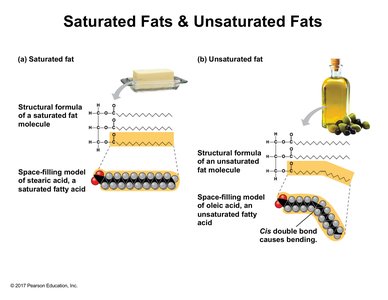
Example: Cooking animal fats (saturated) results in solidification at room temperature, while plant oils (unsaturated) remain liquid.
Additional info: Enzymes, dehydration, and hydrolysis reactions are fundamental to both polymer and non-polymer biological molecules. Lipids, while not true polymers, are essential for energy storage, membrane structure, and signaling.
