 Back
BackCommunity Ecology: Species Interactions, Energy Flow, Succession, and Biomes
Study Guide - Smart Notes
 Tailored notes based on your materials, expanded with key definitions, examples, and context.
Community Ecology
Introduction to Community Ecology
Community ecology examines the interactions among all living organisms in a given area and how these interactions shape the structure and dynamics of biological communities. Key topics include species interactions, energy flow, ecological succession, invasive species, and the classification of biomes.
Types of Species Interactions
Competition
Competition occurs when two or more organisms attempt to use the same limited resource. This interaction can be either intraspecific (within the same species) or interspecific (between different species). Competition often leads to adaptations that reduce overlap in resource use.
Intraspecific competition: Competition among individuals of the same species; intensifies as population density increases.
Interspecific competition: Competition between individuals of different species.
Competitive exclusion: One species outcompetes another, leading to the exclusion of the less competitive species.
Species coexistence: Both species persist at lower population sizes, often through resource partitioning.
Niche Concepts
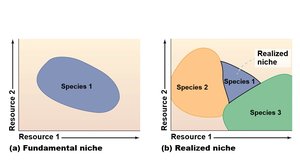
A niche is the functional role of an organism in its community, including its use of resources, habitat, and interactions with other species. The fundamental niche is the full range of conditions and resources a species can theoretically use, while the realized niche is the actual range occupied due to competition and other interactions.
Predation
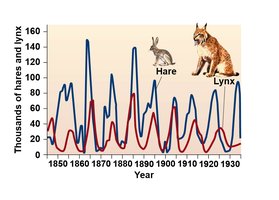
Predation is an interaction where one organism (the predator) kills and consumes another (the prey). Predator and prey populations influence each other's dynamics, often resulting in cyclical population patterns. Natural selection favors adaptations in both predators (for hunting) and prey (for defense).
Parasitism
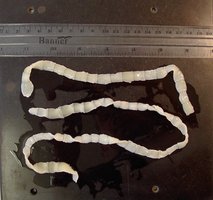
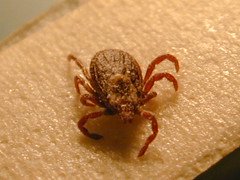
Parasitism is a relationship in which one organism (the parasite) lives on or in another organism (the host), deriving nourishment at the host's expense. Parasites typically do not kill their hosts outright and may be internal, external, or free-living during part of their life cycle.
Internal parasites: Live inside the host (e.g., tapeworms).
External parasites: Live on the surface of the host (e.g., ticks).
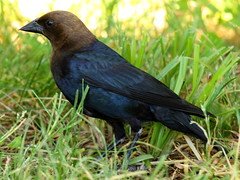
Brood parasites: Manipulate other species to raise their young (e.g., some birds).
Herbivory
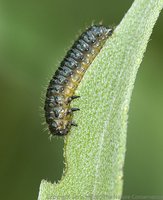
Herbivory involves animals feeding on plants. Both plants and herbivores evolve adaptations in response to each other; plants may develop chemical or physical defenses, while herbivores evolve mechanisms to overcome these defenses.
Mutualism
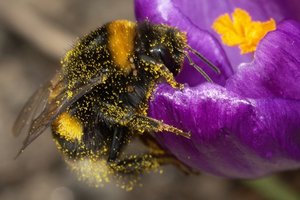
Mutualism is a symbiotic relationship where both species benefit. Examples include plant roots and mycorrhizal fungi, corals and algae, and plants with their pollinators.
Energy Flow in Communities
Trophic Levels
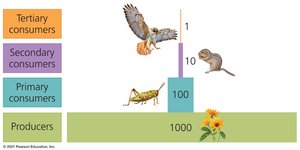
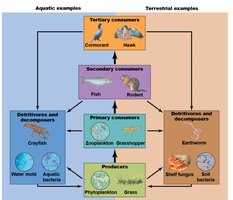
Energy flows through communities in a series of steps known as trophic levels. These include producers, consumers (primary, secondary, tertiary), detritivores, and decomposers. Energy, biomass, and organism numbers decrease at higher trophic levels, with roughly 10% of energy transferred to the next level.
Food Chains and Food Webs
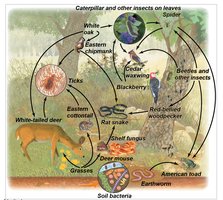
Food chains are linear sequences showing who eats whom, while food webs are complex networks of feeding relationships that better represent real ecosystems.
Keystone Species
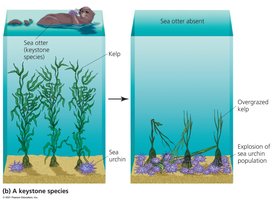
Keystone species have a disproportionately large effect on their communities relative to their abundance. Their removal can cause dramatic changes, such as trophic cascades, where the effects ripple through multiple trophic levels.
Community Response to Disturbance
Disturbance and Succession
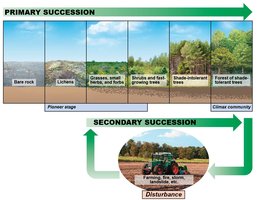
Disturbances are rapid changes in environmental conditions that alter community structure. Communities may be resistant, resilient, or sensitive to disturbance. Succession is the predictable sequence of community changes following a disturbance.
Primary succession: Occurs on surfaces where no soil or life exists (e.g., after volcanic eruption).
Secondary succession: Occurs where a disturbance alters a community but leaves soil and some organisms intact (e.g., after fire or farming).
Invasive Species
Impact of Invasive Species
Invasive species are non-native organisms that spread rapidly and disrupt native communities, often outcompeting or preying on native species. Their introduction can be accidental or intentional and is a major threat to biodiversity.
Restoration Ecology
Restoring Communities
Restoration ecology aims to return disturbed communities to their historical conditions through active management and restoration projects, ranging from small-scale habitat restoration to large ecosystem recovery efforts.
Biomes
Definition and Determinants of Biomes
A biome is a large ecological unit defined by its dominant plant types and vegetation structure. The two main environmental variables determining biome type are temperature and precipitation. Biomes occur over broad geographic regions and include examples such as tundra, boreal forest, temperate forest, grassland, desert, and tropical rainforest.
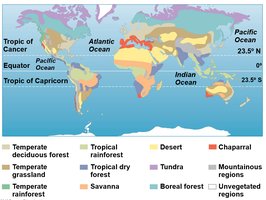
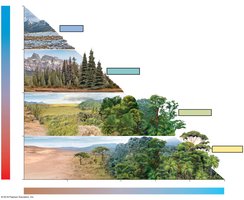
Biome | Temperature | Precipitation | Example |
|---|---|---|---|
Tundra | Very cold | Low | Arctic tundra |
Boreal forest | Cold | Moderate | Taiga |
Temperate deciduous forest | Moderate | Moderate-high | Eastern US forests |
Desert | Hot or cold | Very low | Sahara Desert |
Tropical rainforest | Hot | Very high | Amazon rainforest |
Grassland | Moderate | Low-moderate | Prairies |
