 Back
BackComprehensive Study Guide: Energy, Enzymes, and Cellular Respiration
Study Guide - Smart Notes
 Tailored notes based on your materials, expanded with key definitions, examples, and context.
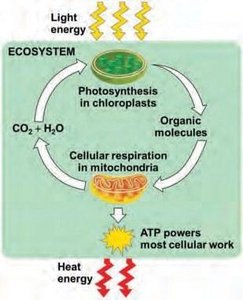
Q1. Using figure 7.2, describe photosynthesis and how it makes the macromolecules that are in your food.
Background
Topic: Photosynthesis and Energy Flow in Ecosystems
This question tests your understanding of how photosynthesis captures light energy and converts it into chemical energy, which is then used to build macromolecules (like carbohydrates, proteins, and lipids) that make up food.
Key Terms and Concepts:
Photosynthesis: The process by which plants, algae, and some bacteria convert light energy, carbon dioxide, and water into glucose and oxygen.
Macromolecules: Large molecules such as carbohydrates, proteins, and lipids, which are synthesized from smaller organic molecules.
Chloroplasts: Organelles in plant cells where photosynthesis occurs.
Key Formula:
Step-by-Step Guidance
Start by identifying the main inputs of photosynthesis: carbon dioxide (), water (), and light energy.
Explain how chloroplasts in plant cells use light energy to convert and into glucose (), a simple sugar.
Describe how glucose serves as a building block for larger macromolecules (such as starch, cellulose, and other carbohydrates, as well as amino acids and lipids).
Connect this process to the food chain: plants make these macromolecules, which are then consumed by animals (including humans) for energy and growth.
Try solving on your own before revealing the answer!
Q2. Using figure 7.2 again, describe how photosynthesis is related to cellular respiration.
Background
Topic: Relationship Between Photosynthesis and Cellular Respiration
This question is about the cyclical relationship between photosynthesis (which stores energy in organic molecules) and cellular respiration (which releases that energy for cellular work).
Key Terms and Concepts:
Cellular Respiration: The process by which cells break down glucose and other organic molecules to produce ATP, releasing and .
ATP: Adenosine triphosphate, the main energy currency of the cell.
Key Formulas:
Photosynthesis:
Cellular Respiration:
Step-by-Step Guidance
Identify that photosynthesis captures light energy and stores it in glucose and other organic molecules.
Explain that cellular respiration occurs in mitochondria, where these organic molecules are broken down to release energy in the form of ATP.
Note that the products of photosynthesis (glucose and oxygen) are the reactants for cellular respiration, and vice versa.
Discuss how this cycle maintains the flow of energy and recycling of matter in ecosystems.
Try solving on your own before revealing the answer!
Q3. Describe how metabolic pathways break down macromolecules to get energy (using the word catabolic).
Background
Topic: Catabolic Pathways and Energy Release
This question focuses on how cells use catabolic pathways to break down large macromolecules into smaller units, releasing energy in the process.
Key Terms and Concepts:
Catabolic Pathways: Metabolic pathways that break down complex molecules into simpler ones, releasing energy.
Macromolecules: Large molecules such as carbohydrates, proteins, and fats.
ATP: The energy currency produced during catabolic reactions.
Step-by-Step Guidance
Define catabolic pathways and give examples (e.g., glycolysis, beta-oxidation of fatty acids).
Explain how enzymes catalyze the breakdown of macromolecules into smaller molecules (e.g., glucose, amino acids, fatty acids).
Describe how the breakdown of these molecules releases energy, which is captured in the form of ATP and electron carriers (NADH, FADH2).
Connect this process to cellular respiration, where the energy from these molecules is used to produce ATP.
Try solving on your own before revealing the answer!
Q4. Below is the equation for cellular respiration. In the table, list where each component of the reaction comes from.
Background
Topic: Inputs and Outputs of Cellular Respiration
This question asks you to trace the origin of each reactant and product in the cellular respiration equation.
Key Formula:
Step-by-Step Guidance
Identify the source of glucose () – typically from food (carbohydrates).
Identify the source of oxygen () – from the air, taken in by breathing.
Determine where carbon dioxide () is produced – as a waste product during the breakdown of glucose.
Determine where water () is produced – as a byproduct of the electron transport chain.
Try solving on your own before revealing the answer!
