 Back
BackDiversity of Form and Function: Study Guide for Exam 1 (Plant and Microbial Biology)
Study Guide - Smart Notes
 Tailored notes based on your materials, expanded with key definitions, examples, and context.
Three Domains of Life
Classification and Evolutionary Relationships
The classification of life has evolved from simple morphological groupings to a system based on genetic and molecular evidence. The three domains of life are Bacteria, Archaea, and Eukarya. Early classification relied on visible traits, but the advent of the microscope and genetic analysis (especially rRNA sequencing) revealed deeper evolutionary relationships.
Bacteria and Archaea are prokaryotes, lacking a membrane-bound nucleus and organelles.
Eukarya includes all eukaryotic organisms with organized nuclei and membrane-bound organelles.
Genetic similarity, especially in rRNA, is used to determine evolutionary relationships because rRNA is universal and evolves slowly.
Prokaryotes differ from eukaryotes in their cell division (binary fission vs. mitosis), DNA structure (circular vs. linear), and lack of membrane-bound organelles. Archaea are more closely related to eukaryotes than to bacteria.
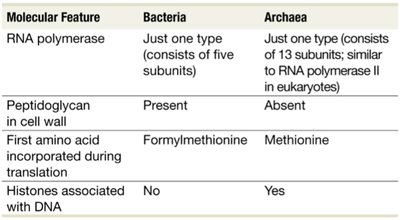
Molecular Feature | Bacteria | Archaea |
|---|---|---|
RNA polymerase | Just one type (five subunits) | One type (13 subunits; similar to eukaryotic RNA polymerase II) |
Peptidoglycan in cell wall | Present | Absent |
First amino acid during translation | Formylmethionine | Methionine |
Histones associated with DNA | No | Yes |
Bacterial and Eukaryotic Diversity
Bacterial Diversity
Bacteria are found in nearly every environment on Earth. They exhibit a variety of shapes (cocci, bacilli, spirochetes) and can move by flagella, gliding, or remain stationary. Communication occurs via chemicals or light, and quorum sensing enables coordinated behaviors like biofilm formation.
Shapes: Spheres (cocci), rods (bacilli), spirals (spirochetes/spirilla)
Colonial living is common, though each cell is independent.
Eukaryotic Diversity
Eukaryotes possess a true nucleus and membrane-bound organelles. They can be unicellular or multicellular, with complex life cycles involving sexual and asexual reproduction. Multicellularity allows for specialization and increased size.
Sexual reproduction involves meiosis (producing haploid gametes) and fertilization (restoring diploidy).
Asexual reproduction occurs via mitosis.
Not all eukaryotes are sexual (e.g., some rotifers reproduce asexually).
Plant Diversity and Evolution
Plant Life History and Innovations
Plants evolved from green algae (archaeaplastids) and adapted to terrestrial life through several key innovations:
Roots: Anchorage and absorption of water/minerals
Stems: Support and transport, composed of lignin
Vascular tissue: Efficient internal transport (xylem and phloem)
Cuticle: Prevents desiccation
Stomata: Gas exchange
Land plants exhibit alternation of generations, with distinct multicellular haploid (gametophyte) and diploid (sporophyte) stages.
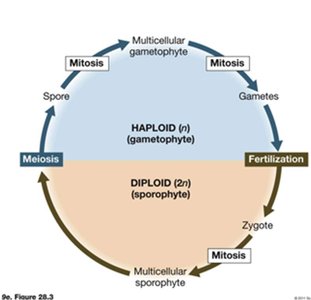
Sporophyte (2n): Produces haploid spores via meiosis
Gametophyte (n): Produces gametes via mitosis; gametes fuse to form a zygote
Major Groups of Land Plants
Land plants diversified into several major groups, each with unique adaptations:
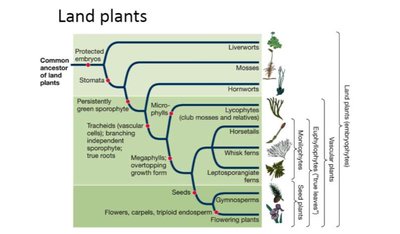
Nonvascular plants (e.g., mosses, liverworts): Dominant gametophyte, lack vascular tissue, small and simple bodies
Vascular plants: Possess tracheids for water transport, dominant sporophyte, include lycophytes, ferns, horsetails, and seed plants
Seed plants: Protect and nourish embryos, include gymnosperms (seeds in cones) and angiosperms (seeds in flowers)
Plant Structure and Function
Plant Body Organization
Plant morphology (external structure) and anatomy (internal structure) reflect adaptations for terrestrial life. The plant body is divided into root and shoot systems, with organs such as stems, leaves, and buds.
Roots: Anchorage, absorption, storage
Shoots: Photosynthesis, reproduction
Leaves: Broad and flat for efficient light capture and gas exchange
Plant cells have unique features: chloroplasts (photosynthesis), large vacuole (storage), cell wall (support), and plasmodesmata (communication).
Plant Tissues and Growth
Parenchyma cells: Living, primary cell wall, metabolic functions
Sclerenchyma cells: Thick secondary walls, support
Xylem: Water/mineral transport (tracheids, vessel elements)
Phloem: Sugar transport (sieve elements, companion cells)
Growth occurs at meristems (regions of active cell division). Primary growth elongates the plant; secondary growth (in woody plants) increases girth via the vascular cambium, producing annual rings in wood.
Transport in Plants
Xylem and Phloem Transport
Water and minerals move upward through xylem by root pressure and transpiration pull. The Transpiration-Cohesion-Tension Theory explains how water is pulled up due to evaporation from leaves, cohesion between water molecules, and adhesion to xylem walls.
Phloem sap moves from sources (leaves) to sinks (roots, fruits) by hydrostatic pressure generated by active loading of sucrose.
Stomatal Regulation
Stomata control gas exchange and water loss. Guard cells regulate stomatal opening by changing turgor pressure, influenced by light, CO2 concentration, and hormones like abscisic acid (ABA).
Plant Nutrition
Essential Elements and Adaptations
Plants are autotrophs, synthesizing carbohydrates via photosynthesis. They require mineral nutrients (e.g., nitrogen, phosphorus, potassium, magnesium, iron) for growth and development. Nitrogen is often limiting and is made available by nitrogen-fixing bacteria (e.g., Rhizobium).
Deficiency symptoms (e.g., chlorosis from magnesium deficiency) help diagnose nutrient needs.
Some plants are parasitic or carnivorous to obtain nutrients in poor soils.
Plant Development and Hormones
Seed Germination and Hormonal Control
Seeds contain dormant embryos and stored food. Germination is triggered by environmental cues (water, light, temperature). The hormone gibberellin (GA) stimulates the production of enzymes (e.g., α-amylase) that mobilize stored food for growth.
Major Plant Hormones and Their Functions
Auxin: Promotes cell elongation, phototropism, apical dominance
Cytokinin: Stimulates cell division, branching
Abscisic acid (ABA): Induces dormancy, closes stomata during water stress
Ethylene: Promotes fruit ripening, leaf abscission
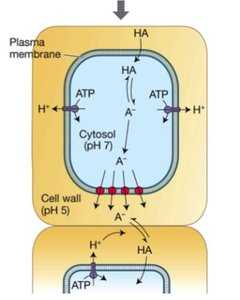
Auxin acts by acidifying the cell wall, loosening it for expansion. This process involves ATP-driven proton pumps and the movement of weak acids (e.g., indole acetic acid, IAA) across membranes.
Light as an External Cue
Light regulates plant development (e.g., flowering, germination) via photoreceptors like phytochrome and phototropin. Phytochrome exists in two forms (Pr and Pfr) that interconvert in response to red and far-red light, influencing growth responses.
Additional info: Where content was brief or fragmented, academic context was added to clarify the alternation of generations, the role of hormones, and the significance of plant adaptations for terrestrial life.
