 Back
BackDNA Replication: Structure, Mechanisms, and Laboratory Applications
Study Guide - Smart Notes
 Tailored notes based on your materials, expanded with key definitions, examples, and context.
DNA Structure and Function
Molecular Components of DNA
DNA is a polymer composed of nucleotide monomers, each consisting of a sugar, phosphate group, and nitrogenous base. The structure of DNA is essential for its function as the genetic material of all living organisms.
Backbone: The DNA backbone is formed by alternating sugar (deoxyribose) and phosphate groups, connected by strong covalent bonds known as phosphodiester bonds.
Rungs: The rungs of the DNA ladder are pairs of nitrogenous bases: adenine (A), thymine (T), guanine (G), and cytosine (C). A pairs with T via 2 hydrogen bonds, and G pairs with C via 3 hydrogen bonds.
Bond Types: Covalent bonds hold the backbone together, while hydrogen bonds connect the base pairs, allowing the strands to separate during replication and transcription.
Antiparallel Structure and Directionality
Double-stranded DNA consists of two nucleotide strands running in opposite directions, termed antiparallel. One strand runs from the 5' end to the 3' end, and the other from 3' to 5'.
3' and 5' Labels: Refer to the carbon atoms in the sugar. The 5' end has a phosphate group attached to the fifth carbon, and the 3' end has a hydroxyl group attached to the third carbon.
Importance: This orientation is crucial for the double helix structure and for accurate base pairing during replication.
Information Storage and Template Function
DNA's stable double helix structure enables it to store genetic information reliably. Complementary base pairing allows precise copying of sequences, making DNA an ideal template for replication.
Complementary Base Pairing: Ensures accurate transmission of genetic information.
Template Mechanism: Each strand can serve as a template for synthesis of a new complementary strand.
Key Principles of DNA Replication
Role of DNA Polymerase
DNA polymerase is the enzyme responsible for catalyzing the polymerization of deoxyribonucleotide monomers into DNA. It acts as a catalyst, speeding up the reaction without being consumed.
Directionality: DNA polymerase can only add nucleotides to the 3' end of a growing strand, synthesizing DNA in the 5' to 3' direction.
Bond Formation: The enzyme forms a covalent phosphodiester bond between the 3' hydroxyl group of the last nucleotide and the 5' phosphate group of the incoming dNTP.
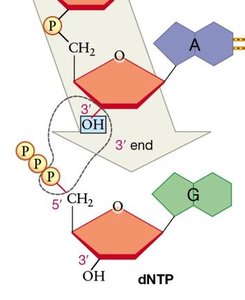
Energetics of DNA Replication
Synthesis of dNTPs: Endergonic process requiring energy input to add phosphate groups.
Condensation Reaction: Exergonic; the addition of a dNTP to the DNA strand releases energy by cleaving two phosphates (pyrophosphate), driving the reaction forward.
Origins of Replication
Bacterial Chromosomes: Typically have a single origin of replication.
Eukaryotic Chromosomes: Have multiple origins of replication to efficiently copy large chromosomes.
Initiation of DNA Synthesis
DNA polymerase cannot start a new strand; it requires an RNA primer synthesized by primase to provide a starting point.
Elongation: DNA polymerase adds nucleotides to the 3' end of the RNA primer.
Direction: New DNA strand is synthesized in the 5' to 3' direction.
Primer Replacement: DNA polymerase later replaces the RNA primer with DNA nucleotides.
Accuracy and Mutation
Speed: DNA polymerase adds 600–1000 nucleotides per second.
Error Rate: About one error per billion nucleotides; most mistakes are corrected by proofreading and repair mechanisms.
Mutations: Accidental mistakes are a source of genetic mutations, which can be beneficial, neutral, or harmful. Mutations are the ultimate source of new alleles and drive evolution.
Application of DNA Replication in the Laboratory
Polymerase Chain Reaction (PCR)
PCR is a laboratory technique used to amplify DNA, making millions of copies of a specific DNA sequence.
Similarities to Natural Replication:
Both require a DNA template.
Both synthesize new DNA strands in the 5' to 3' direction using DNA polymerase.
Differences:
PCR is performed in vitro (in a lab) using a thermal cycler, while natural replication occurs in vivo (in cells).
PCR uses specific DNA primers, whereas natural replication uses RNA primers synthesized by primase.
Exponential Amplification in PCR
Each PCR cycle doubles the amount of target DNA. Starting with one copy, after 10 cycles:
copies
Primer Design for PCR
First primer: 5’–TACGTGCCGTTAAAGGGG–3’
Second primer: 5’–TTTCAGTGGG–3’
Applications of PCR
PCR solves the problem of insufficient DNA quantity, enabling identification, genetic analysis, evolutionary studies, and forensic investigations.
Forensics: Amplifies tiny DNA samples for identification.
Evolutionary Biology: Studies ancient DNA and genetic variation.
Summary Table: DNA Replication vs. PCR
Feature | Natural DNA Replication | PCR (Lab Technique) |
|---|---|---|
Location | In vivo (cell) | In vitro (lab) |
Initiation | RNA primer (primase) | DNA primer (synthetic) |
Enzyme | DNA polymerase | Heat-stable DNA polymerase (e.g., Taq) |
Direction of Synthesis | 5' to 3' | 5' to 3' |
Purpose | Cell division, genetic continuity | DNA amplification for analysis |
Additional info: Academic context was added to clarify the mechanisms, energetics, and applications of DNA replication and PCR, as well as to provide a summary table for comparison.
----------------------------------------
