 Back
BackDNA Structure and Replication Study Guide
Study Guide - Smart Notes
 Tailored notes based on your materials, expanded with key definitions, examples, and context.
Q1. DNA replication occurs during which part of the cell cycle?
Background
Topic: Cell Cycle and DNA Replication
This question tests your understanding of when DNA synthesis happens in the cell cycle, which is crucial for cell division and genetic inheritance.
Key Terms:
Interphase: The phase of the cell cycle when the cell grows, replicates its DNA, and prepares for division.
S phase: The specific part of interphase when DNA replication occurs.
Step-by-Step Guidance
Recall the main stages of the cell cycle: interphase (G1, S, G2) and mitosis (M phase).
Identify which stage is responsible for DNA synthesis.
Consider why DNA must be replicated before cell division.
Try solving on your own before revealing the answer!
Final Answer: Interphase (specifically S phase)
DNA replication occurs during the S phase of interphase, ensuring each daughter cell receives a complete set of genetic material.
Q2. If a strand of DNA has the sequence 5' C C T A T G C A 3', what is the sequence of the complementary strand?
Background
Topic: DNA Structure and Base Pairing
This question tests your knowledge of complementary base pairing rules in DNA.
Key Terms:
Complementary base pairing: Adenine (A) pairs with Thymine (T), Cytosine (C) pairs with Guanine (G).
Antiparallel strands: DNA strands run in opposite directions (5' to 3' and 3' to 5').
Step-by-Step Guidance
Write out the original DNA sequence: 5' C C T A T G C A 3'.
Apply base pairing rules: C pairs with G, T with A, A with T, G with C.
Construct the complementary strand, making sure to write it in the 5' to 3' direction.
Try solving on your own before revealing the answer!
Final Answer: 5' T G C A T A G G 3'
The complementary strand is written from 5' to 3', following base pairing rules.
Q3. Which of the following pictures the monomer we would expect to see in a strand of DNA?
Background
Topic: DNA Monomers
This question tests your ability to recognize the structure of a nucleotide, the monomer of DNA.
Key Terms:
Nucleotide: The basic building block of DNA, consisting of a phosphate group, a deoxyribose sugar, and a nitrogenous base.
Step-by-Step Guidance
Examine each molecular structure and identify the components: phosphate, sugar, and base.
Compare the structures to the typical nucleotide structure.
Determine which option matches the DNA nucleotide.
Try solving on your own before revealing the answer!
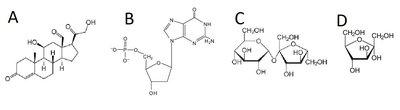
Final Answer: B
Option B shows a nucleotide with a phosphate group, deoxyribose sugar, and nitrogenous base.
Q4. The two molecules below are different ways of drawing the same molecule. What type of macromolecule would these be used to synthesize?
Background
Topic: Macromolecules and Amino Acids
This question tests your ability to identify amino acids and understand their role in protein synthesis.
Key Terms:
Amino acid: The monomer used to build proteins.
Protein: A macromolecule made of amino acid chains.
Step-by-Step Guidance
Identify the functional groups present in the molecules (amino and carboxyl groups).
Recall which macromolecule is synthesized from amino acids.
Connect the structure to its biological function.
Try solving on your own before revealing the answer!
Final Answer: Protein
These molecules are amino acids, which are used to build proteins.
Q6. Below is a diagram of a section of a DNA molecule. Answer the question based on the diagram.
Background
Topic: DNA Structure and Function
This question tests your ability to identify key structural features of DNA, such as sugars, bases, bonds, and strand orientation.
Key Terms:
Deoxyribose sugar: The sugar component of DNA's backbone.
Hydrogen bonds: Weak bonds between nitrogenous bases holding the two DNA strands together.
Phosphodiester bond: Covalent bond linking nucleotides in a DNA strand.
Pyrimidine and purine bases: Types of nitrogenous bases in DNA.
5' and 3' ends: Indicate the directionality of DNA strands.
Step-by-Step Guidance
Examine the diagram and locate the labeled parts (A, B, C, D, E, G, H).
Recall the structure of DNA: backbone (sugar-phosphate), bases (A, T, C, G), and bonds.
Match each label to its corresponding structural feature (e.g., A = deoxyribose sugar).
Review the directionality of the strands (5' and 3' ends).
Try solving on your own before revealing the answer!
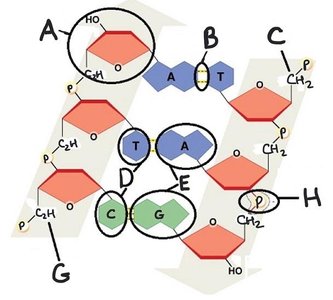
Final Answer:
A: deoxyribose sugar
B: hydrogen bonds between nitrogenous bases
C: 5' end of strand
D: pyrimidine bases
E: purine bases
H: phosphodiester bond containing phosphate group
Each label corresponds to a key structural feature of DNA.
Q10. Below are four diagrams illustrating a replication fork and the direction in which DNA is synthesized. The arrowhead indicates the direction in which the new strand is being built; the end with the arrow is the end that is being added to. Which of the diagrams shows the directions of replication correctly? Briefly explain in your own words why that diagram would be the correct one.
Background
Topic: DNA Replication Fork and Strand Synthesis
This question tests your understanding of the antiparallel nature of DNA and the directionality of strand synthesis during replication.
Key Terms:
Replication fork: The structure formed during DNA replication where the double helix is unwound.
Leading and lagging strands: The two new DNA strands synthesized in opposite directions.
3' end: The end of the DNA strand where new nucleotides are added.
Step-by-Step Guidance
Examine each diagram and note the direction of the arrows (strand synthesis).
Recall that DNA polymerase adds nucleotides to the 3' end of the growing strand.
Identify which diagram shows both new strands being built in the correct direction (toward the 3' end).
Try solving on your own before revealing the answer!
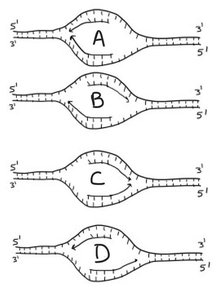
Final Answer: D
Diagram D correctly shows the new strands being synthesized by adding nucleotides to their 3' ends, reflecting the antiparallel nature of DNA replication.
