 Back
BackDNA Transcription and RNA Processing: From Gene to Protein
Study Guide - Smart Notes
 Tailored notes based on your materials, expanded with key definitions, examples, and context.
DNA Transcription and RNA Processing
Introduction to the Central Dogma
The central dogma of molecular biology describes the flow of genetic information within a biological system. It states that information is transferred from DNA to RNA to protein. This process involves two main steps: transcription (DNA to RNA) and translation (RNA to protein).

Genes and Chromosomes
Genes are specific sequences of DNA nucleotides (A, T, C, G) that encode instructions for making proteins or functional RNAs. Each gene is located at a particular position (locus) on a chromosome, which is a long DNA molecule containing many genes.
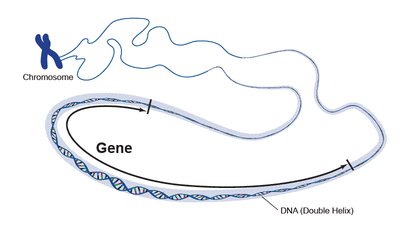
Gene Expression Overview
Gene expression is the process by which the information in a gene is used to synthesize a functional gene product, typically a protein. This process involves two main stages: transcription and translation. In eukaryotes, an additional step called RNA processing occurs between transcription and translation.
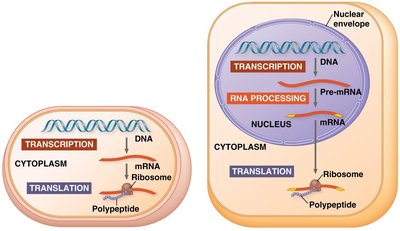
The Central Dogma: DNA to RNA to Protein
Transcription: Making an RNA Copy of a Gene
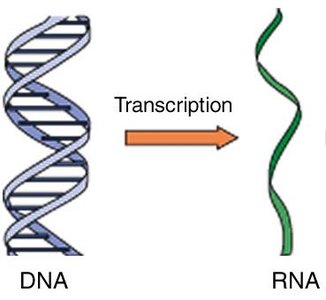
Transcription is the process by which a segment of DNA is used as a template to synthesize a complementary RNA strand. The resulting RNA molecule is called messenger RNA (mRNA), which carries the genetic code from the DNA in the nucleus to the ribosome for protein synthesis.
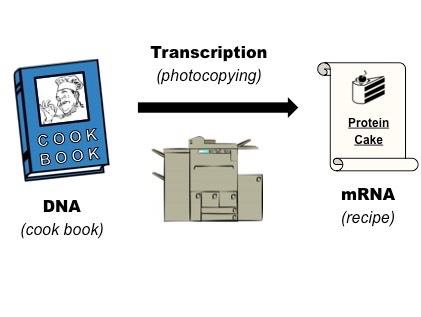
Cooking Analogy for Gene Expression
Gene expression can be compared to following a recipe from a cookbook. The DNA is like a cookbook, transcription is like photocopying a recipe (making mRNA), and the ribosome is the chef that reads the recipe to make the final dish (protein).
Transcription: Steps and Key Components
Ingredients for Transcription
Template DNA strand: One of the two DNA strands serves as the template for RNA synthesis.
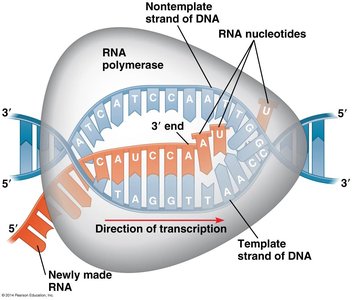
RNA polymerase: The enzyme that synthesizes RNA by joining RNA nucleotides together.
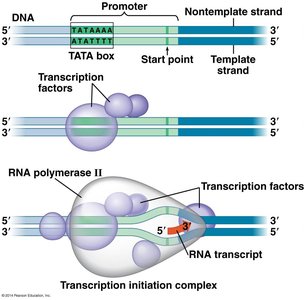
Transcription factors: Proteins that help RNA polymerase bind to the promoter and initiate transcription.
RNA nucleotides: The building blocks (A, U, C, G) for the RNA strand.
Stages of Transcription
Transcription occurs in three main stages:
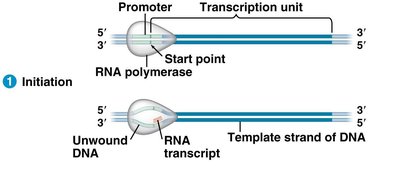
Initiation: RNA polymerase binds to the promoter region of the gene with the help of transcription factors. The DNA strands are separated, and transcription begins at the start site.
Elongation: RNA polymerase moves along the template strand, synthesizing the RNA molecule in the 5' to 3' direction by adding complementary RNA nucleotides.
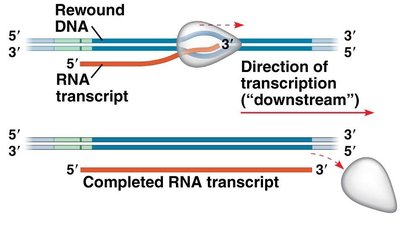
Termination: Transcription ends when RNA polymerase reaches a terminator sequence (in prokaryotes) or a polyadenylation signal (in eukaryotes), causing the RNA transcript to be released.
Promoters and Terminators
Promoter: A DNA sequence upstream of the gene that signals the start of transcription. In eukaryotes, the TATA box is a common promoter element that helps RNA polymerase identify the template strand.
Terminator: A DNA sequence that signals the end of transcription.
Types of RNA Produced by Transcription
mRNA (messenger RNA): Carries the genetic code from DNA to the ribosome for translation.
rRNA (ribosomal RNA): Forms the core of the ribosome's structure and catalyzes protein synthesis.
tRNA (transfer RNA): Brings amino acids to the ribosome during translation.
snRNA (small nuclear RNA): Involved in RNA splicing in eukaryotes.
RNA Processing in Eukaryotes
Modification of 5' and 3' Ends
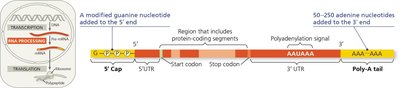
In eukaryotic cells, the primary RNA transcript (pre-mRNA) undergoes several modifications before becoming mature mRNA:
5' cap: A modified guanine nucleotide is added to the 5' end of the RNA. This cap protects the mRNA from degradation and helps with ribosome binding during translation.
Poly-A tail: A string of 50-250 adenine nucleotides is added to the 3' end. This tail also protects the mRNA and aids in export from the nucleus.
RNA Splicing: Removal of Introns
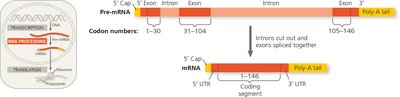
The initial pre-mRNA contains both exons (coding regions) and introns (non-coding regions). RNA splicing removes introns and joins exons together to form the mature mRNA. This process is carried out by a complex called the spliceosome, which is made of proteins and small RNAs.
Alternative RNA Splicing
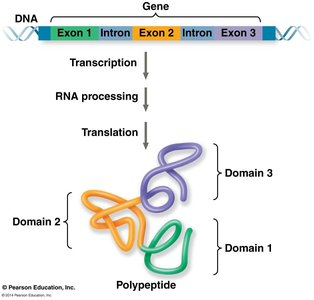
Alternative splicing allows a single gene to code for multiple proteins by varying which exons are included in the final mRNA. This increases protein diversity without increasing the number of genes.
Translation: From mRNA to Protein
Genetic Code and Codons
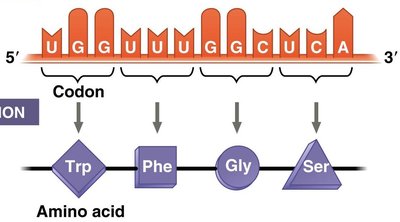
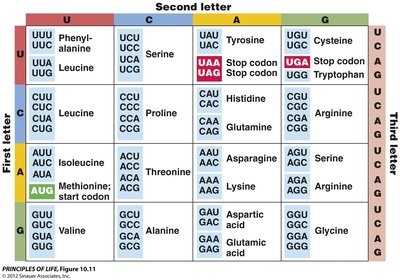
The genetic code is read in sets of three nucleotides called codons, each of which specifies a particular amino acid. There are 64 possible codons but only 20 amino acids, making the code redundant (more than one codon can specify the same amino acid). Some codons serve as start or stop signals for translation.
Summary Table: Key Terms and Definitions
Term | Definition |
|---|---|
Gene expression | Process by which information from a gene is used to synthesize a functional product (protein or RNA) |
Transcription | Synthesis of RNA from a DNA template |
Translation | Synthesis of a protein from an mRNA template |
Pre-mRNA | Primary transcript before processing in eukaryotes |
mRNA | Mature messenger RNA that carries genetic code to ribosome |
rRNA | Ribosomal RNA, structural and catalytic component of ribosomes |
tRNA | Transfer RNA, brings amino acids to ribosome |
snRNA | Small nuclear RNA, involved in splicing |
Loci | Specific location of a gene on a chromosome |
Template strand | DNA strand used as template for RNA synthesis |
RNA polymerase | Enzyme that synthesizes RNA |
Transcription factors | Proteins that help initiate transcription |
Initiation, Elongation, Termination | Stages of transcription |
Promoter | DNA sequence where RNA polymerase binds to start transcription |
TATA box | Promoter sequence important for initiation in eukaryotes |
Poly-A tail | String of adenines added to 3' end of mRNA |
5’ cap | Modified guanine added to 5' end of mRNA |
Intron | Non-coding region removed during RNA processing |
Exon | Coding region retained in mature mRNA |
Spliceosome | Complex that removes introns from pre-mRNA |
Summary
Genetic information flows from DNA to RNA to protein via transcription and translation.
Transcription involves initiation, elongation, and termination, with the help of RNA polymerase and transcription factors.
In eukaryotes, pre-mRNA undergoes processing (capping, polyadenylation, and splicing) before translation.
The genetic code is read in codons, and alternative splicing allows for protein diversity.
