 Back
Back121.3 Biology chapter 27
Study Guide - Smart Notes
 Tailored notes based on your materials, expanded with key definitions, examples, and context.
Domain Eukarya: Introduction and Unique Features
Overview of Eukaryotes
Eukaryotes are organisms whose DNA is supercoiled and packaged within a membrane-bound nucleus. They are typically larger than prokaryotic cells and can form cooperative aggregations, leading to multicellular organisms, tissues, and organs. The domain Eukarya contains the most familiar organisms, including fungi, plants, animals, and protists.
Eukaryotic cells are distinguished by their nucleus and complex internal structures.
Four main kingdoms of multicellular eukaryotes: Plants (cell walls of cellulose, large vacuoles, chloroplasts), Fungi (cell walls of chitin, septa), Animals (no cell walls, no chloroplasts, small vacuoles), and Protists.
Eukaryotic Origins
Chemical traces suggest the first eukaryotes appeared about 2.7 billion years ago, with microfossils dating back 1.5 billion years. Modern eukaryotic cells are likely much different from the originals due to horizontal gene transfers, endosymbiosis, and membrane infolding.
Key evolutionary processes: Endosymbiosis (engulfing other cells), membrane infolding.
Eight modern clades: Alveolates, Excavates, Stramenopiles, Plants, Rhizarians, Amoebozoans, Fungi, Animals.
Origins of Eukaryotic Organelles
Nucleus and Endoplasmic Reticulum
The nucleus and endoplasmic reticulum (ER) are integral to eukaryotic cells. Both are believed to have formed by infolding of the cell membrane.
Nucleus: Contains genetic material, regulates gene expression.
Endoplasmic reticulum: Protein translation, transport, storage.
Membrane invaginations serve as passageways and are common in eukaryotes.
The nuclear envelope is an extension of the ER.
Mitochondria and Chloroplasts: Endosymbiont Hypotheses
Mitochondria: Believed to have originated from bacteria living inside larger prokaryotes. They detoxified oxygen and later coupled reduction to water with ATP production. Mitochondria have their own genome and replicate by binary fission.
Chloroplasts: Originated from photosynthetic cyanobacteria engulfed by red algae (primary endosymbiosis), then by other protists (secondary and tertiary endosymbiosis).
Endosymbiosis is not rare; other structures (flagella, microtubules, centrioles) may have resulted from similar processes.
Kingdom Protista: Diversity and Characteristics
General Features of Protists
Protists are the simplest eukaryotes, comprising about 200,000 species. Most are unicellular and very diverse in shape, size, and life history.
Defined more by what they are not: not plants, fungi, or animals; do not develop from embryos; minimal cell differentiation.
Cell surfaces vary: some have only a membrane, others have silica shells or cysts.
Locomotion: flagella, pseudopodia, or cilia.
Nutrition: mostly heterotrophic, some photosynthetic, some both.
Reproduction: both asexual (budding, schizogony) and sexual (meiosis, mitosis).
Protist Diversity and Classification
Protists are a loose grouping defined by unicellularity, lack of embryonic cleavage, heterotrophy, and possession of a membrane-bound nucleus. They are found in all habitats, with some symbiotic and pathogenic forms.
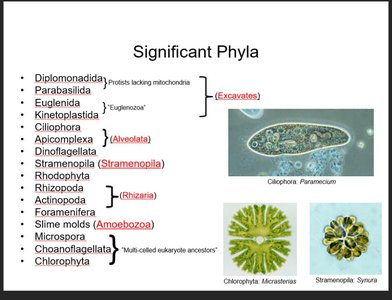
Significant Protist Phyla
Overview of Major Phyla
The following table summarizes the main protist phyla, their characteristics, and classification:
Phylum | Main Features | Classification |
|---|---|---|
Diplomonadida | Paired nuclei, lack mitochondria (mitosomes), flagella | Excavates |
Parabasilida | Anaerobic, parabasal fiber, hydrogenosomes, flagella | Excavates |
Euglenida | Flexible pellicle, flagella, autotrophic/heterotrophic | Excavates |
Kinetoplastida | Kinetoplast DNA, undulating membrane, parasitic | Excavates |
Ciliophora | Cilia, alveoli, macro/micronucleus, conjugation | Alveolata |
Apicomplexa | Apical complex, parasitic, complex life cycles | Alveolata |
Dinoflagellata | Flagella, bioluminescent, red tides, alveoli | Alveolata |
Stramenopila | 3-part flagellar hairs, diatoms, brown algae | Stramenopila |
Actinopoda | Axopodia, silica skeleton, radial symmetry | Rhizaria |
Foraminifera | Tests (shells), complex life cycles, benthic | Rhizaria |
Rhodophyta | Red algae, phycobilisomes, alternation of generations | Archaeplastida |
Loboseans | Amoeboid, pseudopodia, free-living/parasitic | Amoebozoa |
Slime Molds | Plasmodial/cellular, fruiting bodies, spores | Amoebozoa |
Choanoflagellata | Collar of villi, single flagellum, animal ancestor | Opisthokonta |
Microspora | Intracellular parasites, mitosomes, spores | Fungi (Microsporidia) |
Chlorophyta | Green algae, chlorophylls, cell walls | Archaeplastida |
Excavates: Diplomonadida, Parabasilida, Euglenida, Kinetoplastida
Diplomonadida: Paired nuclei, lack mitochondria, flagella. Example: Giardia lamblia.
Parabasilida: Anaerobic, parabasal fiber, hydrogenosomes, flagella. Example: Trichomonas vaginalis.
Euglenida: Flexible pellicle, flagella, autotrophic/heterotrophic. Example: Euglena.
Kinetoplastida: Kinetoplast DNA, undulating membrane, parasitic. Example: Trypanosomes (sleeping sickness).
Alveolata: Ciliophora, Apicomplexa, Dinoflagellata
Ciliophora: Cilia, alveoli, macro/micronucleus, conjugation. Example: Paramecium.
Apicomplexa: Apical complex, parasitic, complex life cycles. Example: Plasmodium (malaria).
Dinoflagellata: Flagella, bioluminescent, red tides, alveoli. Example: Red tide dinoflagellates.
Stramenopila: Diatoms, Brown Algae
3-part flagellar hairs, diatoms, brown algae, heterotrophic/photosynthetic.
Important producers in marine food webs.
Rhizaria: Actinopoda, Foraminifera
Actinopoda: Axopodia, silica skeleton, radial symmetry.
Foraminifera: Tests (shells), complex life cycles, benthic.
Amoebozoa: Loboseans, Slime Molds
Loboseans: Amoeboid, pseudopodia, free-living/parasitic.
Slime Molds: Plasmodial/cellular, fruiting bodies, spores.
Opisthokonta: Choanoflagellata
Collar of villi, single flagellum, animal ancestor.
Fungi: Microspora
Intracellular parasites, mitosomes, spores.
Archaeplastida: Chlorophyta, Rhodophyta
Chlorophyta: Green algae, chlorophylls, cell walls.
Rhodophyta: Red algae, phycobilisomes, alternation of generations.
Representative Images of Protist Diversity
Ciliophora: Paramecium (example of ciliate structure and movement)
Chlorophyta: Micrasterias (green algae, cell wall structure)
Stramenopila: Synura (example of colonial stramenopile)
Summary Table: Protist Phyla and Their Features
Phylum | Key Features | Example |
|---|---|---|
Diplomonadida | Lack mitochondria, paired nuclei | Giardia lamblia |
Parabasilida | Anaerobic, hydrogenosomes | Trichomonas vaginalis |
Euglenida | Flexible pellicle, flagella | Euglena |
Kinetoplastida | Kinetoplast DNA, parasitic | Trypanosomes |
Ciliophora | Cilia, alveoli, conjugation | Paramecium |
Apicomplexa | Apical complex, parasitic | Plasmodium |
Dinoflagellata | Flagella, red tides | Dinoflagellates |
Stramenopila | 3-part flagellar hairs | Diatoms, brown algae |
Actinopoda | Axopodia, silica skeleton | Radiolarians |
Foraminifera | Tests, benthic | Foraminiferans |
Rhodophyta | Red algae, phycobilisomes | Nori, agar |
Loboseans | Amoeboid, pseudopodia | Entamoeba |
Slime Molds | Plasmodial/cellular, spores | Myxogastria |
Choanoflagellata | Collar, flagellum | Choanoflagellates |
Microspora | Intracellular parasites | Microsporidia |
Chlorophyta | Green algae, chlorophylls | Volvox, Micrasterias |
Key Terms and Concepts
Endosymbiosis: The process by which one organism lives inside another, leading to organelle formation.
Pellicle: Flexible protein strips under the cell membrane, providing shape and flexibility.
Axopodia: Thin pseudopodia radiating outward, used for feeding and locomotion.
Alternation of Generations: Life cycle alternating between haploid and diploid stages.
Binary Fission: Asexual reproduction by splitting into two cells.
Conjugation: Sexual process in ciliates involving exchange of genetic material.
Summary
The domain Eukarya encompasses a vast diversity of organisms, with protists representing the most varied and foundational group. Understanding their structure, origins, and classification is essential for grasping the evolution and complexity of eukaryotic life. Protist phyla are classified based on unique structural, reproductive, and ecological features, and their study provides insight into the origins of multicellular life and the evolutionary history of eukaryotes. Additional info: Some details about evolutionary relationships and classification were inferred for completeness and clarity.
