 Back
BackEcology: The Study of Interactions and Biomes
Study Guide - Smart Notes
 Tailored notes based on your materials, expanded with key definitions, examples, and context.
Introduction to Ecology
Ecology is the scientific study of the interactions between organisms and the living and nonliving components of their environment. These interactions determine the distribution and abundance of organisms on Earth. Ecologists investigate these relationships at multiple levels of biological organization, from individual organisms to the entire biosphere.
What Determines Where a Species Lives?
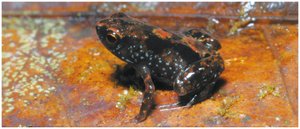
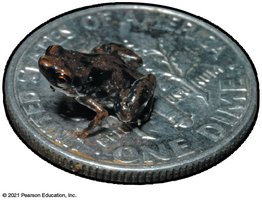
Environmental Factors: The presence and abundance of a species are influenced by environmental factors such as climate, temperature, precipitation, light, and nutrient availability.
Terrestrial vs. Aquatic: On land, climate (especially temperature and precipitation) is the strongest determinant, while in aquatic environments, light and nutrient availability are key.
Levels of Ecological Study
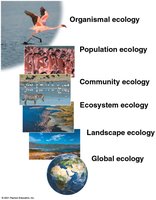
Ecologists ask research questions at different levels of the biological hierarchy, each focusing on specific interactions and processes.
Organismal Ecology
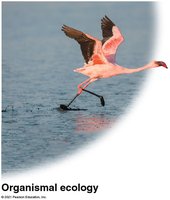
Organismal ecology examines how an organism’s structure, physiology, and behavior help it meet environmental challenges. This includes physiological, evolutionary, and behavioral ecology.
Example Question: How do flamingos select a mate?
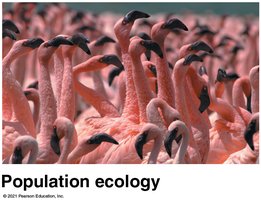
Population Ecology
A population is a group of individuals of the same species living in an area. Population ecology analyzes factors affecting population size and why it changes over time.
Example Question: What environmental factors affect the reproductive rate of flamingos?
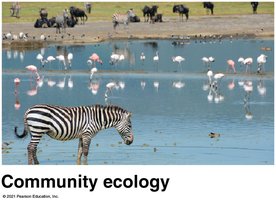
Community Ecology
A community consists of populations of different species in an area. Community ecology examines how interactions between species (such as predation, competition, and mutualism) affect community structure and organization.
Example Question: What factors influence the diversity of species that interact at an African lake?
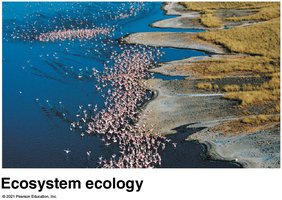
Ecosystem Ecology
An ecosystem includes all organisms in an area and the physical factors with which they interact. Ecosystem ecology emphasizes energy flow and chemical cycling between organisms and their environment.
Example Question: What factors control photosynthetic productivity in an aquatic ecosystem?
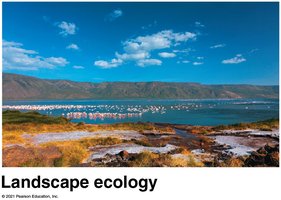
Landscape Ecology
A landscape (or seascape) is a mosaic of connected ecosystems. Landscape ecology focuses on the exchanges of energy, materials, and organisms across multiple ecosystems.
Example Question: To what extent do nutrients from terrestrial ecosystems affect organisms in a lake?
Global Ecology
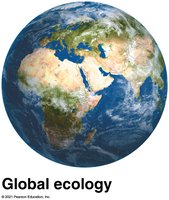
The biosphere is the global ecosystem—the sum of all the planet’s ecosystems and landscapes. Global ecology examines how the exchange of energy and materials influences the function and distribution of organisms across the biosphere.
Example Question: How do global patterns of air circulation affect the distribution of organisms?
Earth’s Climate and Its Influence on Life
Climate: Definition and Components
Climate is the long-term prevailing weather conditions in an area and is the most significant influence on the distribution of terrestrial organisms. The four major physical components of climate are temperature, precipitation, sunlight, and wind.
Global Climate Patterns
Solar Energy: The sun’s energy drives temperature variations, air and water circulation, and evaporation, leading to latitudinal climate differences.
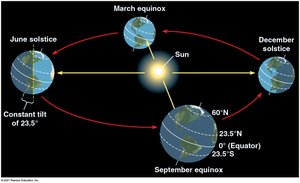
Sunlight Intensity: Sunlight is most direct at the tropics (23.5º N to 23.5º S), resulting in higher temperatures. At higher latitudes, sunlight is more diffuse.
Seasonality
Seasonal changes in climate are caused by the tilt of Earth’s axis and its orbit around the sun, leading to variations in day length, solar radiation, and temperature, especially at higher latitudes.
Bodies of Water and Climate
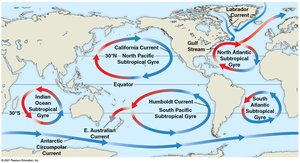
Oceans and large lakes moderate the climate of nearby land due to water’s high specific heat. Ocean currents transport warm and cold water, influencing regional climates.
Mountains and Climate
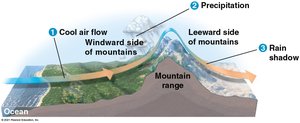
Mountains affect climate by influencing air flow and precipitation. As moist air rises over mountains, it cools and releases moisture on the windward side, creating a rain shadow of dry conditions on the leeward side.
Vegetation and Climate
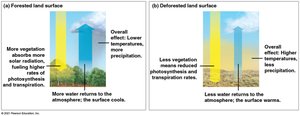
Vegetation, especially forests, can alter local and regional climates by absorbing solar energy and through transpiration, which cools the surface and increases precipitation. Deforestation leads to hotter, drier climates.
Microclimate
Microclimate refers to localized climate patterns, often influenced by features such as shade, soil moisture, and wind patterns. For example, forests moderate the microclimate beneath their canopy.
Global Climate Change
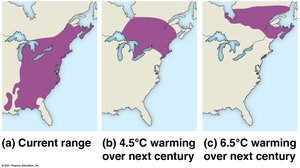
Human activities, such as burning fossil fuels and deforestation, have increased greenhouse gases, causing global climate change. This has led to a rise in average global temperatures, shifting wind and precipitation patterns, and more frequent extreme weather events.
Species Responses: Some species have shifted their ranges in response to climate change, while others have not kept pace, leading to reduced ranges or extinction.
Terrestrial Biomes
Definition and Distribution
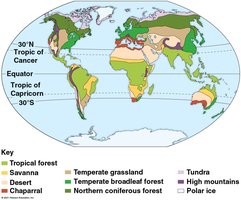
Biomes are major life zones characterized by vegetation type (terrestrial biomes) or physical environment (aquatic biomes). Climate is a major factor determining the locations of terrestrial biomes.
General Features of Terrestrial Biomes
Ecotone: The area of intergradation between biomes, which may be wide or narrow.
Vertical Layering: Forests often have multiple layers (canopy, understory, shrub, herbaceous, forest floor, root layer), providing diverse habitats.
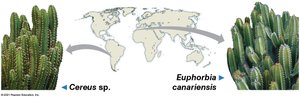
Convergent Evolution: Similar adaptations can arise in distant biomes (e.g., cacti in the Americas and euphorbs in Africa).
Disturbance and Biomes
Disturbance (e.g., fire, storms, human activity) can alter community structure and maintain certain biomes. Many dominant plants depend on periodic disturbance.
Major Terrestrial Biomes
Biome | Location | Precipitation | Temperature | Dominant Vegetation | Human Impact |
|---|---|---|---|---|---|
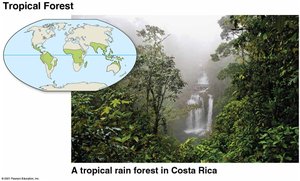
Tropical Forest | Equatorial, subequatorial | 200–400 cm (rain), 150–200 cm (dry) | 25–29ºC | Broadleaf evergreen/deciduous trees | Deforestation |
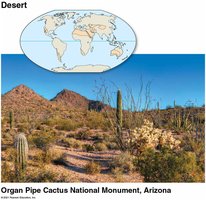
Desert | 30º N/S, interior continents | <30 cm | –30ºC to >50ºC | Succulents, shrubs | Urbanization, agriculture |
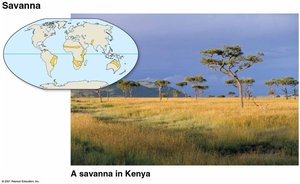
Savanna | Equatorial, subequatorial | 30–50 cm | 24–29ºC | Grasses, forbs | Ranching, overhunting |
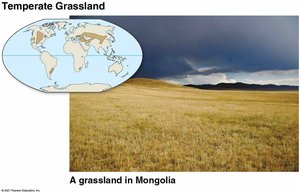
Temperate Grassland | Continents | 30–100 cm | –10ºC to 30ºC | Grasses, forbs | Agriculture, grazing |
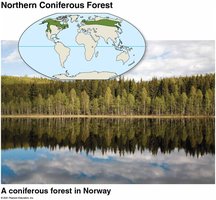
Northern Coniferous Forest | N. America, Eurasia | Varies | –50ºC to 20ºC | Conifers | Logging |
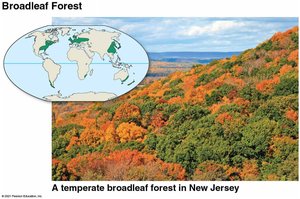
Temperate Broadleaf Forest | Midlatitudes | 70–200+ cm | 0ºC (winter), up to 35ºC (summer) | Deciduous/evergreen trees | Settlement, recovery |
Aquatic Biomes
General Features
Aquatic biomes cover most of Earth and are classified by physical and chemical characteristics, such as salt concentration, depth, and light penetration. Marine biomes have about 3% salt, while freshwater biomes have less than 0.1%.
Zonation in Aquatic Biomes
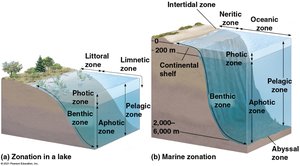
Aquatic biomes are stratified into zones based on light, temperature, and depth:
Photic Zone: Sufficient light for photosynthesis.
Aphotic Zone: Little light penetration.
Benthic Zone: Bottom substrate.
Pelagic Zone: Open water.
Abyssal Zone: Deepest regions (2,000–6,000 m).
Major Aquatic Biomes
Biome | Key Features | Dominant Organisms | Human Impact |
|---|---|---|---|
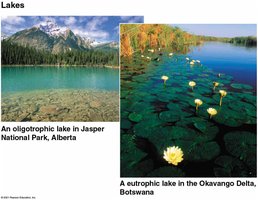
Lakes | Oligotrophic (nutrient-poor, O2-rich), Eutrophic (nutrient-rich, O2-poor) | Phytoplankton, zooplankton, fish | Eutrophication, fish kills |
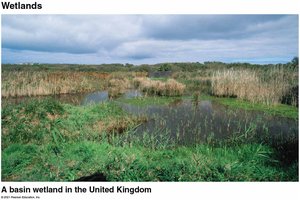
Wetlands | Water-saturated soil, high productivity | Lilies, cattails, birds, amphibians | Draining, filling |
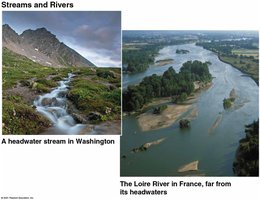
Streams & Rivers | Current, headwaters (cold, clear), downstream (warm, turbid) | Fish, invertebrates | Pollution, damming |
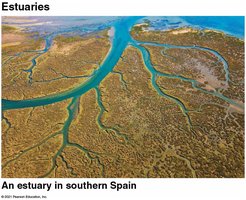
Estuaries | Transition between river and sea, variable salinity | Saltmarsh grasses, fish, birds | Pollution, dredging |
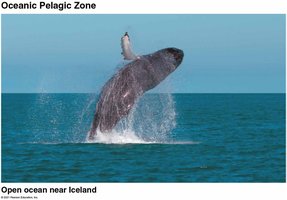
Oceanic Pelagic Zone | Open water, mixed by currents | Phytoplankton, zooplankton, fish | Overfishing, acidification |
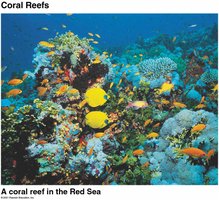
Coral Reefs | Calcium carbonate skeletons, high diversity | Corals, fish, algae | Warming, pollution |
Additional info: This guide covers the foundational concepts of ecology, including the factors influencing species distribution, the structure of ecological research, the impact of climate and disturbance on biomes, and the diversity of terrestrial and aquatic biomes. It is suitable for exam preparation in introductory college biology courses.
