 Back
BackEnergy and Enzymes: Cellular Respiration, Photosynthesis, and Metabolic Pathways
Study Guide - Smart Notes
 Tailored notes based on your materials, expanded with key definitions, examples, and context.
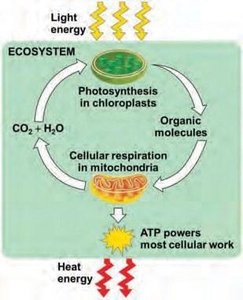
Q1. Using figure 7.2, describe photosynthesis and how it makes the macromolecules that are in your food.
Background
Topic: Photosynthesis and Energy Flow in Ecosystems
This question tests your understanding of how photosynthesis converts light energy into chemical energy, producing organic molecules that serve as the building blocks for macromolecules in food.
Key Terms and Concepts:
Photosynthesis: The process by which plants, algae, and some bacteria convert light energy, carbon dioxide, and water into glucose and oxygen.
Macromolecules: Large molecules such as carbohydrates, proteins, and lipids, which are synthesized from smaller organic molecules.
Chloroplast: The organelle where photosynthesis occurs.
Step-by-Step Guidance
Examine figure 7.2 to identify the flow of energy and matter in an ecosystem. Notice how light energy is captured by chloroplasts during photosynthesis.
Recall the photosynthesis equation: .
Understand that glucose () produced by photosynthesis is used as a starting material for synthesizing macromolecules (such as starch, cellulose, proteins, and lipids).
Consider how these macromolecules are then consumed by organisms as food, providing energy and building blocks for growth.
Try solving on your own before revealing the answer!
Final Answer:
Photosynthesis in chloroplasts uses light energy to convert carbon dioxide and water into glucose and oxygen. The glucose is then used to build macromolecules like carbohydrates, proteins, and lipids, which are found in food.
Q2. Using figure 7.2 again, describe how photosynthesis is related to cellular respiration.
Background
Topic: Relationship Between Photosynthesis and Cellular Respiration
This question tests your ability to connect the processes of photosynthesis and cellular respiration, showing how they form a cycle of energy and matter in ecosystems.
Key Terms and Concepts:
Cellular Respiration: The process by which cells break down glucose to produce ATP, releasing carbon dioxide and water.
Photosynthesis: Produces glucose and oxygen, which are used in cellular respiration.
ATP: The energy currency of the cell.
Step-by-Step Guidance
Look at figure 7.2 and identify the arrows connecting photosynthesis and cellular respiration.
Recall the equation for cellular respiration: .
Notice that the products of photosynthesis (glucose and oxygen) are the reactants for cellular respiration.
Understand that cellular respiration releases energy stored in glucose, producing ATP and releasing carbon dioxide and water, which are then used again in photosynthesis.
Try solving on your own before revealing the answer!
Final Answer:
Photosynthesis produces glucose and oxygen, which are used in cellular respiration to generate ATP. Cellular respiration releases carbon dioxide and water, which are then used in photosynthesis, forming a cycle.
Q3. Describe how metabolic pathways break down macromolecules to get energy (using the word catabolic).
Background
Topic: Catabolic Pathways and Energy Release
This question tests your understanding of how catabolic pathways break down macromolecules to release energy for cellular processes.
Key Terms and Concepts:
Catabolic Pathways: Metabolic pathways that break down molecules into smaller units, releasing energy.
ATP: The main energy carrier in cells.
Macromolecules: Large molecules such as carbohydrates, proteins, and fats.
Step-by-Step Guidance
Recall that catabolic pathways involve the breakdown of macromolecules (like glucose, fatty acids, and amino acids) into smaller molecules.
Understand that these breakdown processes release energy, which is captured in the form of ATP.
Recognize that cellular respiration is a key catabolic pathway, breaking down glucose through glycolysis, the citric acid cycle, and oxidative phosphorylation.
Consider how the energy released is used for cellular work, growth, and maintenance.
Try solving on your own before revealing the answer!
Final Answer:
Catabolic pathways break down macromolecules into smaller molecules, releasing energy that is captured as ATP. This energy is then used for cellular activities.
Q4. Below is the equation for cellular respiration. In the table, list where each component of the reaction comes from.
Background
Topic: Inputs and Outputs of Cellular Respiration
This question tests your ability to identify the sources of reactants and products in the cellular respiration equation.
Key Terms and Concepts:
Cellular Respiration Equation:
Glucose: Comes from food (plants or animals).
Oxygen: Obtained from the atmosphere via breathing.
Carbon Dioxide and Water: Produced as waste products during cellular respiration.
Step-by-Step Guidance
Write out the equation for cellular respiration.
Identify the source of glucose (food, photosynthesis).
Identify the source of oxygen (atmosphere, breathing).
Determine where carbon dioxide and water are produced (mitochondria during cellular respiration).
Try solving on your own before revealing the answer!
Final Answer:
Glucose comes from food, oxygen from the atmosphere, carbon dioxide and water are produced in the mitochondria during cellular respiration.
