 Back
BackEukaryotic Cell Structure: Endomembrane System and Related Organelles
Study Guide - Smart Notes
 Tailored notes based on your materials, expanded with key definitions, examples, and context.
Eukaryotic Cell Structure: The Endomembrane System and Related Organelles
Endoplasmic Reticulum (ER)
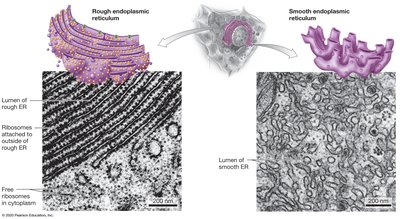
The endoplasmic reticulum (ER) is a network of membranous sacs and tubules within eukaryotic cells, playing a central role in the synthesis, processing, and storage of proteins and lipids. There are two distinct regions: the rough ER (RER) and the smooth ER (SER).
Rough ER (RER): Studded with ribosomes on its cytoplasmic surface, the RER is primarily involved in the synthesis of proteins destined for secretion, insertion into membranes, or lysosomes.
Smooth ER (SER): Lacks ribosomes and is involved in lipid synthesis, detoxification, and calcium ion storage.
Lumen: The internal space of the ER where newly synthesized proteins are folded and modified.
Transport: Proteins and lipids produced in the ER are packaged into vesicles for transport to other organelles, such as the Golgi apparatus.
Example: Secretory proteins like insulin are synthesized in the RER and processed through the endomembrane system.
Golgi Apparatus
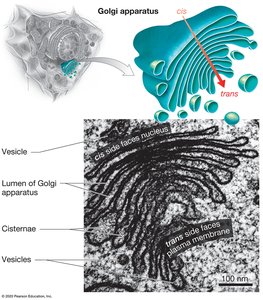
The Golgi apparatus is a series of stacked, flat, membranous sacs called cisternae. It functions as the cell's processing, sorting, and shipping center for proteins and lipids received from the ER.
Structure: Exhibits polarity with a cis face (receiving side, oriented toward the nucleus/ER) and a trans face (shipping side, oriented toward the plasma membrane).
Function: Modifies, sorts, and packages proteins and lipids for delivery to various destinations within or outside the cell.
Vesicular Transport: Membranous vesicles carry materials to and from the Golgi apparatus.
Example: Glycosylation (addition of carbohydrate groups) of proteins occurs in the Golgi before they are sent to their final destinations.
Lysosomes
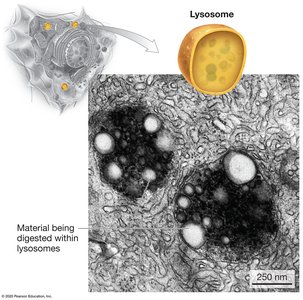
Lysosomes are membrane-bound organelles found only in animal cells, functioning as the cell's recycling centers. They contain about 40 different hydrolytic enzymes specialized for breaking down macromolecules.
Acid Hydrolases: Digestive enzymes that function optimally at acidic pH (~5.0), maintained by proton pumps in the lysosomal membrane.
Function: Degrade and recycle cellular waste, damaged organelles, and macromolecules.
Origin: Acid hydrolases are synthesized in the ER, processed in the Golgi apparatus, and delivered to lysosomes.
Example: Lysosomal storage diseases result from defects in specific hydrolases, leading to accumulation of undigested substrates.
The Endomembrane System
The endomembrane system is a coordinated network of organelles—including the ER, Golgi apparatus, and lysosomes—that produces, processes, and transports proteins, carbohydrates, and lipids throughout the cell.
Pathway Example: Acid hydrolases are synthesized in the ER, processed in the Golgi, and shipped to lysosomes for function.
Integration: Vesicular transport connects these organelles, ensuring efficient intracellular trafficking.
Vacuoles
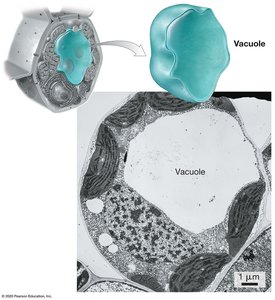
Vacuoles are large, membrane-bound organelles prominent in plant, fungal, and some protist cells. They serve as storage centers and play diverse roles depending on cell type.
Functions:
Storage of water, ions, nutrients, and waste products
Digestion and recycling of macromolecules (analogous to lysosomes in animal cells)
Storage of proteins in seeds
Contain pigments in flower petals and fruits
May store toxic compounds for defense against herbivores
Example: Central vacuole in plant cells maintains turgor pressure, supporting cell structure.
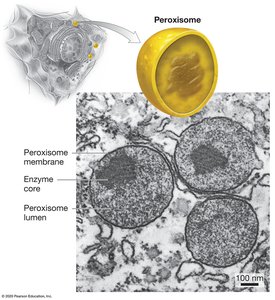
Peroxisomes
Peroxisomes are small, globular organelles found in all eukaryotic cells. They are the site of reduction–oxidation (redox) reactions, particularly those that break down fatty acids and detoxify harmful substances.
Function: Carry out oxidation reactions that often produce hydrogen peroxide (H2O2).
Detoxification: Contain the enzyme catalase, which converts hydrogen peroxide into water and oxygen, preventing cellular damage.
Example: In liver cells, peroxisomes detoxify ethanol and other toxins.
Summary Table: Key Eukaryotic Organelles of the Endomembrane System
Organelle | Main Function(s) | Key Features | Example |
|---|---|---|---|
Rough ER | Protein synthesis and processing | Ribosome-studded, continuous with nuclear envelope | Secretory protein production |
Smooth ER | Lipid synthesis, detoxification, Ca2+ storage | Lacks ribosomes, tubular structure | Steroid hormone synthesis |
Golgi Apparatus | Protein and lipid modification, sorting, shipping | Stacked cisternae, cis/trans polarity | Glycosylation of proteins |
Lysosome | Macromolecule digestion and recycling | Acidic lumen, hydrolytic enzymes | Breakdown of cellular debris |
Vacuole | Storage, digestion, structural support | Large, central in plant cells | Water storage in plant cells |
Peroxisome | Redox reactions, detoxification | Contains catalase, single membrane | Breakdown of fatty acids |
