 Back
BackGene Expression: Basic Mechanisms in Transcription
Study Guide - Smart Notes
 Tailored notes based on your materials, expanded with key definitions, examples, and context.
Gene Expression and Its Importance
Overview of Gene Expression
Gene expression is the process by which the information encoded in a gene is used to direct the synthesis of a functional gene product, typically a protein. This process is fundamental to cellular function, differentiation, and response to environmental signals.
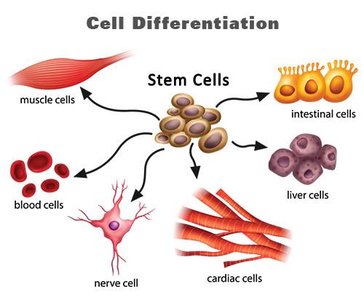
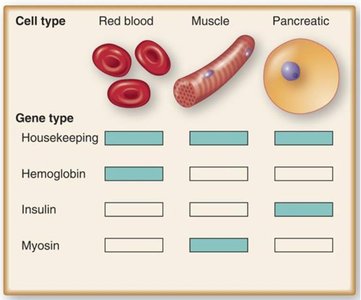
Gene expression determines cell identity and function, as all cells contain the same DNA but express different sets of genes.
Regulation of gene expression is crucial for development, cellular differentiation, and adaptation to environmental changes.
Mis-regulation of gene expression is associated with diseases such as cancer.
Central Dogma of Molecular Biology
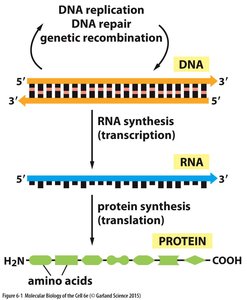
The central dogma describes the flow of genetic information within a biological system: DNA is transcribed into RNA, which is then translated into protein.
Replication: DNA is copied to produce identical DNA molecules.
Transcription: DNA is used as a template to synthesize RNA.
Translation: RNA is used as a template to synthesize proteins.
Regulation of Gene Expression
Control Points in Gene Expression
Gene expression is regulated at multiple levels, but the primary control point is usually the initiation of transcription. This allows cells to efficiently control protein production.
Cells have distinct sets of transcription regulators that can increase or suppress transcription.
In prokaryotes, gene expression is often regulated by nutrient availability.
In eukaryotes, regulation is more complex, involving multiple regulatory proteins and distant regulatory DNA elements.
DNA vs. RNA
Structural Differences
DNA and RNA are nucleic acids with distinct structural and functional properties.
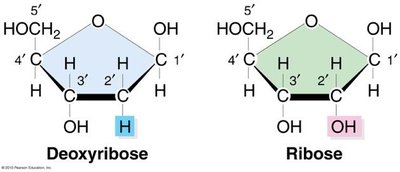
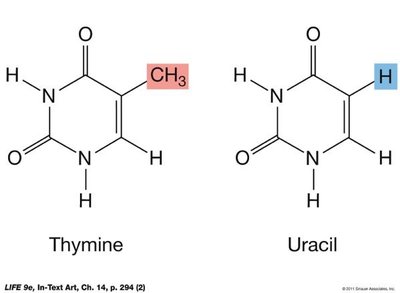
DNA (deoxyribonucleic acid): Double-stranded, contains deoxyribose sugar, and uses thymine (T) as a base.
RNA (ribonucleic acid): Usually single-stranded, contains ribose sugar, and uses uracil (U) instead of thymine.
RNA can fold into complex secondary structures (hairpins, loops) due to internal base pairing.
Types of RNA
There are several types of RNA, each with specific roles in gene expression.
mRNA (messenger RNA): Encodes protein sequences.
tRNA (transfer RNA): Adaptor molecule that brings amino acids to the ribosome during translation.
rRNA (ribosomal RNA): Structural and catalytic component of ribosomes.
snRNA (small nuclear RNA): Involved in RNA processing (splicing).
miRNA (microRNA): Regulates gene expression by inhibiting translation.
Transcription: Synthesis of RNA from DNA
Basic Mechanism
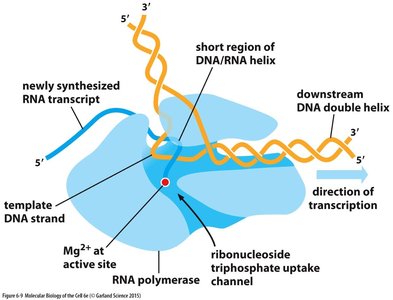
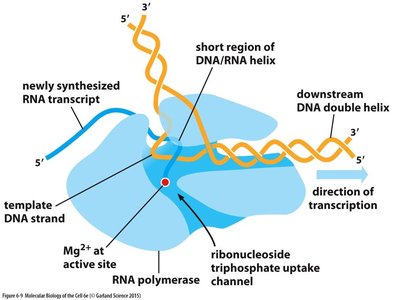
Transcription is the process by which RNA is synthesized from a DNA template. It occurs in three main steps: initiation, elongation, and termination.
RNA is synthesized in the 5' to 3' direction, using nucleoside triphosphates (NTPs) as substrates.
RNA polymerase separates the DNA strands and uses one strand (the template strand) to direct RNA synthesis.
RNA polymerases do not require primers and do not proofread.
Steps of Transcription
Initiation: RNA polymerase binds to the promoter region of DNA, aided by sigma factors (prokaryotes) or transcription factors (eukaryotes). The DNA is unwound to expose the template strand.
Elongation: RNA polymerase moves along the DNA, synthesizing RNA by adding complementary nucleotides to the growing RNA strand.
Termination: Transcription ends when RNA polymerase reaches a termination sequence. The RNA transcript is released from the DNA template.
RNA Polymerases
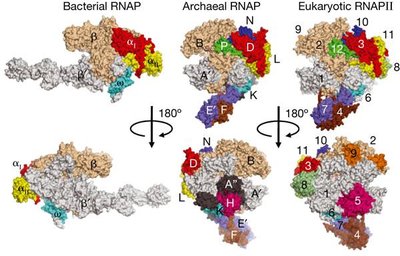
RNA polymerases are enzymes that catalyze the synthesis of RNA from a DNA template. They are structurally conserved across the three domains of life but differ in complexity and subunit composition.
Bacterial RNA polymerase: Simpler, with fewer subunits.
Archaeal RNA polymerase: Intermediate complexity.
Eukaryotic RNA polymerase II: More complex, with multiple subunits and specialized functions.
Three Main Steps of Transcription
Initiation: Recruitment of RNA polymerase to the promoter, unwinding of DNA, and start of RNA synthesis.
Elongation: RNA polymerase moves along the DNA, synthesizing RNA in the 5' to 3' direction.
Termination: RNA polymerase stops transcription at a termination site, releasing the RNA transcript.
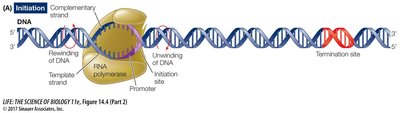
Key Components of Transcription
Promoter: DNA sequence where RNA polymerase binds to initiate transcription.
Template strand: The DNA strand used as a template for RNA synthesis (read 3' to 5').
Nucleoside triphosphates (NTPs): ATP, GTP, CTP, and UTP serve as substrates for RNA synthesis.
RNA polymerase: Enzyme that synthesizes RNA from the DNA template.
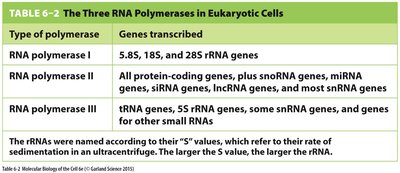
Comparison of RNA Polymerases in Eukaryotes
Type of polymerase | Genes transcribed |
|---|---|
RNA polymerase I | 5.8S, 18S, and 28S rRNA genes |
RNA polymerase II | All protein-coding genes, plus snoRNA, miRNA, siRNA, lncRNA, and most snRNA genes |
RNA polymerase III | tRNA genes, 5S rRNA genes, some snRNA genes, and other small RNAs |
Summary and Key Terms
Central dogma: DNA → RNA → Protein
Transcription: Synthesis of RNA from a DNA template
Promoter: DNA sequence where transcription begins
RNA polymerase: Enzyme that synthesizes RNA
Initiation, elongation, termination: Main steps of transcription
Gene regulation: Control of gene expression at the transcriptional level
Example Question: If an mRNA has the sequence 5’-AUGAAAUCCUAG-3’, what is the template DNA strand for this sequence?
The correct answer is: 5’-CTAGGATTTCAT-3’ (option e), as the template strand is complementary and antiparallel to the mRNA sequence.
Recommended Reading: Life: the Science of Biology, Sadava et al. 11th edition Chapters 14 (14.1-14.4) and 16 (16.2).
