 Back
Gene Expression: From Gene to Protein – Study Notes
Study Guide - Smart Notes
 Tailored notes based on your materials, expanded with key definitions, examples, and context.
Gene Expression: From Gene to Protein
Introduction to Gene Expression
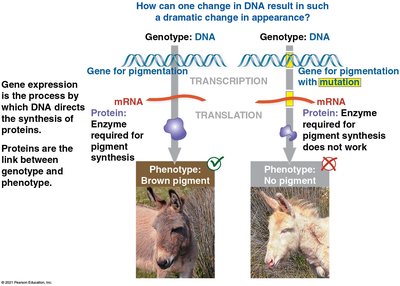
Gene expression is the process by which the information encoded in DNA directs the synthesis of proteins, which are the molecular links between genotype and phenotype. This process involves two main stages: transcription and translation. The study of gene expression reveals how genetic information is converted into functional products, ultimately determining an organism's traits.
Genes and Metabolic Pathways
Historical Evidence: One Gene–One Enzyme Hypothesis
Early research by Archibald Garrod and later by Beadle and Tatum established that genes dictate phenotypes through enzymes that catalyze specific chemical reactions. Their experiments with Neurospora (bread mold) mutants demonstrated that each gene encodes a specific enzyme, leading to the formulation of the one gene–one enzyme hypothesis.
Metabolic pathway: A series of steps in which cells synthesize and degrade molecules.
Nutritional mutants: Mutants unable to survive on minimal media due to the inability to synthesize essential enzymes.

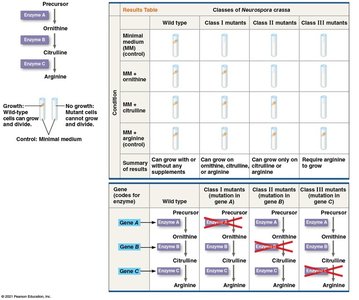
Revision of the Hypothesis: Not all proteins are enzymes, and many proteins are composed of multiple polypeptides, each encoded by a different gene. The hypothesis was updated to the one gene–one polypeptide hypothesis.
Basic Principles of Transcription and Translation
Overview of the Central Dogma
Gene expression involves two key processes:
Transcription: Synthesis of RNA using DNA as a template, producing messenger RNA (mRNA).
Translation: Synthesis of a polypeptide using the information in mRNA, occurring at ribosomes.
In prokaryotes, translation can begin before transcription is complete. In eukaryotes, the nuclear envelope separates these processes, and RNA transcripts undergo processing before translation.
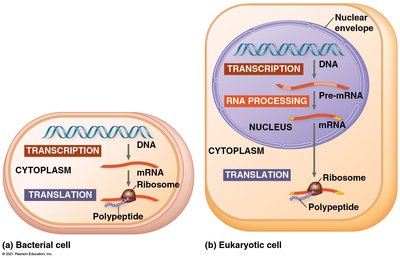
The central dogma of molecular biology describes the flow of genetic information:

The Genetic Code
Codons and the Triplet Code
The genetic code consists of triplets of nucleotides called codons, each specifying an amino acid. There are 64 possible codons, with 61 coding for amino acids and 3 serving as stop signals. The code is redundant but not ambiguous, and codons must be read in the correct reading frame.
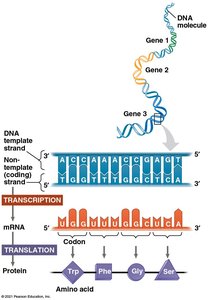

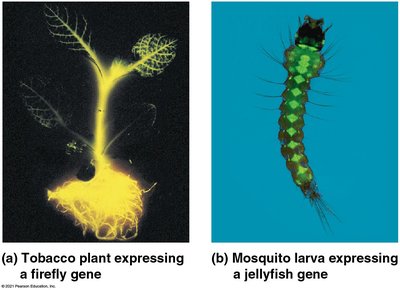
The genetic code is nearly universal, allowing genes from one organism to be expressed in another, as demonstrated by transgenic experiments.
Transcription: DNA-Directed Synthesis of RNA
Molecular Components and Stages
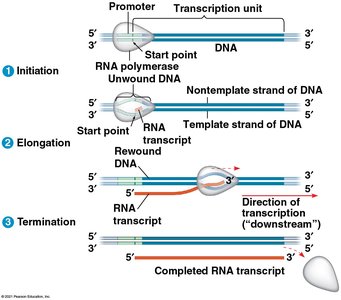
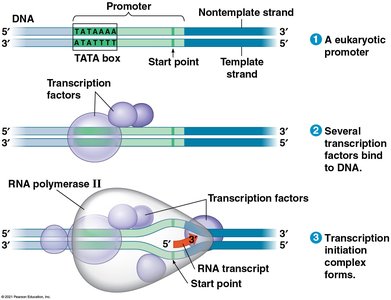
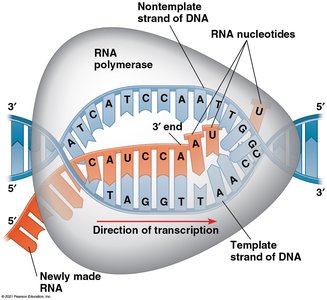
Transcription is catalyzed by RNA polymerase, which binds to the promoter region of DNA and synthesizes RNA complementary to the template strand. The process occurs in three stages:
Initiation: RNA polymerase binds to the promoter, aided by transcription factors in eukaryotes.
Elongation: RNA polymerase moves along the DNA, unwinding it and adding RNA nucleotides to the 3′ end.
Termination: In bacteria, transcription ends at a terminator sequence; in eukaryotes, it ends after the polyadenylation signal sequence.
RNA Processing in Eukaryotes
Modification of mRNA Ends
Eukaryotic pre-mRNA undergoes processing before leaving the nucleus:
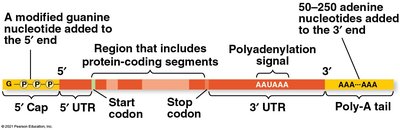
The 5′ end receives a 5′ cap (modified guanine nucleotide).
The 3′ end receives a poly-A tail (50–250 adenine nucleotides).
These modifications facilitate mRNA export, protect it from degradation, and help ribosomes recognize the mRNA.
RNA Splicing
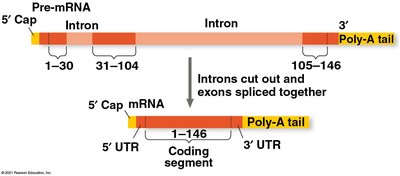
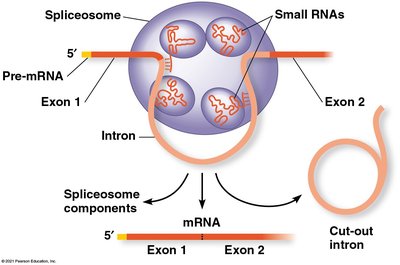
Most eukaryotic genes contain introns (noncoding regions) and exons (coding regions). Introns are removed and exons joined together by spliceosomes, which are complexes of proteins and small RNAs. Some RNA molecules, called ribozymes, can catalyze their own splicing.
Alternative RNA Splicing and Exon Shuffling
Alternative splicing allows a single gene to code for multiple polypeptides by varying which exons are included in the final mRNA. Exon shuffling can create new proteins by mixing exons from different genes, contributing to protein diversity.

Translation: RNA-Directed Synthesis of Polypeptides
Molecular Components of Translation
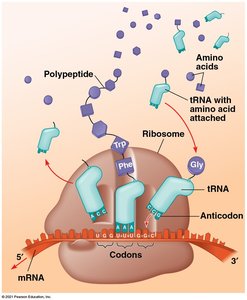
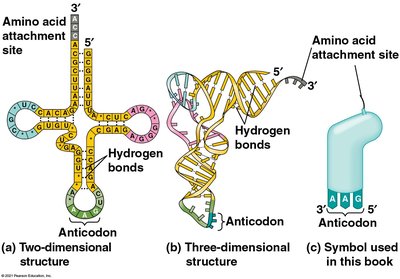
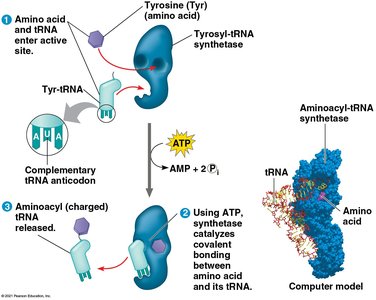
Translation converts the mRNA sequence into a polypeptide with the help of transfer RNA (tRNA) and ribosomes. Each tRNA carries a specific amino acid and has an anticodon that pairs with the corresponding mRNA codon.
Ribosome Structure and Function
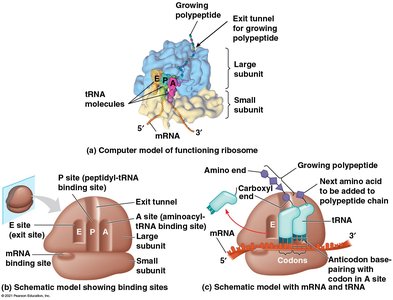
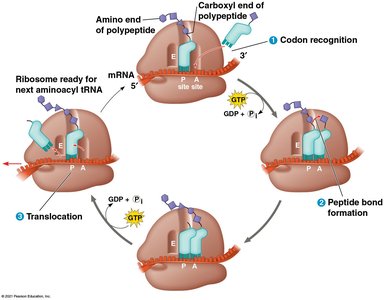
Ribosomes have three binding sites for tRNA:
P site: Holds the tRNA with the growing polypeptide chain.
A site: Holds the tRNA with the next amino acid.
E site: Exit site for discharged tRNAs.
Stages of Translation
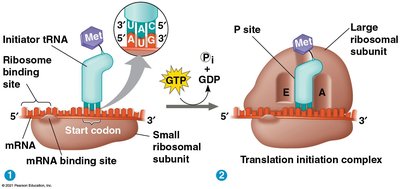
Initiation: The small ribosomal subunit binds to mRNA and initiator tRNA, then the large subunit joins to form the initiation complex.
Elongation: Amino acids are added one by one to the growing chain through codon recognition, peptide bond formation, and translocation.
Termination: When a stop codon is reached, a release factor binds, causing the polypeptide to be released.
Protein Folding and Post-Translational Modifications
Folding and Targeting
Newly synthesized polypeptides fold into their functional three-dimensional shapes. Some undergo post-translational modifications, such as cleavage or the addition of chemical groups. Proteins may be targeted to specific cellular locations by signal peptides and the signal-recognition particle (SRP).
Mutations and Their Effects on Gene Expression
Types of Mutations
Mutations are changes in the genetic material. Point mutations affect a single nucleotide pair and can be classified as:
Substitutions: Replace one nucleotide pair with another. Can be silent, missense, or nonsense mutations.
Insertions and deletions: Add or remove nucleotide pairs, often causing frameshift mutations that alter the reading frame.
Mutations can arise spontaneously or be induced by mutagens, which are physical or chemical agents. Many mutagens are also carcinogens.
Gene Editing: CRISPR-Cas9
The CRISPR-Cas9 system allows precise editing of genes by introducing targeted double-strand breaks, which can be repaired to disrupt or correct genes. This technology has potential for treating genetic diseases but requires caution due to possible off-target effects.
Defining a Gene
The concept of a gene has evolved. A gene is now defined as a region of DNA that can be expressed to produce a final functional product, either a polypeptide or an RNA molecule.
