 Back
Gene Expression: From Gene to Protein (Campbell Biology, Ch. 17) – Study Notes
Study Guide - Smart Notes
 Tailored notes based on your materials, expanded with key definitions, examples, and context.
Gene Expression: From Gene to Protein
Introduction to Gene Expression
Gene expression is the process by which information encoded in DNA directs the synthesis of proteins, ultimately determining an organism’s phenotype. Proteins serve as the link between genotype and phenotype, and gene expression involves two main stages: transcription and translation.
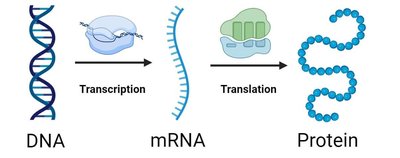
Transcription: Synthesis of RNA using DNA as a template.
Translation: Synthesis of a polypeptide using the information in mRNA.
Gene expression explains how a change in DNA can result in a dramatic change in appearance or function.
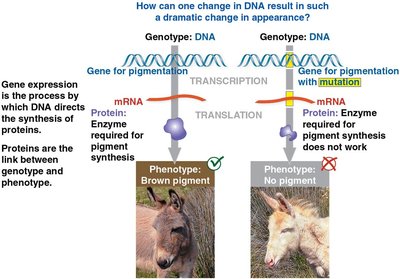
Basic Principles of Transcription and Translation
Overview of the Flow of Genetic Information
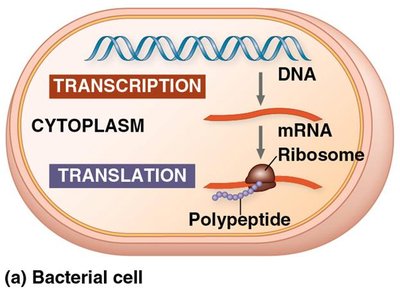
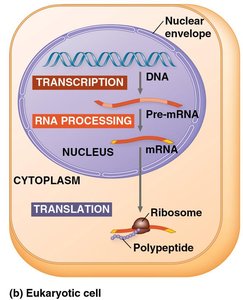
Genetic information flows from DNA to RNA to protein, a concept known as the central dogma of molecular biology. In prokaryotes, transcription and translation occur in the cytoplasm, while in eukaryotes, transcription occurs in the nucleus and translation in the cytoplasm.
mRNA (messenger RNA): Carries genetic information from DNA to the ribosome.
Ribosomes: Sites of protein synthesis (translation).
In eukaryotes, RNA transcripts are processed before translation.

The Genetic Code
Codons: Triplets of Nucleotides
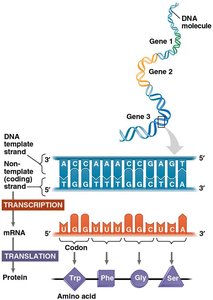
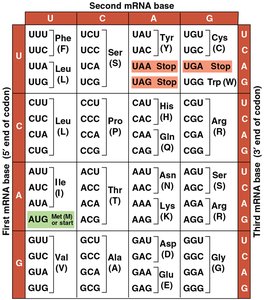
The genetic code is based on a triplet code, where each set of three nucleotides (codon) in mRNA specifies a particular amino acid. There are 64 possible codons, 61 of which code for amino acids and 3 serve as stop signals.
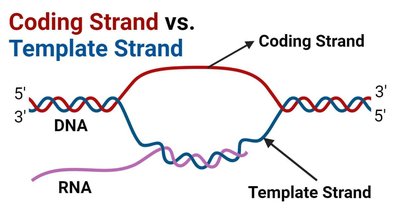
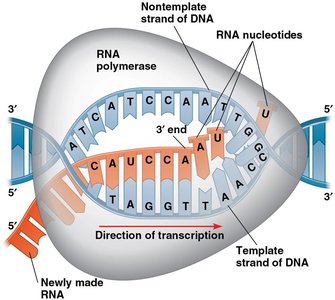
Template strand: The DNA strand used as a template for RNA synthesis.
Coding strand: The DNA strand not used as a template; its sequence matches the mRNA (except T for U).
Codons are read in the 5′ → 3′ direction during translation.
The genetic code is redundant (more than one codon per amino acid) but not ambiguous (each codon specifies only one amino acid).
Evolutionary Conservation of the Genetic Code
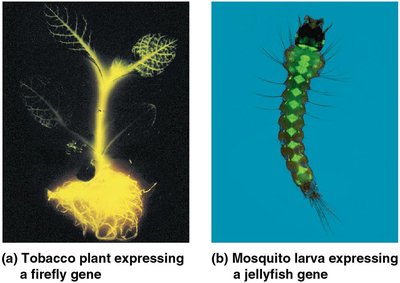
The genetic code is nearly universal, shared by all living organisms, which supports the idea of a common evolutionary origin. Genes from one species can often be expressed in another species.
Transcription: DNA-Directed Synthesis of RNA
Stages of Transcription
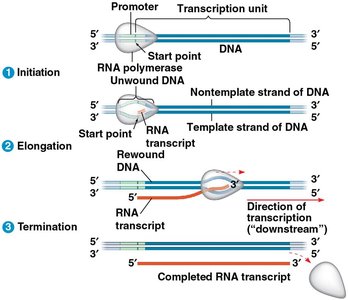
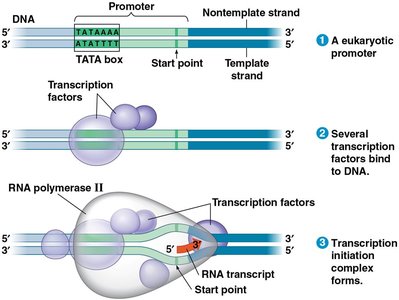
Transcription occurs in three main stages: initiation, elongation, and termination. RNA polymerase catalyzes the synthesis of RNA, using one DNA strand as a template.
Initiation: RNA polymerase binds to the promoter region of DNA, aided by transcription factors in eukaryotes.
Elongation: RNA polymerase moves along the DNA, unwinding it and synthesizing RNA in the 5′ → 3′ direction.
Termination: In bacteria, transcription ends at a terminator sequence; in eukaryotes, it ends after a polyadenylation signal sequence.
RNA Processing in Eukaryotes
Modification of mRNA Ends
Before mRNA leaves the nucleus, it undergoes processing:
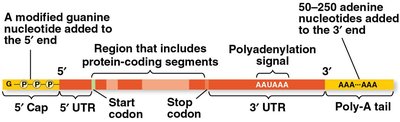
5′ cap: A modified guanine nucleotide added to the 5′ end.
Poly-A tail: 50–250 adenine nucleotides added to the 3′ end.
These modifications facilitate export, protect mRNA, and help ribosome binding.
RNA Splicing
Most eukaryotic genes contain noncoding regions (introns) that are removed by RNA splicing, leaving only coding regions (exons) to be joined together. Alternative RNA splicing allows a single gene to code for multiple proteins.
Introns: Noncoding sequences removed from pre-mRNA.
Exons: Coding sequences that remain in mRNA.
Spliceosome: Complex responsible for RNA splicing.
Translation: RNA-Directed Synthesis of Polypeptides
Molecular Components of Translation
Translation converts the genetic information in mRNA into a specific sequence of amino acids, forming a polypeptide. This process requires tRNA, ribosomes, and various protein factors.
tRNA (transfer RNA): Brings amino acids to the ribosome and matches them to the mRNA codon via its anticodon.
Aminoacyl-tRNA synthetase: Enzyme that attaches the correct amino acid to its tRNA.
Ribosome: Composed of rRNA and proteins; has three binding sites (A, P, E) for tRNA.
Stages of Translation
Initiation: Small ribosomal subunit binds mRNA and initiator tRNA; large subunit joins to form the initiation complex.
Elongation: Amino acids are added one by one to the growing chain through codon recognition, peptide bond formation, and translocation.
Termination: Occurs when a stop codon is reached; a release factor binds, releasing the polypeptide.
Protein Folding and Post-Translational Modifications
Newly synthesized polypeptides fold into their functional three-dimensional shapes. Some undergo further modifications or are targeted to specific cellular locations.
Making Multiple Polypeptides
Polyribosomes and Coupling of Transcription and Translation
Multiple ribosomes can translate a single mRNA simultaneously, forming a polyribosome. In bacteria, transcription and translation are coupled, allowing rapid protein synthesis. In eukaryotes, these processes are separated by the nuclear envelope.
Mutations and Their Effects on Protein Structure and Function
Types of Mutations
Mutations are changes in the genetic material. Point mutations affect a single nucleotide pair and can be classified as:
Silent mutations: No effect on the amino acid sequence.
Missense mutations: Change one amino acid to another.
Nonsense mutations: Change an amino acid codon to a stop codon, leading to a truncated protein.
Insertions and deletions: Addition or loss of nucleotide pairs, often causing frameshift mutations that alter the reading frame.
Mutagens
Mutations can occur spontaneously or be induced by mutagens, which are physical or chemical agents that cause changes in DNA. Many mutagens are also carcinogens.
Defining a Gene
The modern definition of a gene is a region of DNA that can be expressed to produce a final functional product, either a polypeptide or an RNA molecule.
Summary Table: Key Differences in Gene Expression
Feature | Prokaryotes | Eukaryotes |
|---|---|---|
Location of Transcription | Cytoplasm | Nucleus |
RNA Processing | Absent | Present (5′ cap, poly-A tail, splicing) |
Coupling of Transcription & Translation | Yes | No |
Polyribosomes | Yes | Yes |
Additional info: This summary integrates textbook content, figures, and academic context to provide a comprehensive overview of gene expression, suitable for college-level biology students.
