 Back
Backlec 26
Study Guide - Smart Notes
 Tailored notes based on your materials, expanded with key definitions, examples, and context.
Gene Flow and Migration
Introduction to Gene Flow
Gene flow is a fundamental evolutionary process that involves the transfer of alleles from one population to another. It can occur through various mechanisms, including the migration of individuals, movement of gametes, or even the transfer of organellar elements. Gene flow plays a critical role in shaping genetic diversity and population structure.
Gene Flow: The movement of alleles between populations, which can alter allele frequencies and reduce genetic differentiation.
Migration: The physical movement of individuals between populations, which may or may not result in gene flow depending on reproductive success.
Applications: Understanding gene flow is essential for conservation biology, phylogeography, and the study of speciation.
Mathematical Models of Gene Flow
One-Island Migration Model
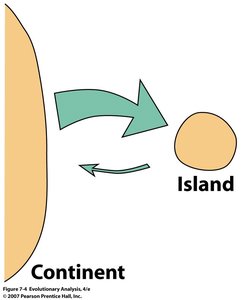
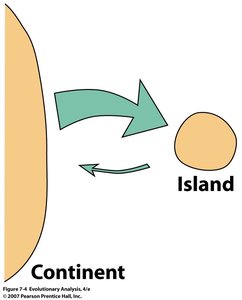
This model considers two populations: a large continental population and a smaller island population. It describes how allele frequencies change on the island due to migration from the continent.
Key Equation: The change in allele frequency on the island is given by:
Where p_I is the allele frequency on the island, p_C is the allele frequency on the continent, and m is the proportion of migrants in the island population each generation.
The change in allele frequency is:
Gene flow causes allele frequencies on the island to approach those of the continent over time.
n-Island and Stepping-Stone Models
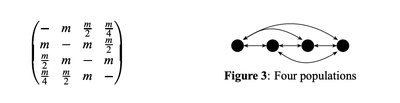
More complex models consider multiple populations exchanging migrants.
n-Island Model: All subpopulations are equal in size and exchange migrants at equal rates.
Key Equation: , where N is the population size and m is the migration rate.
Stepping-Stone Model: Gene flow occurs primarily between neighboring populations, with migration rates scaled by distance.
Measuring and Inferring Gene Flow
FST and Genetic Differentiation
FST is a statistic that measures genetic differentiation among populations. It is influenced by gene flow, genetic drift, and population structure.
Interpretation: Low FST values indicate high gene flow and little differentiation; high values indicate restricted gene flow.
Equation: (for the infinite island model and neutral alleles).
Genealogy-Based Methods
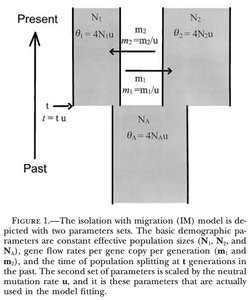
Modern approaches use multilocus genetic data and statistical models to estimate migration rates, population sizes, and divergence times.
Isolation with Migration (IM) Models: Estimate demographic parameters using likelihood or Bayesian methods.
Migrate-n: Uses Markov Chain Monte Carlo (MCMC) to sample parameter space and estimate migration rates.
Landscape Genomics and Resistance
Landscape Features and Gene Flow
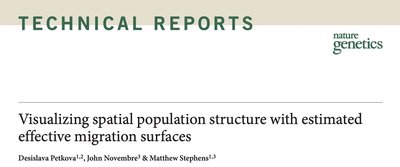
Landscape genomics integrates geographic information systems (GIS) with genetic data to assess how landscape features influence gene flow.
Resistance Surfaces: Maps that quantify how different landscape features (e.g., roads, elevation, habitat quality) impede or facilitate dispersal.
Isolation by Resistance: Genetic differentiation increases with landscape resistance to movement.
Founder Effect and Genetic Diversity
Founder Effect
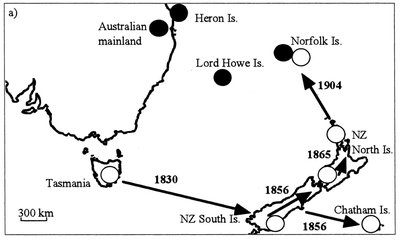
The founder effect occurs when a new population is established by a small number of individuals, leading to reduced genetic diversity and potentially rapid evolutionary change.
Genetic Consequences: Reduced heterozygosity and allelic diversity, increased genetic drift.
Example: Island-colonizing birds often show sequential founder events, with each new population having less genetic diversity than the source.


Spatial Sorting Effect
Evolution at Expanding Range Edges
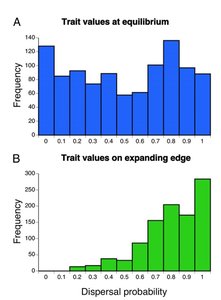
Spatial sorting is an evolutionary process where traits that enhance dispersal accumulate at the expanding edge of a population's range, independent of natural selection.
Key Concept: Individuals with higher dispersal ability are more likely to colonize new areas, leading to non-random spatial distribution of traits.
Example: Range expansions in invasive species often show increased dispersal traits at the leading edge.
Evolutionary Role of Gene Flow
Shifting Balance Theory (Sewall Wright)
Sewall Wright's shifting balance theory proposes that evolution is most effective in large populations subdivided into partially isolated groups. Genetic drift, selection, gene flow, and demographic changes interact to promote adaptive evolution.
Adaptive Landscape: Populations explore different adaptive peaks through drift and selection; successful adaptations can spread via gene flow.
Forces Affecting Heterozygosity
Decreasing Heterozygosity
Self-fertilization: Increases homozygosity over time.
Non-random Mating: Inbreeding reduces heterozygosity; calculated as , where F is the inbreeding coefficient.
Population Structure: The Wahlund effect leads to excess homozygosity in structured populations.
Purifying Selection: Removes non-adaptive alleles introduced by migration or mutation.
Directional Selection: Favors one allele, reducing genetic diversity.
Genetic Drift: More effective in small populations, leading to fixation or loss of alleles.
Increasing Heterozygosity
Mutation: Introduces new alleles, increasing diversity.
Balancing Selection: Favors heterozygotes (overdominance).
Outbreeding: Increases heterozygosity and can reverse inbreeding depression.
Gene Flow: Introduces new alleles from other populations, increasing genetic diversity.
Key Equation for Gene Flow:
At equilibrium, , and allele frequencies on the island and continent become equivalent.
