 Back
BackGenetics and Inheritance Patterns: Study Guidance
Study Guide - Smart Notes
 Tailored notes based on your materials, expanded with key definitions, examples, and context.
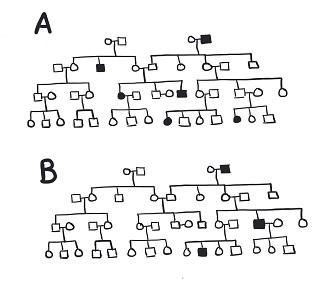
Q6. The two pedigrees above show the inheritance of a condition in a family. Squares represent XY males; circles represent XX females. Shaded individuals have the condition; unshaded individuals do not. Carriers (if any) are not indicated. The condition shown in pedigree A is most likely caused by ______. The condition shown in pedigree B is most likely caused by ______.
Background
Topic: Patterns of Inheritance and Pedigree Analysis
This question tests your ability to interpret pedigrees and determine the mode of inheritance (autosomal dominant, autosomal recessive, X-linked, etc.) based on how a trait appears in a family tree.
Key Terms and Concepts:
Pedigree: A diagram showing the occurrence of phenotypes (and sometimes genotypes) across generations in a family.
Autosomal Recessive: Trait appears only when an individual has two copies of the recessive allele; often skips generations.
X-linked Recessive: Trait is more common in males; affected males often have carrier mothers; can skip generations.
Carrier: An individual who has one copy of a recessive allele but does not show the trait.
Step-by-Step Guidance
Examine pedigree A. Look for patterns such as whether the trait appears in both males and females, and whether it skips generations. Traits that skip generations and appear in both sexes are often autosomal recessive.
Check if unaffected parents can have affected children in pedigree A. If so, this supports autosomal recessive inheritance.
Examine pedigree B. Notice if the trait appears more frequently in males and if affected males are born to unaffected mothers. This pattern is typical of X-linked recessive inheritance.
Consider whether affected females are rare or absent in pedigree B, which is another clue for X-linked recessive traits.
Try solving on your own before revealing the answer!
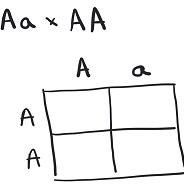
Q9. An animal has the genotype Aa. When they pass on their alleles to offspring, they can pass on one or the other of their alleles. We can represent this using a Punnett square. What is the reason that only one of the parent's 2 alleles is passed on to an offspring?
Background
Topic: Mendelian Genetics and Meiosis
This question is about how alleles segregate during gamete formation and why offspring inherit only one allele from each parent for a given gene.
Key Terms and Concepts:
Allele: Different forms of a gene.
Meiosis: The process by which gametes (sperm and egg cells) are formed, reducing the chromosome number by half.
Punnett Square: A diagram used to predict the outcome of a genetic cross.
Law of Segregation: Mendel's principle stating that the two alleles for a gene separate during gamete formation.
Step-by-Step Guidance
Recall that each parent has two alleles for each gene, but gametes (sperm or egg) only get one allele for each gene.
Understand that meiosis is the process that reduces the chromosome number by half, ensuring that gametes have only one allele for each gene.
During fertilization, the offspring receives one allele from each parent, restoring the diploid number.
Use the Punnett square to visualize how alleles segregate and combine in the offspring.
Try solving on your own before revealing the answer!
