 Back
BackGenetics, Meiosis, and Mendelian Inheritance: Step-by-Step Study Guidance
Study Guide - Smart Notes
 Tailored notes based on your materials, expanded with key definitions, examples, and context.
Q2. Which combination of alleles is least likely to be found following crossing over, assuming that crossing over occurs randomly?
Background
Topic: Genetic Recombination and Crossing Over
This question tests your understanding of how crossing over during meiosis can create new combinations of alleles on homologous chromosomes, and how the physical distance between genes affects the likelihood of recombination between them.
Key Terms and Concepts:
Homologous chromosomes: Chromosome pairs, one from each parent, that are similar in length, gene position, and centromere location.
Alleles: Different versions of a gene found at the same locus on homologous chromosomes.
Crossing over: The exchange of genetic material between non-sister chromatids of homologous chromosomes during prophase I of meiosis.
Genetic linkage: Genes that are close together on the same chromosome tend to be inherited together because crossing over between them is rare.
Step-by-Step Guidance
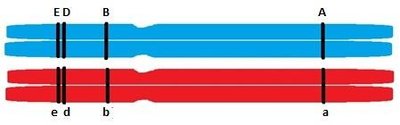
Examine the diagram of homologous chromosomes. Identify the arrangement of alleles on each chromatid (e.g., blue: A, B, D, E; red: a, b, d, e).
Recall that crossing over can swap segments between chromatids, creating new combinations of alleles. The closer two genes are, the less likely a crossover will occur between them.
Consider the physical distance between the genes. Which alleles are closest together? (For example, D and E are very close.)
Think about which recombinant combinations would require a crossover between the closest genes. These combinations are least likely to occur.
Try solving on your own before revealing the answer!
Final Answer: A, B, D, e
This combination would require a crossover between the D and E genes, which are very close together. Because the likelihood of crossing over between closely linked genes is low, this recombinant genotype is least likely to be found.
Q4. Plant and Animal Life Cycles: Identifying Ploidy and Meiosis
Background
Topic: Life Cycles and Alternation of Generations
This question asks you to analyze diagrams of plant and animal life cycles, identify which stages are diploid (2N) or haploid (1N), and determine where meiosis occurs in each cycle.
Key Terms and Concepts:
Diploid (2N): Cells with two sets of chromosomes (one from each parent).
Haploid (1N): Cells with one set of chromosomes.
Meiosis: Cell division that reduces chromosome number by half, producing haploid gametes or spores.
Sporophyte: The diploid generation in plants that produces spores by meiosis.
Gametophyte: The haploid generation in plants that produces gametes by mitosis.
Step-by-Step Guidance
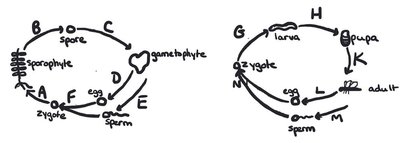
Identify the stages in the plant life cycle diagram. Label each as diploid (2N) or haploid (1N) based on whether they arise from fertilization (diploid) or meiosis (haploid).
Do the same for the animal life cycle diagram. Remember that in animals, most stages are diploid except for gametes (egg and sperm).
Locate the arrows labeled with letters. Determine which arrows represent meiosis (reduction from diploid to haploid) in each cycle.
Match the stages and arrows to the correct ploidy and process for both plant and animal cycles.
Try solving on your own before revealing the answer!
Final Answer:
Plant diploid stages: zygote and sporophyte
Plant haploid stages: spore, gametophyte, egg, sperm
Animal diploid stages: zygote, larva, pupa, adult
Animal haploid stages: egg, sperm
Meiosis in plant: arrow B
Meiosis in animal: arrows L and M
These answers reflect the alternation of generations in plants and the typical animal life cycle, as well as the specific points where meiosis occurs.
Q14. Predicting Genotype and Phenotype Frequencies in Dog Crosses
Background
Topic: Mendelian Genetics and Punnett Squares
This question asks you to predict the expected genotype and phenotype ratios in the offspring of two dog crosses, using your understanding of dominant and recessive alleles.
Key Terms and Concepts:
Genotype: The genetic makeup of an organism (e.g., BB, Bb, bb).
Phenotype: The observable traits (e.g., black or brown fur).
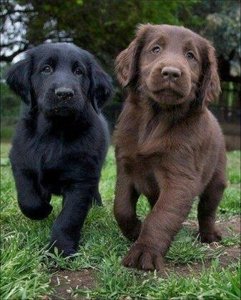
Dominant allele: Expressed in the phenotype even if only one copy is present (B = black).
Recessive allele: Only expressed when two copies are present (b = brown).
Punnett square: A tool to predict the probability of offspring genotypes and phenotypes from parental crosses.
Step-by-Step Guidance
For a Bb x Bb cross, set up a Punnett square with B and b alleles from each parent. Fill in the possible combinations for the offspring.
Count the number of each genotype (BB, Bb, bb) and calculate their frequencies.
Determine the phenotype for each genotype (BB and Bb = black, bb = brown) and calculate the phenotype frequencies.
Repeat the process for a Bb x bb cross. Set up the Punnett square, fill in the combinations, and determine genotype and phenotype frequencies.
Try solving on your own before revealing the answer!
Final Answer:
Bb x Bb cross: Genotype ratio = 1/4 BB : 1/2 Bb : 1/4 bb; Phenotype ratio = 3/4 black : 1/4 brown
Bb x bb cross: Genotype ratio = 1/2 Bb : 1/2 bb; Phenotype ratio = 1/2 black : 1/2 brown
These ratios are predicted by Mendelian inheritance for a single gene with two alleles, where black is dominant to brown.
Q15. Probability of Offspring Phenotypes in Beetle Crosses
Background
Topic: Dihybrid Crosses and Probability
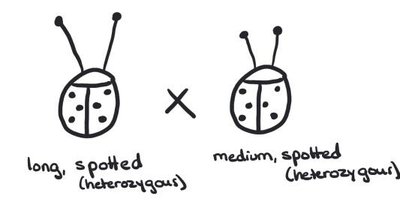
This question involves predicting the probability of specific trait combinations in beetle offspring, using Punnett squares for two unlinked genes (antenna length and presence of dots).
Key Terms and Concepts:
Dihybrid cross: A cross between individuals heterozygous for two traits.
Genotype: The genetic makeup for each trait (e.g., AaDd, AADd).
Punnett square: Used to determine the probability of each genotype and phenotype combination in the offspring.
Probability: The chance of a particular outcome, calculated by multiplying the probabilities of independent events.
Step-by-Step Guidance
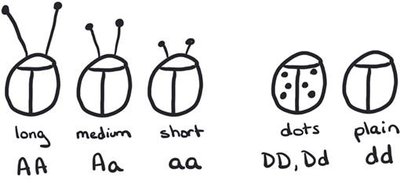
Identify the genotypes of the parents based on the phenotypes and the information given (e.g., medium antennae = Aa, heterozygous for dots = Dd).
Set up Punnett squares for each trait separately (antenna length and dots) or a combined Punnett square for both traits.
Calculate the probability of each genotype and phenotype for the offspring by multiplying the probabilities for each trait (if using separate Punnett squares).
Determine the probability of offspring with specific combinations (e.g., long antennae and dots; medium antennae and plain).
Try solving on your own before revealing the answer!
Final Answer:
Parent 1: AaDd; Parent 2: AADd
Probability of long antennae and dots: 3/8
Probability of medium antennae and plain: 1/8
These probabilities are found by setting up Punnett squares and multiplying the probabilities for each independent trait.
