 Back
BackHow Cells Harvest Chemical Energy: Muscle Fiber Types, Redox Reactions, and Cellular Respiration
Study Guide - Smart Notes
 Tailored notes based on your materials, expanded with key definitions, examples, and context.
How Cells Harvest Chemical Energy
Muscle Fiber Types and Athletic Performance
Human muscles contain two main types of muscle fibers—slow muscle fibers and fast muscle fibers. The proportion of these fibers varies between individuals and muscles, influencing athletic capabilities such as endurance and sprinting. These differences are largely genetically determined and cannot be fundamentally changed by training.
Slow Muscle Fibers ("slow-twitch" fibers): Specialized for endurance activities (e.g., long-distance running). They use aerobic respiration, have many mitochondria, and contain high levels of myoglobin, giving them a reddish color. Example: "dark meat" in turkey legs.
Fast Muscle Fibers ("fast-twitch" fibers): Adapted for short bursts of intense activity (e.g., sprinting, weight lifting). They use anaerobic respiration, have fewer mitochondria, and less myoglobin, making them pale. Example: "white meat" in turkey breast. They produce lactate, which can cause muscle fatigue.
Genetic Determination: Most marathon runners have a higher percentage of slow fibers, while sprinters have more fast fibers. Training cannot usually convert one fiber type into another.

Energy Use in the Human Body
The human body relies on ATP for all activities. The amount of energy consumed varies greatly depending on the activity performed. The following table summarizes the energy expenditure for various activities in a 67.5-kg (150-lb) person:
Activity | Kcal Consumed per Hour |
|---|---|
Bicycling (racing) | 514 |
Bicycling (slowly) | 170 |
Dancing (slow) | 202 |
Dancing (fast) | 599 |
Eating | 28 |
Gymnastics | 186 |
Laboratory work | 73 |
Running (7 min/mi) | 865 |
Sitting (writing) | 28 |
Sleeping or lying still | 20 |
Standing (relaxed) | 32 |
Swimming (2 mph) | 535 |
Walking (3 mph) | 135 |
Walking (4 mph) | 231 |
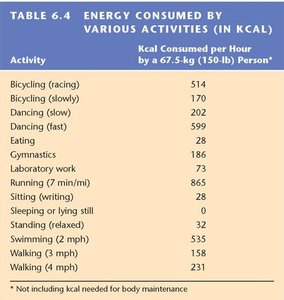
Additional info: The table does not include the energy required for basic body maintenance (basal metabolic rate).
Catabolic Pathways and Cellular Respiration
Overview of Catabolic Pathways
Catabolic pathways break down glucose and other organic fuels, releasing energy stored in their chemical bonds. This energy is captured in the form of ATP, which powers cellular activities. Cellular respiration is a key catabolic pathway in cells.
Cellular Respiration: Involves the transfer of hydrogen from glucose to oxygen through a series of enzyme-catalyzed steps.
Net Reaction for Respiration:
Oxidation: Loss of hydrogen atoms (and electrons) from glucose.
Reduction: Gain of hydrogen atoms (and electrons) by oxygen.
Redox Reactions
Oxidation-reduction (redox) reactions involve the transfer of electrons from one substance to another. These reactions are fundamental to energy transfer in biological systems.
Oxidation: Loss of electrons from a substance.
Reduction: Gain of electrons by a substance.
Acronym: OIL RIG (Oxidation Is Loss, Reduction Is Gain of electrons).
Ionic Bonds and Redox
In ionic bonds, electrons are completely transferred from one atom to another. For example, in the formation of table salt (NaCl):
Sodium (Na) loses an electron (is oxidized).
Chlorine (Cl) gains an electron (is reduced).
Reducing and Oxidizing Agents
Reducing Agent: The electron donor in a redox reaction (gets oxidized).
Oxidizing Agent: The electron acceptor in a redox reaction (gets reduced).
Oxidation and reduction always occur together because electron transfer requires both a donor and an acceptor.
Covalent Bonds and Redox
In redox reactions involving covalent bonds, electrons are not completely transferred but the degree of electron sharing changes. For example, in the reaction between methane and oxygen:
Methane (CH4) has slightly polar bonds due to differences in electronegativity between carbon and hydrogen.
When methane reacts with oxygen, electrons in the new bonds are drawn closer to oxygen, so oxygen is reduced.
Redox Reactions in Organic Molecules
Organic molecules rich in hydrogen are excellent fuels because their bonds contain high-energy electrons. During respiration, these electrons "fall" down an energy gradient to oxygen, releasing energy that is captured as ATP.
Each electron transfer is usually accompanied by a proton (H+), so hydrogen atoms are transferred.
Enzymes lower the activation energy barrier, allowing glucose to be oxidized gradually in a series of steps.
Additional info: Without the activation energy barrier, glucose would react explosively with oxygen. Enzymes ensure controlled energy release for cellular work.
