 Back
BackHow Genes Work: From DNA to Protein and the Impact of Mutations
Study Guide - Smart Notes
 Tailored notes based on your materials, expanded with key definitions, examples, and context.
How Genes Work
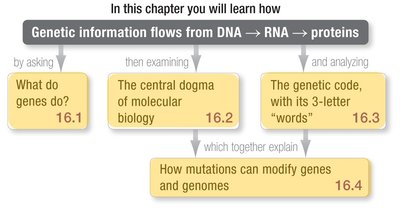
I. What Do Genes Do? (16.1)
Genes are fundamental units of heredity that carry instructions for building proteins, which are essential for cellular structure and function. The "one-gene, one-enzyme" hypothesis, developed through experiments with Neurospora and loss-of-function alleles, established that each gene typically encodes a single enzyme or protein.
Genes carry information about how to build a protein.
One-gene, one-enzyme hypothesis: Each gene encodes a specific enzyme, demonstrated by mutagenesis and knockout experiments.
Loss-of-function alleles: Disrupting a gene and observing the resulting phenotype reveals its function.
Example: Neurospora experiments showed that mutations in specific genes led to loss of enzyme activity.
II. The Central Dogma (16.2)
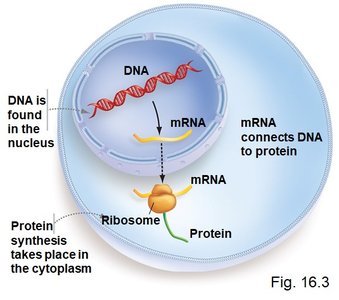
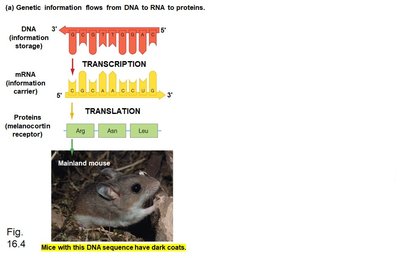
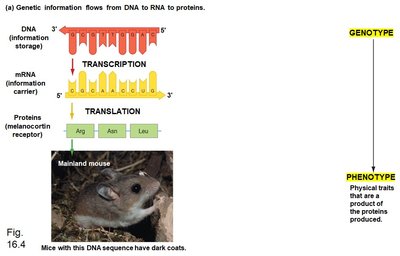
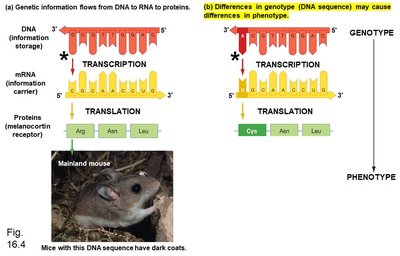
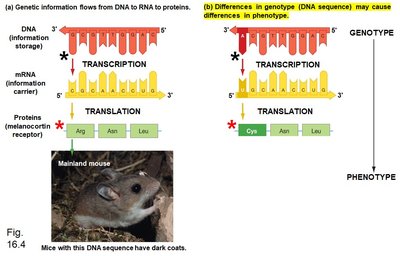
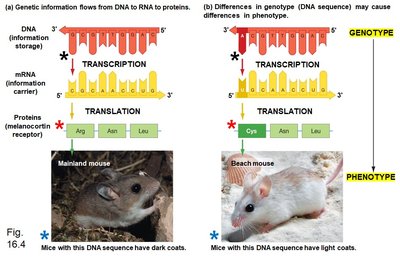
The central dogma of molecular biology describes the flow of genetic information: DNA is transcribed into RNA, which is then translated into protein. This process connects genotype (genetic makeup) to phenotype (observable traits).
Dogma vs. Paradigm: Dogma is an authoritative principle; paradigm is a model or example.
Genetic code hypothesis: DNA stores information as a sequence of nucleotides, analogous to Morse code.
DNA → RNA → Protein: Messenger RNA (mRNA) acts as an intermediary, carrying genetic information from DNA to the ribosome for protein synthesis.
Transcription: DNA is copied into mRNA.
Translation: mRNA is decoded to build a protein.
Genotype to phenotype: The sequence of DNA determines the sequence of amino acids in proteins, which influences traits.
Example: Coat color in mice is determined by alleles of the melanocortin receptor gene.
Exceptions: Some genes code for RNAs that are not translated; reverse transcriptase can produce DNA from RNA; environmental factors can influence phenotype.
III. The Genetic Code (16.3)
The genetic code is the set of rules by which information encoded in DNA and RNA is translated into proteins. Each "word" or codon consists of three nucleotides, and the code is read in triplets without overlap.
Codon: A sequence of three nucleotides that specifies an amino acid.
Triplet hypothesis: Experiments showed that adding or deleting one or two nucleotides causes a frameshift, disrupting the reading frame.
Translation: Each codon is associated with a specific amino acid. The start codon (AUG) initiates translation, and three stop codons signal termination.
Reading frame: The code is read as sequential triplets, starting from the first AUG.
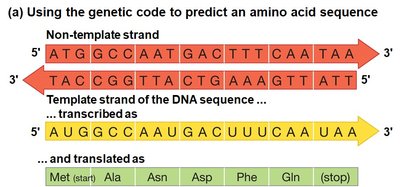
Example: Predicting amino acid sequence from DNA using the genetic code.
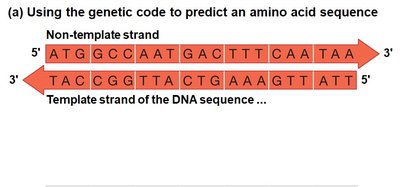
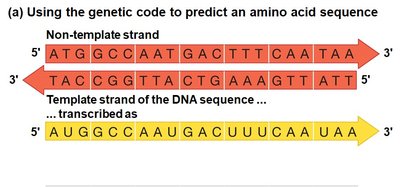
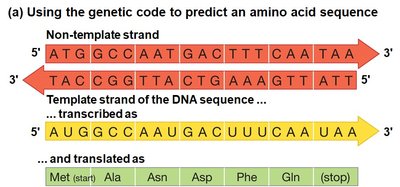
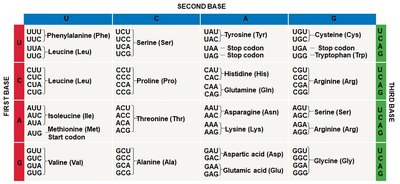
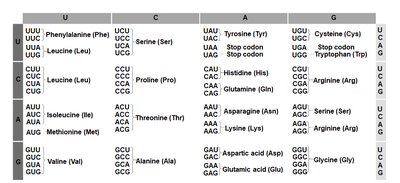
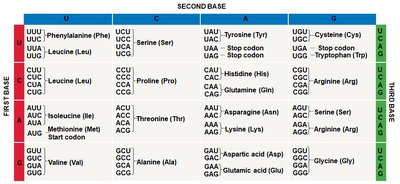
Analysis of the code:
The code is redundant: multiple codons can specify the same amino acid.
The code is unambiguous: each codon specifies only one amino acid.
The code is not overlapping: codons are read in sequence, not overlapping.
The code is nearly universal: codons specify the same amino acids in almost all species.
The code is conservative: when multiple codons specify the same amino acid, the first two bases are usually the same.
Value of knowing the code: If the gene sequence is known, the mRNA and protein sequence can be predicted, and vice versa.
IV. Types and Consequences of Mutation (16.4)
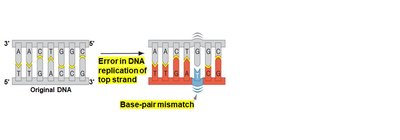
Mutations are changes in the DNA sequence that can affect gene function and phenotype. They can occur at the level of individual nucleotides (point mutations) or larger chromosomal segments.
Point mutation: Change in a single nucleotide.
Silent mutation: Does not alter the amino acid sequence; effect is neutral.
Missense mutation: Results in amino acid substitution; effect can be beneficial, deleterious, or neutral.
Nonsense mutation: Creates a new stop codon, truncating the protein; usually deleterious.
Frameshift mutation: Addition or deletion of 1-2 nucleotides causes a shift in the reading frame, often severely altering the protein; almost always deleterious.
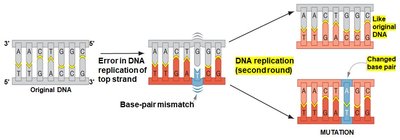
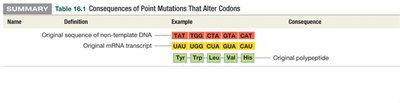



Mutation in non-coding sequences: These regions do not code for proteins, but mutations can affect gene expression and phenotype.
Chromosome mutations:
Inversion: Segment breaks out, flips, and rejoins the chromosome.
Translocation: Segment breaks away and attaches to a different chromosome.
Deletion: Loss of a chromosome segment.
Duplication: Segment of a chromosome is duplicated.
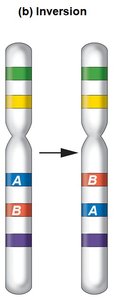
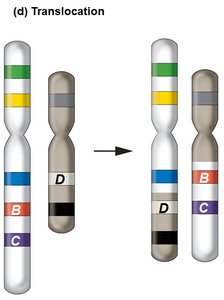
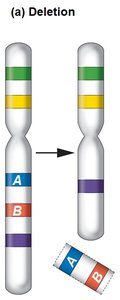
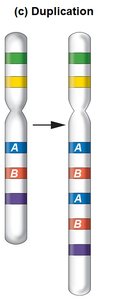
Potential impacts of mutated sequences:
Beneficial (rare)
Neutral (most common)
Deleterious (common)
Example: Chromosome mutations can lead to cancer, as seen in abnormal karyotypes.
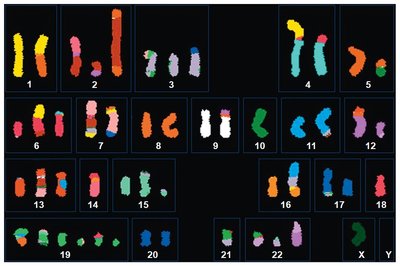
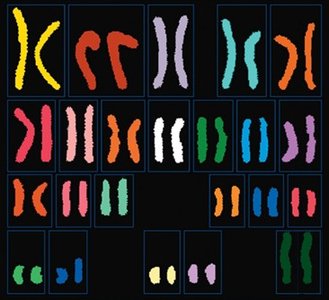
Additional info:
Mutations are a source of genetic variation, which is essential for evolution and adaptation.
Natural selection acts on phenotypes, which are influenced by gene expression and mutations.
