 Back
BackHow Genes Work: From DNA to Protein and the Genetic Code
Study Guide - Smart Notes
 Tailored notes based on your materials, expanded with key definitions, examples, and context.
How Genes Work
Genes: Definition and Function
Genes are units of genetic information composed of DNA that carry instructions for building polypeptides (proteins) or functional RNA molecules, along with regulatory sequences that control their expression. Genes are fundamental to heredity and cellular function.
Gene: A segment of DNA that encodes information for the synthesis of a specific protein or functional RNA.
Regulatory sequences: DNA regions that control when and where genes are expressed.
Gene Expression
Gene expression is the process by which the information encoded in a gene is used to direct the synthesis of a functional gene product, typically a protein or RNA molecule. This process involves two main steps: transcription and translation.
Transcription: The synthesis of messenger RNA (mRNA) from a DNA template.
Translation: The synthesis of a protein using the information carried by mRNA.
DNA, mRNA, and Protein Synthesis
In eukaryotic cells, DNA is located in the nucleus, while protein synthesis occurs in the cytoplasm at ribosomes. Messenger RNA (mRNA) serves as an intermediary, carrying genetic information from DNA to ribosomes, where proteins are synthesized.
DNA: Stores genetic information.
mRNA: Acts as an information carrier between DNA and proteins.
Proteins: Perform cellular functions as enzymes, structural components, and signaling molecules.
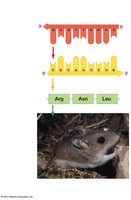
The Central Dogma of Molecular Biology
The central dogma, proposed by Francis Crick in 1958, summarizes the flow of genetic information in cells: DNA is transcribed into RNA, which is then translated into protein. This concept is foundational to understanding molecular biology.
Central Dogma: DNA → RNA → Protein
Some genes code for functional RNAs (e.g., rRNA, tRNA) that are not translated into proteins.
Information flow can sometimes occur from RNA back to DNA (e.g., retroviruses).
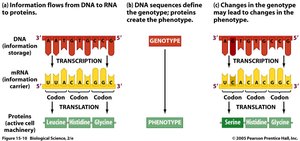
Transcription and Translation
Transcription is the process of synthesizing mRNA from a DNA template, following complementary base pairing rules. Translation is the process by which ribosomes read the mRNA sequence and assemble the corresponding amino acid sequence to form a protein.
Complementary base pairing: In RNA, adenine (A) pairs with uracil (U), and cytosine (C) pairs with guanine (G).
Genetic code: The set of rules by which nucleotide sequences in mRNA are translated into amino acid sequences in proteins.
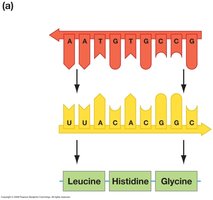
The Genetic Code
Triplet Code and Codons
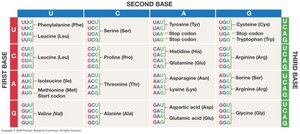
The genetic code is a triplet code, meaning that each amino acid is specified by a sequence of three nucleotide bases called a codon. With four different bases, there are 64 possible codons, more than enough to code for the 20 amino acids found in proteins.
Codon: A sequence of three mRNA bases that specifies a particular amino acid.
There are 64 possible codons (43).
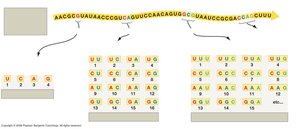
Properties of the Genetic Code
The genetic code has several important properties:
Redundant: More than one codon may specify the same amino acid.
Unambiguous: Each codon specifies only one amino acid.
Conservative: Codons for the same amino acid often share the first two bases.
Universal: The genetic code is nearly universal among all living organisms.
Start and Stop Codons
The genetic code includes specific codons that signal the start and end of translation:
Start codon (AUG): Specifies methionine and signals the start of protein synthesis.
Stop codons (UAA, UAG, UGA): Signal the end of translation and do not code for any amino acid.
Using the Genetic Code
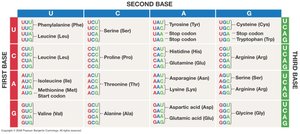
To translate a gene, the DNA template strand is first transcribed into mRNA, which is then read in codons to assemble the corresponding amino acid sequence. The process always begins with a start codon and ends with a stop codon.
Different DNA/RNA sequences can sometimes result in the same amino acid sequence due to redundancy (degeneracy) of the code.
However, a single DNA/RNA sequence will always produce the same amino acid sequence (unambiguous).
Mutations and Their Effects
Types of Mutations
Mutations are permanent changes in an organism's DNA sequence. The effects of mutations depend on their type and location within the gene.
Point mutation: Replacement of one nucleotide with another.
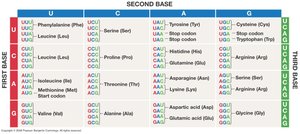
Silent mutation: Does not alter the amino acid sequence (due to redundancy in the code).
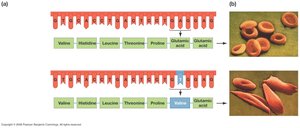
Missense mutation: Changes one amino acid to another, potentially altering protein function.
Nonsense mutation: Changes a codon to a stop codon, resulting in a truncated, usually non-functional protein.
Frameshift mutation: Insertion or deletion of bases that alters the reading frame, affecting all downstream codons and usually resulting in a non-functional protein.
Consequences of Mutations
Mutations can have a range of effects, from no impact (silent mutations) to severe consequences (frameshift or nonsense mutations). For example, a missense mutation in the hemoglobin gene causes sickle cell anemia, altering the shape and function of red blood cells.
Frameshift mutations generally have more severe effects than point mutations because they disrupt the entire downstream amino acid sequence.
Summary Table: Types of Mutations
Mutation Type | Description | Effect on Protein |
|---|---|---|
Silent | Base change does not alter amino acid | No effect |
Missense | Base change alters one amino acid | May alter protein function |
Nonsense | Base change creates a stop codon | Truncated, usually non-functional protein |
Frameshift | Insertion or deletion shifts reading frame | Usually non-functional protein |
