 Back
BackKey Concepts in Introductory Biology: Atoms, Bonds, and Molecules
Study Guide - Smart Notes
 Tailored notes based on your materials, expanded with key definitions, examples, and context.
Q1. What two theories are central to biology?
Background
Topic: Foundations of Biology
This question tests your understanding of the fundamental theories that underpin all biological study.
Key Terms:
Cell Theory: All living things are composed of cells, and cells are the basic unit of life.
Theory of Evolution: Explains how species change over time through natural selection and genetic variation.
Step-by-Step Guidance
Recall the major unifying principles in biology that explain both the structure and function of living organisms.
Think about which theories explain both the origin of life and the diversity of life forms.
Consider why cell theory and the theory of evolution are considered foundational, compared to theories from physics (like relativity or gravity).
Try solving on your own before revealing the answer!
Final Answer: Cell theory and theory of evolution
These two theories are central because they explain the basic unit of life and the process by which life changes over time.
Q2. What are potential proximate explanations for differences in snail shell thickness?
Background
Topic: Proximate vs. Ultimate Explanations in Biology
This question tests your ability to distinguish between immediate (proximate) causes and evolutionary (ultimate) causes for observed traits.
Key Terms:
Proximate Explanation: Immediate genetic, physiological, or environmental factors causing a trait.
Ultimate Explanation: Evolutionary reasons why a trait exists.
Step-by-Step Guidance
Identify which explanations involve direct genetic or environmental influences on individual snails.
Distinguish these from explanations that involve changes over generations (evolutionary).
Look for answers that mention genes or environmental triggers (like chemicals from fish).
Try solving on your own before revealing the answer!
Final Answer: Genetic differences and environmental triggers (chemical from fish)
Proximate explanations focus on immediate causes, such as genetic variation or environmental cues.
Q3. Which subatomic particles are NOT found in the nucleus?
Background
Topic: Atomic Structure
This question tests your knowledge of the location of subatomic particles within an atom.
Key Terms:
Proton: Found in the nucleus, positive charge.
Neutron: Found in the nucleus, neutral charge.
Electron: Found outside the nucleus, negative charge.
Step-by-Step Guidance
Recall the basic structure of an atom: nucleus (center) and electron cloud (surrounding).
Identify which particles are located in the nucleus and which are not.
Consider the charges and masses of each particle to help remember their locations.
Try solving on your own before revealing the answer!
Final Answer: Electrons
Electrons are found outside the nucleus in the electron cloud.
Q4. What charge and atomic mass are associated with each subatomic particle?
Background
Topic: Atomic Structure and Properties
This question tests your understanding of the properties of electrons, protons, and neutrons.
Key Terms:
Atomic Mass Unit (amu): Standard unit for atomic mass.
Charge: Indicates whether a particle is positive, negative, or neutral.
Step-by-Step Guidance
Recall the mass and charge of each particle:
Electron: very small mass, negative charge.
Proton: mass of 1 amu, positive charge.
Neutron: mass of 1 amu, neutral charge.
Try solving on your own before revealing the answer!
Final Answer: Electron (0.00055 amu, -1), Proton (1 amu, +1), Neutron (1 amu, 0)
These values are standard for atomic structure.
Q5. How do you determine the number of protons, neutrons, electrons, and valence electrons in an atom?
Background
Topic: Atomic Number, Mass, and Charge
This question tests your ability to use atomic number, atomic mass, and charge to determine the composition of an atom.
Key Terms and Formulas:
Atomic Number: Number of protons.
Atomic Mass: Number of protons + neutrons.
Charge: Difference between protons and electrons.
Step-by-Step Guidance
Use the atomic number to find the number of protons.
Subtract the atomic number from the atomic mass to find the number of neutrons.
For a neutral atom, electrons = protons. For ions, adjust based on charge.
Valence electrons are determined by the group number in the periodic table.
Try solving on your own before revealing the answer!
Final Answer: Use atomic number for protons, atomic mass minus atomic number for neutrons, adjust electrons for charge, and use periodic table for valence electrons.
These steps allow you to determine the composition of any atom or ion.
Q6. Which of the following molecules shows each atom with the correct number of bonds?
Background
Topic: Chemical Bonding and Molecular Structure
This question tests your understanding of how many bonds each atom typically forms in organic molecules.
Key Terms:
Valence: The number of bonds an atom can form based on its valence electrons.
Carbon: Usually forms 4 bonds.
Hydrogen: Forms 1 bond.
Oxygen: Forms 2 bonds.
Step-by-Step Guidance
Examine each molecule and count the number of bonds for each atom.
Compare the number of bonds to the typical valence for carbon, hydrogen, and oxygen.
Identify which molecules have atoms with the correct number of bonds.

Try solving on your own before revealing the answer!
Final Answer: Molecules 1 and 4 show correct bonding
Carbon has 4 bonds, hydrogen has 1, and oxygen has 2 in these molecules.
Q7. What is the primary factor that determines whether an ionic, polar covalent, or non-polar covalent bond occurs between two atoms?
Background
Topic: Chemical Bond Types
This question tests your understanding of how differences in electronegativity influence bond type.
Key Terms:
Electronegativity: The tendency of an atom to attract electrons.
Ionic Bond: Large difference in electronegativity; electrons are transferred.
Polar Covalent Bond: Moderate difference; electrons are shared unequally.
Non-polar Covalent Bond: Small or no difference; electrons are shared equally.
Step-by-Step Guidance
Recall the definition of electronegativity and how it affects electron sharing.
Compare the electronegativity values of two atoms to predict bond type.
Understand that a large difference leads to ionic bonds, moderate to polar covalent, and small to non-polar covalent.
Try solving on your own before revealing the answer!
Final Answer: The difference in electronegativity between the two atoms
This determines whether electrons are shared equally, unequally, or transferred.
Q8. What type of bond forms between each of the pairs of atoms given (carbon/hydrogen, carbon/oxygen, hydrogen/hydrogen, potassium/chlorine)?
Background
Topic: Bond Types and Electronegativity
This question tests your ability to use electronegativity values to predict bond types.
Key Terms and Formulas:
Electronegativity Difference:
Bond Types: Non-polar covalent (), Polar covalent (), Ionic ()
Step-by-Step Guidance
Calculate the difference in electronegativity for each pair.
Compare the difference to the thresholds for bond types.
Assign the correct bond type based on the calculated difference.
Try solving on your own before revealing the answer!
Final Answer: A (non-polar covalent), B (polar covalent), C (non-polar covalent), D (ionic)
Bond type is determined by the difference in electronegativity.
Q9. Are the diagrams below different ways of representing the same molecule?
Background
Topic: Molecular Representations
This question tests your ability to recognize different models and diagrams of the same molecule.
Key Terms:
Structural Formula: Shows bonds and arrangement of atoms.
Ball-and-Stick Model: 3D representation of atoms and bonds.
Space-Filling Model: Shows relative sizes and positions of atoms.
Step-by-Step Guidance
Compare the arrangement of atoms and bonds in each diagram.
Look for consistent atom types and connections, even if the style differs.
Understand that different models can represent the same molecule in various ways.

Try solving on your own before revealing the answer!
Final Answer: True
All diagrams represent the same molecule using different conventions.
Q10. What is an ion?
Background
Topic: Atomic Structure and Charge
This question tests your understanding of what makes an atom an ion.
Key Terms:
Ion: An atom that has gained or lost electrons.
Anion: Negatively charged ion (gained electrons).
Cation: Positively charged ion (lost electrons).
Step-by-Step Guidance
Recall that ions are formed when atoms gain or lose electrons.
Understand the difference between cations and anions.
Remember that gaining electrons results in negative charge, losing electrons results in positive charge.
Try solving on your own before revealing the answer!
Final Answer: An atom that has gained or lost one or more electrons
This is the definition of an ion.
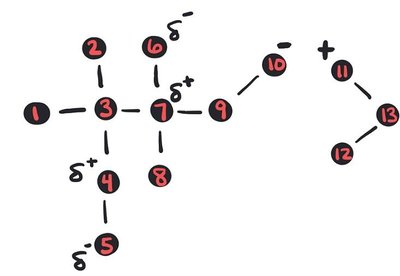
Q11. Which atoms in the diagram are involved in polar covalent bonds?
Background
Topic: Bond Polarity and Partial Charges
This question tests your ability to identify polar covalent bonds based on partial charges in a molecular diagram.
Key Terms:
Polar Covalent Bond: Bond where electrons are shared unequally, resulting in partial charges.
Partial Charge: Indicated by (partial positive) or (partial negative).
Step-by-Step Guidance
Look for bonds between atoms with different partial charges ( and ).
Identify which atoms are connected by these bonds.
Mark those atoms as involved in polar covalent bonds.
Try solving on your own before revealing the answer!
Final Answer: Atoms with partial charges and bonds between them are involved in polar covalent bonds
Partial charges indicate unequal sharing of electrons.
Q12. What types of bonds are responsible for joining atoms together to form molecules?
Background
Topic: Chemical Bonding
This question tests your understanding of which bond types result in molecule formation.
Key Terms:
Covalent Bond: Atoms share electrons to form molecules.
Polar Covalent Bond: Unequal sharing of electrons.
Non-polar Covalent Bond: Equal sharing of electrons.
Ionic Bond: Electrons are transferred, but does not form molecules in the same way.
Step-by-Step Guidance
Recall that covalent bonds (polar and non-polar) join atoms to form molecules.
Understand that ionic bonds result in ions, not molecules.
Identify which bond types are responsible for molecular formation.
Try solving on your own before revealing the answer!
Final Answer: Polar covalent and non-polar covalent bonds
These bonds join atoms to form molecules.
