 Back
BackMacromolecules: Carbohydrates & Lipids – Structure, Function, and Biological Roles
Study Guide - Smart Notes
 Tailored notes based on your materials, expanded with key definitions, examples, and context.
Macromolecules: An Overview
Definition and Classification
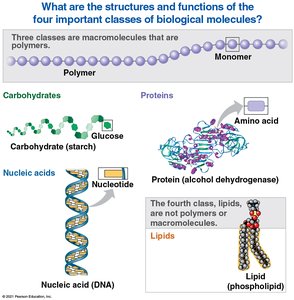
Macromolecules are large, complex molecules essential for life, built from smaller units called monomers. The four main classes are carbohydrates, proteins, nucleic acids, and lipids. Most are polymers, except lipids, which are structurally unique and often not considered true polymers.
Carbohydrates: Monomer = monosaccharide
Proteins: Monomer = amino acid
Nucleic acids: Monomer = nucleotide
Lipids: Not true polymers; main types include triglycerides, phospholipids, and steroids
Carbohydrates
Monomers: Monosaccharides
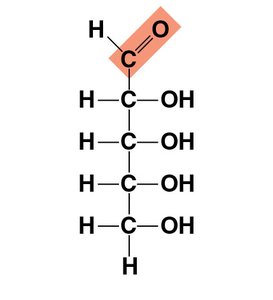
Monosaccharides are simple sugars that cannot be broken down further. They are categorized by the number of carbon atoms and typically have the formula CxH2xOx. Common examples include glucose, fructose, galactose, and ribose.
Triose: 3 carbons (e.g., glyceraldehyde)
Pentose: 5 carbons (e.g., ribose)
Hexose: 6 carbons (e.g., glucose, galactose)
Functional Groups in Monosaccharides
Monosaccharides contain several functional groups:
Hydroxyl (-OH): Found at almost every carbon
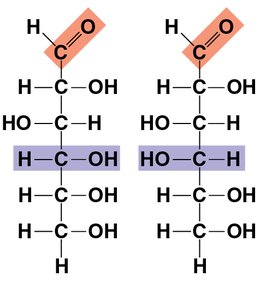
Carbonyl (C=O): Either as an aldehyde (at the end) or ketone (within the chain)
Isomerism in Monosaccharides
Monosaccharides can exist as structural isomers (same formula, different arrangement) or stereoisomers (different spatial arrangement). For example, glucose and galactose are both hexoses but differ in the orientation of one hydroxyl group.
Ring Formation
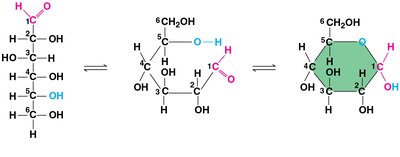
Most pentoses and hexoses form ring structures in aqueous solutions, which is the predominant form in biological systems.
Disaccharides and Glycosidic Bonds
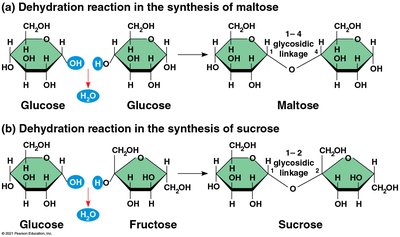
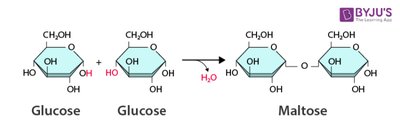
Disaccharides are formed by linking two monosaccharides via a glycosidic bond through a dehydration reaction (removal of water). Common disaccharides include maltose (glucose + glucose), lactose (galactose + glucose), and sucrose (glucose + fructose).
Dehydration Reaction:
Oligosaccharides and Polysaccharides
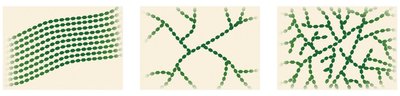
Oligosaccharides (3–10 sugars) and polysaccharides (10+ sugars) are formed by repeated glycosidic linkages. Polysaccharides include starch, glycogen, and cellulose.
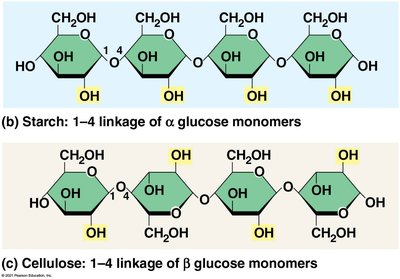
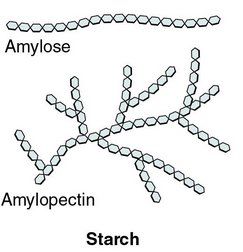
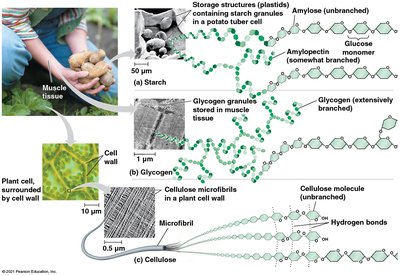
Starch: Storage polysaccharide in plants; composed of amylose (unbranched) and amylopectin (branched)
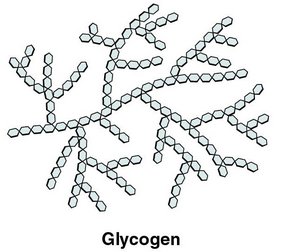
Glycogen: Storage polysaccharide in animals; highly branched
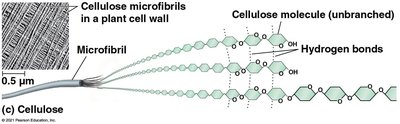
Cellulose: Structural polysaccharide in plants; unbranched, linear fibers
Biological Roles of Carbohydrates
Fuel Source
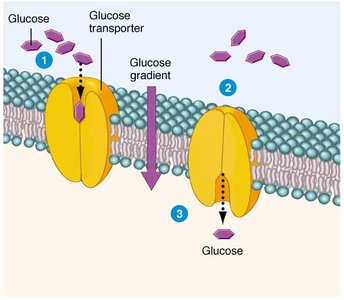
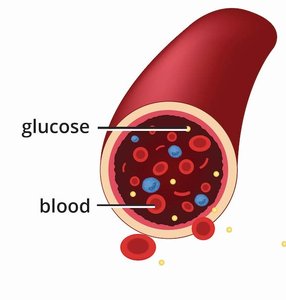
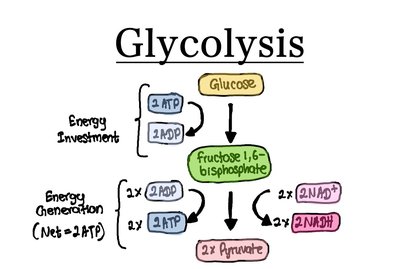
Monosaccharides, especially glucose, are the primary energy source for cells. Glucose is transported in the blood and taken up by cells via specific transporters.
Energy Storage
Excess monosaccharides are stored as polysaccharides. Plants store energy as starch (amylose and amylopectin), while animals store it as glycogen in muscles and liver.

Structural Support
Carbohydrates provide structural support in organisms. Cellulose forms plant cell walls, while chitin is found in fungal cell walls and arthropod exoskeletons.

Comparison of Starch and Cellulose
Starch and cellulose are both polymers of glucose but differ in their glycosidic linkages:
Starch: α-1,4 linkages (digestible by humans)
Cellulose: β-1,4 linkages (not digestible by humans)
Lipids
General Properties
Lipids are primarily hydrocarbons, making them nonpolar and hydrophobic. They are structurally diverse and not true polymers, but are considered macromolecules due to their size and biological importance.
Three main types: Triglycerides, phospholipids, steroids
Interactions: Van der Waals and hydrophobic interactions
Triglycerides
Triglycerides consist of three fatty acid chains attached to a glycerol head via ester bonds formed by dehydration reactions. Fatty acids can be saturated (all single bonds), monounsaturated (one double bond), or polyunsaturated (multiple double bonds).
Saturated fatty acids: Tightly packed, solid at room temperature
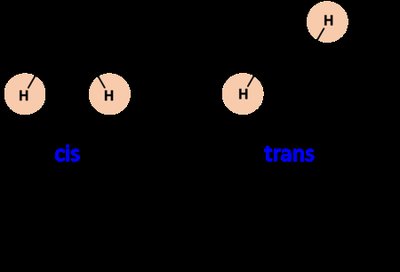
Unsaturated fatty acids: Kinked, less tightly packed, liquid at room temperature
Trans fats: Chemically altered unsaturated fats, unhealthy
Biological Roles of Triglycerides
Triglycerides serve as energy storage, insulation, and cushioning in organisms. They are stored in the liver or subcutaneously.
Phospholipids
Phospholipids are major components of cell membranes. They are amphipathic, with a hydrophilic head (glycerol + phosphate group) and hydrophobic tails (fatty acids). This structure allows them to form bilayers in aqueous environments.
Structure: Glycerol backbone, two fatty acid tails, one phosphate group
Function: Structural component of plasma membranes
Steroids
Steroids are lipids composed of four fused hydrocarbon rings. They are hydrophobic and not built from fatty acids or glycerol. Examples include cholesterol (membrane fluidity), sex hormones (progesterone, estrogen, testosterone), and lipid-soluble vitamins (A, D, E, K).
Structure: Four carbon rings
Function: Membrane fluidity, hormones, vitamins
Key Vocabulary
Amphipathic: Molecule with both hydrophilic and hydrophobic regions
Amylose: Unbranched starch
Amylopectin: Branched starch
Bilayer: Double layer of phospholipids in membranes
Cellulose: Structural polysaccharide in plants
Cholesterol: Steroid important for membrane fluidity
Dehydration: Reaction removing water to form bonds
Disaccharide: Two monosaccharides linked
Ester linkage: Bond between fatty acid and glycerol
Fatty acid: Hydrocarbon chain with carboxyl group
Glycogen: Storage polysaccharide in animals
Glycosidic linkage: Bond between monosaccharides
Hydrophilic: Water-loving
Hydrophobic: Water-fearing
Monomer: Single unit of a polymer
Monounsaturated fatty acid: One double bond
Oligosaccharide: Few sugars
Phospholipid: Lipid with phosphate group
Polymer: Many monomers linked
Polysaccharide: Many sugars
Polyunsaturated fatty acid: Multiple double bonds
Saturated fatty acid: All single bonds
Starch: Storage polysaccharide in plants
Steroid: Lipid with four rings
Trans fatty acid: Chemically altered unsaturated fat
Triglyceride: Three fatty acids + glycerol
Unsaturated fatty acid: At least one double bond
Summary Table: Carbohydrate Polysaccharides
Polysaccharide | Monomer | Structure | Function |
|---|---|---|---|
Cellulose | Glucose (β) | Unbranched, linear | Plant cell wall structure |
Amylose | Glucose (α) | Unbranched, coiled | Plant energy storage |
Amylopectin | Glucose (α) | Branched | Plant energy storage |
Glycogen | Glucose (α) | Highly branched | Animal energy storage |
Quiz Yourself
What is the monomer of a carbohydrate?
How do you identify a monosaccharide?
What type of bond holds the monomers of carbohydrates together?
What are the functions of carbohydrates?
What is the monomer of a lipid?
How do you identify a fatty acid?
What is meant by saturated/unsaturated/trans fatty acid?
What type of bond holds fatty acids to the glycerol head?
What are the three types of lipids?
What is the function of triglycerides?
What is the structure of triglycerides?
What is the function of phospholipids?
What is the structure of phospholipids?
What is the structure of steroids?
What is the function of steroids?
Additional info:
Dehydration reactions are catalyzed by enzymes, speeding up polymer formation.
Hydrolysis reactions break polymers into monomers by adding water.
Cellulose is the most abundant macromolecule on Earth.
Chitin contains amino groups and is used for structural support in fungi and arthropods.
