 Back
BackMeiosis and Sexual Reproduction: Study Guide and Comparison with Mitosis
Study Guide - Smart Notes
 Tailored notes based on your materials, expanded with key definitions, examples, and context.
Meiosis and Sexual Reproduction
Key Definitions
Haploid (n): A cell with a single set of chromosomes (e.g., gametes in animals).
Diploid (2n): A cell with two sets of chromosomes, one from each parent (e.g., somatic cells in animals).
Somatic Cell: Any cell in a multicellular organism except a sperm or egg or their precursors; typically diploid.
Gamete: A reproductive cell (sperm or egg) that is haploid and can unite with another gamete to form a diploid zygote.
Autosome: Any chromosome that is not a sex chromosome.
Sex Chromosome: Chromosomes involved in determining the sex of an organism (e.g., X and Y in humans).
Sexual vs. Asexual Reproduction
Asexual Reproduction: Involves a single parent; offspring are genetically identical to the parent (clones). Common in prokaryotes (binary fission) and some eukaryotes (mitosis).
Sexual Reproduction: Involves two parents; offspring are genetically diverse due to the combination of gametes formed by meiosis.
Advantages of Asexual Reproduction: Rapid colonization, efficient in stable environments.
Disadvantages of Asexual Reproduction: Lack of genetic diversity, making populations vulnerable to disease.
Advantages of Sexual Reproduction: Genetic variation, which is the raw material for evolution.
Disadvantages of Sexual Reproduction: Slower, requires finding a mate, and involves complex processes.
Evolution in Prokaryotes
Prokaryotic cells can evolve through:
Mutation: Random changes in DNA sequence.
Transformation: Uptake of foreign DNA from the environment.
Conjugation: Direct transfer of DNA between two cells via a pilus.
Transduction: Transfer of DNA by bacteriophages (viruses that infect bacteria).
Phases of Meiosis
Meiosis consists of two sequential divisions: Meiosis I and Meiosis II, each with distinct phases.
Phase | Key Events |
|---|---|
Prophase I | Homologous chromosomes pair (synapsis) and crossing over occurs; spindle forms; nuclear envelope breaks down. |
Metaphase I | Homologous pairs align at the metaphase plate. |
Anaphase I | Homologous chromosomes separate and move to opposite poles. |
Telophase I | Chromosomes arrive at poles; cell divides (cytokinesis); cells are haploid. |
Prophase II | Spindle forms in each haploid cell; chromosomes condense. |
Metaphase II | Chromosomes align at the metaphase plate (single file). |
Anaphase II | Sister chromatids separate and move to opposite poles. |
Telophase II | Nuclei form; cytokinesis occurs; four haploid cells result. |
Interphase | DNA is replicated prior to meiosis I; no replication between meiosis I and II. |
Key Differences Between Meiosis and Mitosis
Meiosis I vs. Mitosis: Homologous chromosomes pair and separate in meiosis I, but not in mitosis.
Prophase I vs. Prophase II: Crossing over and synapsis occur only in prophase I.
Metaphase I vs. Metaphase II: Homologous pairs align in metaphase I; individual chromosomes align in metaphase II.
Anaphase I vs. Anaphase II: Homologous chromosomes separate in anaphase I; sister chromatids separate in anaphase II.
Nondisjunction and Aneuploidy
Nondisjunction: Failure of homologous chromosomes or sister chromatids to separate properly during meiosis.
Consequences: Can result in aneuploidy (abnormal number of chromosomes), such as trisomy 21 (Down syndrome).
Lethality: Many cases are lethal, but some aneuploidies are viable and lead to genetic disorders.
Sources of Genetic Variation in Sexual Reproduction
Independent Assortment: Random orientation of homologous pairs during metaphase I leads to different combinations of maternal and paternal chromosomes in gametes.
Crossing Over: Exchange of genetic material between homologous chromosomes during prophase I creates new allele combinations.
Random Fertilization: Any sperm can fertilize any egg, further increasing genetic diversity.
Comparison Table: Mitosis vs. Meiosis
This table summarizes the main differences between mitosis and meiosis.
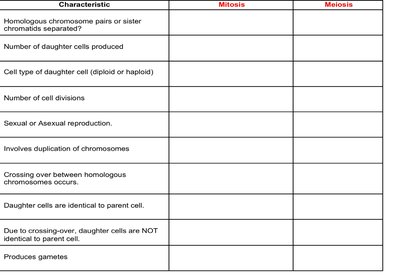
Characteristic | Mitosis | Meiosis |
|---|---|---|
Homologous chromosome pairs or sister chromatids separated? | Sister chromatids | Homologous pairs (Meiosis I), then sister chromatids (Meiosis II) |
Number of daughter cells produced | 2 | 4 |
Cell type of daughter cell (diploid or haploid) | Diploid | Haploid |
Number of cell divisions | 1 | 2 |
Sexual or Asexual reproduction | Asexual (growth, repair) | Sexual (gamete production) |
Involves duplication of chromosomes | Yes | Yes (before meiosis I) |
Crossing over between homologous chromosomes occurs | No | Yes (prophase I) |
Daughter cells are identical to parent cell | Yes | No |
Due to crossing-over, daughter cells are NOT identical to parent cell | No | Yes |
Produces gametes | No | Yes |
Summary
Meiosis is essential for sexual reproduction, generating genetic diversity through independent assortment, crossing over, and random fertilization.
Mitosis produces genetically identical cells for growth and repair, while meiosis produces genetically unique gametes.
