 Back
BackMembrane Structure, Function, and Cellular Respiration: Study Notes for General Biology
Study Guide - Smart Notes
 Tailored notes based on your materials, expanded with key definitions, examples, and context.
Membrane Structure and Function
Fluid Mosaic Model of Membrane Structure
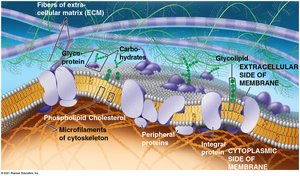
The plasma membrane is a dynamic structure composed primarily of lipids, proteins, and carbohydrates. The fluid mosaic model describes the membrane as a mosaic of protein molecules floating in a fluid bilayer of phospholipids. This arrangement allows for flexibility and the movement of components within the membrane.
Phospholipids form a bilayer with hydrophobic tails facing inward and hydrophilic heads facing outward toward the cytosol and extracellular fluid.
Proteins are embedded within or attached to the membrane, serving various functions such as transport, enzymatic activity, and cell signaling.
Carbohydrates are attached to lipids (glycolipids) or proteins (glycoproteins), playing a role in cell recognition.
Membrane Proteins and Their Functions
Membrane proteins are not randomly distributed; they often form functional groups. Some are anchored to the cytoskeleton or extracellular matrix, such as integrins. Cell-surface proteins perform several key functions:
Transport: Move substances across the membrane.
Enzymatic activity: Catalyze reactions at the membrane surface.
Signal transduction: Relay signals from outside to inside the cell.
Cell-cell recognition: Identify and interact with other cells.
Intercellular joining: Connect adjacent cells.
Attachment: Anchor the membrane to the cytoskeleton and ECM.
Medical Relevance of Cell-Surface Proteins
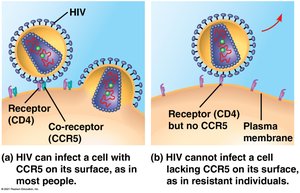
Cell-surface proteins are crucial in medicine. For example, HIV infects immune cells by binding to the CD4 protein and a co-receptor, CCR5. Individuals lacking CCR5 are resistant to HIV infection, and drugs are being developed to block CCR5 in non-immune individuals.
Membrane Carbohydrates and Cell Recognition
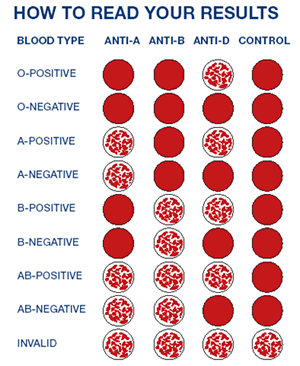
Cells recognize each other by binding to surface molecules, many of which are carbohydrates attached to lipids (glycolipids) or proteins (glycoproteins). These carbohydrates serve as markers for cell identification, such as the ABO blood groups in humans.
Glycoproteins: Carbohydrates attached to proteins, important for cell identity.
Glycolipids: Carbohydrates attached to lipids, also involved in recognition.
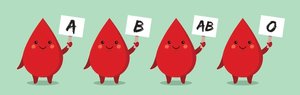
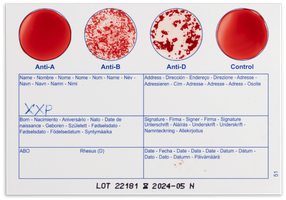
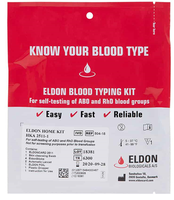
Blood transfusions require matching blood types to avoid immune reactions. Blood typing kits, such as Eldon cards, help determine blood type by observing agglutination reactions.
Selective Permeability of Membranes
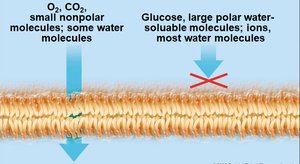
The plasma membrane controls the exchange of materials between the cell and its environment. Membranes are selectively permeable, allowing some substances to cross more easily than others. Hydrophobic (nonpolar) molecules pass through rapidly, while hydrophilic (polar) molecules require transport proteins.
Hydrophobic molecules (e.g., O2, CO2) diffuse easily.
Hydrophilic molecules (e.g., glucose, ions) cross slowly or not at all without assistance.
Transport Proteins
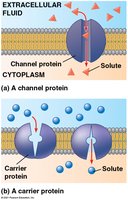
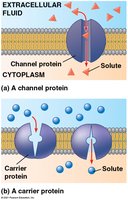
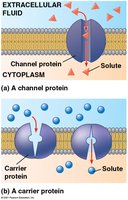
Hydrophilic substances cross membranes via transport proteins. Channel proteins provide hydrophilic tunnels, while carrier proteins bind and shuttle molecules across. Aquaporins are channel proteins that facilitate rapid water transport.
Channel proteins: Form pores for specific molecules or ions.
Carrier proteins: Change shape to move substances across.
Passive Transport: Diffusion and Osmosis
Diffusion
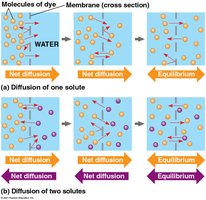
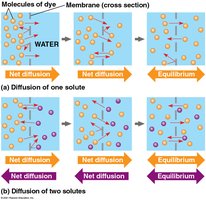
Diffusion is the movement of particles from high to low concentration, spreading out evenly. At equilibrium, movement occurs equally in both directions.
Concentration gradient: The difference in concentration across a membrane.
Dynamic equilibrium: Equal movement in both directions.
Osmosis
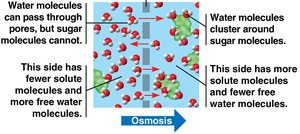
Osmosis is the diffusion of free water across a selectively permeable membrane. Water moves from areas of lower solute concentration to higher solute concentration until equilibrium is reached.
Free water: Water molecules not bound to solutes.
Osmosis: Movement of water to balance solute concentrations.
Tonicity and Water Balance
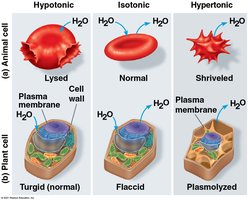
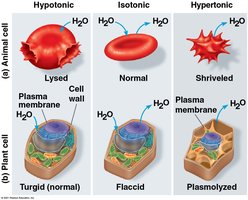
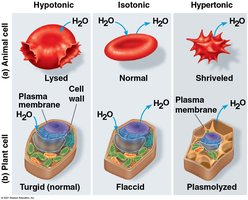
Tonicity describes how a solution affects cell water gain or loss. It depends on solute concentration relative to the cell.
Hypotonic: Lower solute concentration outside; cell gains water and may burst.
Isotonic: Equal solute concentration; cell volume remains stable.
Hypertonic: Higher solute concentration outside; cell loses water and shrivels.
Osmoregulation
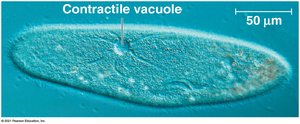
Cells without walls must regulate water balance to survive in hypotonic or hypertonic environments. Organisms like Paramecium use contractile vacuoles to expel excess water.
Water Balance in Cells with Walls
Plant, prokaryote, fungi, and some protist cells have walls that help maintain water balance. In hypotonic solutions, plant cells become turgid (firm); in isotonic, they are flaccid (limp); in hypertonic, they undergo plasmolysis (membrane pulls away from wall).
Facilitated Diffusion
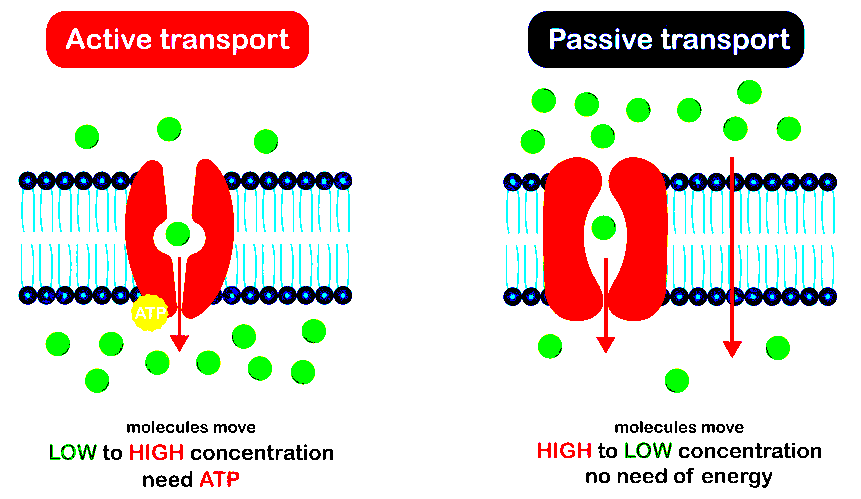
Facilitated diffusion is passive transport aided by proteins. Channel and carrier proteins help move substances down their concentration gradients without energy input.
Gated Channels
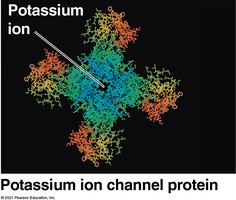
Some ion channels are gated, opening or closing in response to stimuli such as electrical or chemical signals. For example, potassium ion channels open in nerve cells in response to electrical stimuli.
Carrier Proteins
Carrier proteins undergo shape changes to move solutes across the membrane. This process is passive if the solute moves down its concentration gradient.
Active Transport
Mechanism of Active Transport
Active transport moves solutes against their concentration gradients, requiring energy (usually ATP). All active transport proteins are carrier proteins.
ATP hydrolysis provides energy for transport.
Sodium-potassium pump: Maintains high K+ and low Na+ inside animal cells.
Membrane Potential and Electrochemical Gradient
Membrane potential is the voltage across a membrane, created by ion distribution. The electrochemical gradient combines chemical and electrical forces, driving ion diffusion.
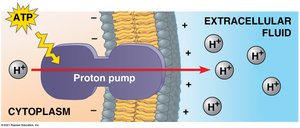
Electrogenic pumps generate voltage across membranes.
Proton pump: Main electrogenic pump in plants, fungi, and bacteria.
Bulk Transport: Exocytosis and Endocytosis
Exocytosis
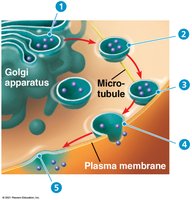
Exocytosis is the process by which cells export large molecules by fusing vesicles with the plasma membrane. Secretory cells, such as those in the pancreas, use exocytosis to release products like insulin.
Endocytosis
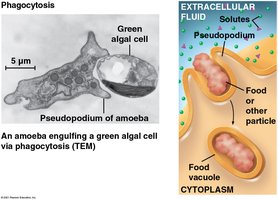
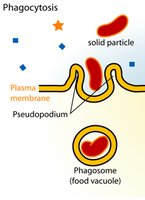
Endocytosis is the uptake of macromolecules by forming vesicles from the plasma membrane. There are three types:
Phagocytosis: "Cellular eating"; cell engulfs particles.
Pinocytosis: "Cellular drinking"; cell takes in fluid and solutes.
Receptor-mediated endocytosis: Specific uptake triggered by solute binding to receptors.
Cellular Respiration and Fermentation
Overview of Cellular Respiration
Cellular respiration is the process by which cells break down organic molecules to produce ATP. It involves catabolic pathways that release energy by oxidizing fuels.
Photosynthesis produces organic molecules and O2.
Cellular respiration uses O2 and organic molecules to make ATP, releasing CO2 and H2O.
Redox Reactions in Cellular Respiration
Redox reactions transfer electrons between molecules, releasing energy. Oxidation is the loss of electrons; reduction is the gain of electrons. These reactions are central to ATP synthesis.
Reducing agent: Electron donor.
Oxidizing agent: Electron acceptor.
Stages of Cellular Respiration
Cellular respiration occurs in three stages:
Glycolysis: Breaks down glucose into pyruvate in the cytoplasm.
Pyruvate oxidation and citric acid cycle: Completes glucose breakdown to CO2 in mitochondria.
Oxidative phosphorylation: Electron transport chain and chemiosmosis produce most ATP.
Glycolysis
Glycolysis consists of two phases:
Energy investment phase: 2 ATP used to split glucose.
Energy payoff phase: 4 ATP produced, 2 NADH formed, 2 pyruvate and 2 H2O generated.
Net ATP gain: 2 ATP per glucose.
Citric Acid Cycle (Krebs Cycle)
Pyruvate is converted to acetyl CoA, which enters the citric acid cycle. Each cycle turn produces 1 ATP, 3 NADH, 1 FADH2, and 2 CO2 per pyruvate.
Oxidative Phosphorylation
NADH and FADH2 donate electrons to the electron transport chain, which powers ATP synthesis via chemiosmosis. ATP synthase uses the H+ gradient to produce ATP.
Fermentation and Anaerobic Respiration
Without oxygen, cells use fermentation or anaerobic respiration to produce ATP. Fermentation regenerates NAD+ by transferring electrons to pyruvate or its derivatives.
Alcohol fermentation: Pyruvate converted to ethanol and CO2.
Lactic acid fermentation: Pyruvate reduced to lactate.
Comparing Fermentation and Respiration
All three pathways use glycolysis. Fermentation produces 2 ATP per glucose; aerobic respiration produces up to 32 ATP. Facultative anaerobes can use either pathway.
Metabolic Pathways Intersections
Glycolysis and the citric acid cycle connect to anabolic and catabolic pathways, allowing cells to build macromolecules or break them down for energy.
Transport Type | Energy Required | Direction Relative to Gradient | Protein Type |
|---|---|---|---|
Passive (Diffusion, Facilitated Diffusion) | No | Down gradient | Channel/Carrier |
Active Transport | Yes (ATP) | Against gradient | Carrier |
Bulk Transport (Exocytosis/Endocytosis) | Yes (ATP) | Bulk movement | Vesicle-mediated |
Example: The sodium-potassium pump uses ATP to maintain ion gradients essential for nerve function.
Additional info: These notes cover the main concepts of membrane structure, transport mechanisms, and cellular respiration, providing a comprehensive overview for General Biology students.
