 Back
Chapter 14 study guide
Study Guide - Smart Notes
 Tailored notes based on your materials, expanded with key definitions, examples, and context.
Mendel and the Gene Idea
Introduction to Mendelian Genetics
Gregor Mendel, known as the "Father of Genetics," was an Austrian monk who, in the 1860s, established foundational laws of heredity through experiments with garden pea plants (Pisum sativum). His work revealed that traits are inherited as discrete units, now known as genes, and laid the groundwork for modern genetics.
Key Concepts in Mendelian Genetics
Pea Plant Traits and Mendel's Experimental System
Mendel selected pea plants for their easily observable traits and ability to self- or cross-pollinate. He identified several contrasting traits, each controlled by a pair of "factors" (now called alleles).
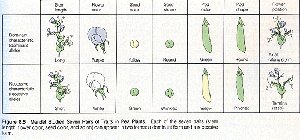
Dominant traits are expressed when at least one dominant allele is present.
Recessive traits are only expressed when both alleles are recessive.
Examples of traits: flower color (purple/white), seed shape (round/wrinkled), pod color (green/yellow).
Mendel’s Experimental Approach
Mendel used true-breeding plants (homozygous for a trait) and performed hybridization experiments:
P generation: Parental generation (true-breeding for a trait)
F1 generation: First filial generation, offspring of P generation cross
F2 generation: Second filial generation, offspring from crossing F1 individuals
Genes, Alleles, and Genotype
Each trait is controlled by a pair of genes (alleles). Alleles are alternative forms of a gene affecting the same trait. The combination of alleles is called the genotype (e.g., BB, Bb, or bb), while the observable trait is the phenotype.
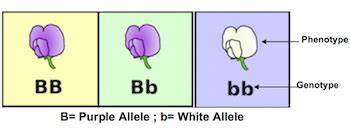
Dominant allele: Represented by a capital letter (e.g., B)
Recessive allele: Represented by a lowercase letter (e.g., b)
Genotype: Genetic makeup (e.g., BB, Bb, bb)
Phenotype: Physical expression (e.g., purple or white flowers)
Law of Segregation
Mendel’s first law states that each individual has two factors for each trait, which segregate during gamete formation. Each gamete receives only one factor from each pair, and fertilization restores the pair in the offspring.
Explains the 3:1 ratio observed in F2 generation for monohybrid crosses.
Formally:
Genetic Vocabulary
Homozygous: Both alleles are the same (e.g., RR or rr)
Heterozygous: Alleles are different (e.g., Rr)
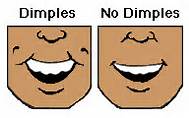
Phenotype: Observable trait (e.g., right-handed or left-handed)
Genotype: Genetic constitution (e.g., RR, Rr, rr)
Testcross
A testcross is used to determine the genotype of an individual expressing a dominant trait by crossing it with a homozygous recessive individual. The offspring phenotypes reveal whether the unknown genotype is homozygous dominant or heterozygous.
Monohybrid and Dihybrid Crosses
Monohybrid cross: Examines inheritance of a single trait.
Dihybrid cross: Examines inheritance of two traits simultaneously.
Law of Independent Assortment
Mendel’s second law states that each pair of alleles segregates independently of other pairs during gamete formation. This leads to genetic variation.
Phenotypic ratio for a dihybrid cross: 9:3:3:1
Occurs during metaphase I of meiosis
Non-Mendelian Inheritance Patterns
Incomplete Dominance
Neither allele is completely dominant. Heterozygotes show an intermediate phenotype (e.g., red x white snapdragons yield pink F1 offspring).
Codominance
Both alleles are fully expressed in the heterozygote (e.g., AB blood type).
Multiple Alleles
Some genes have more than two alleles in the population (e.g., ABO blood group system).
O blood: (recessive)
A blood: or
B blood: or
AB blood:
Polygenic Inheritance
Traits are governed by two or more sets of alleles, resulting in continuous variation (e.g., human height, skin color).
Each dominant allele contributes additively to the phenotype.
Pedigrees
A pedigree is a chart depicting a family’s history with respect to a particular genetic trait. Males are represented by squares, females by circles, and affected individuals are shaded. Roman numerals indicate generations.
Human Genetic Disorders
Autosomal Recessive Disorders
Cystic fibrosis: Defective chloride ion transport; thick mucus in lungs.
Albinism: Lack of melanin; pale skin, white hair, pink eyes.
Tay-Sachs disease: Deficiency of Hex A enzyme; neurodegeneration.
Sickle cell disease: Abnormal hemoglobin; sickle-shaped red blood cells.
Autosomal Dominant Disorders
Huntington disorder: Neurodegenerative; symptoms appear in adulthood.
Achondroplasia: Dwarfism; short limbs, normal torso.
Genetic Testing and Counseling
Fetal testing: Includes non-invasive screening (ultrasound, cell-free fetal DNA) and diagnostic tests (amniocentesis at 15-16 weeks, chorionic villus sampling at 10-11 weeks).
Newborn screening: Biochemical tests for inherited disorders (e.g., PKU, which requires a special diet).
