 Back
Chapter 14 Lecture Part 1 of 2
Study Guide - Smart Notes
 Tailored notes based on your materials, expanded with key definitions, examples, and context.
Mendel and the Gene Idea
Introduction to Genetics
Genetics is the branch of biology that studies heredity and variation in organisms. Gregor Mendel, through his experiments with pea plants, established the basic laws of inheritance that form the foundation of classical genetics. This section explores Mendel's principles, experimental design, and the implications for understanding how traits are passed from one generation to the next.
Key Vocabulary in Genetics
Genetics: The study of heredity and the variation of inherited characteristics.
Character: A heritable feature, such as flower color.
Trait: A variant of a character, e.g., purple or white flowers.
Cross-fertilization (X): Mating between two different individuals.
Self-fertilization: Mating of an individual with itself, common in many plants.
True Breeding: When offspring always display the same traits as the parent(s).
Gregor Mendel and His Experiments
Why Pea Plants?
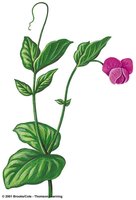
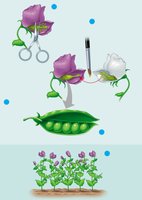
Mendel chose pea plants (Pisum sativum) for his experiments due to their short generation time, the presence of distinct characters with only two possible traits, and the ability to control mating (pollination). Pea plants can self-fertilize naturally or be cross-fertilized artificially, making them ideal for genetic studies.
Mendel's Experimental Design
He used true-breeding parental lines differing in specific traits.
He observed three generations: P (parental), F1 (first filial), and F2 (second filial).
He counted the number of offspring displaying each trait in each generation.
Monohybrid Crosses
A monohybrid cross involves mating true-breeding individuals that differ in one character (e.g., flower color: purple vs. white). Mendel observed that the F1 generation displayed only one of the parental traits, while the F2 generation showed a 3:1 ratio of dominant to recessive phenotypes.
P generation: True-breeding parents (e.g., PP x pp)
F1 generation: All heterozygous (Pp), displaying the dominant trait
F2 generation: Phenotypic ratio of 3:1 (dominant:recessive)
Results and Ratios
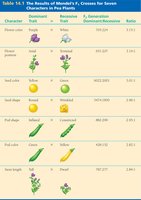
Mendel found that the 3:1 ratio was consistent across all seven characters he studied. This led to the formulation of the basic principles of inheritance.
Character | Dominant Trait | Recessive Trait | F2 Ratio |
|---|---|---|---|
Flower color | Purple | White | 3:1 |
Seed shape | Round | Wrinkled | 3:1 |
Seed color | Yellow | Green | 3:1 |
Pod shape | Inflated | Constricted | 3:1 |
Pod color | Green | Yellow | 3:1 |
Flower position | Axial | Terminal | 3:1 |
Stem length | Tall | Dwarf | 3:1 |
Mendelian Inheritance Model
Concept 1: Alleles and Genes
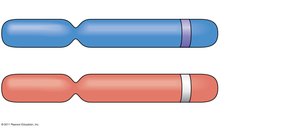
Alleles are different versions of a gene found at the same locus on homologous chromosomes. Each diploid individual inherits two alleles for each gene, one from each parent. These alleles are inherited as discrete units and do not blend.
Concept 2: Genotype and Phenotype
Genotype: The specific allelic composition at a gene locus (e.g., PP, Pp, or pp).
Phenotype: The observable trait resulting from the genotype (e.g., purple or white flowers).
Homozygous: Both alleles are the same (PP or pp).
Heterozygous: The alleles are different (Pp).
Concept 3: Dominance and Recessiveness
Some alleles are dominant and mask the expression of recessive alleles in heterozygotes. Dominant alleles are denoted by uppercase letters (e.g., P), while recessive alleles are denoted by lowercase letters (e.g., p).
PP or Pp: Purple flowers (dominant phenotype)
pp: White flowers (recessive phenotype)
Concept 4: Law of Segregation
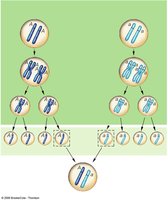
During meiosis, the two alleles for a gene separate so that each gamete receives only one allele. This explains the 3:1 phenotypic ratio observed in the F2 generation of a monohybrid cross.
Heterozygous parent (Aa) produces gametes with either A or a allele.
Homozygous parent (AA) produces gametes with only the A allele.
Punnett Squares and Probability
A Punnett square is a diagram used to predict the genotypic and phenotypic outcomes of a genetic cross. The possible gametes are listed on the outside, and the resulting offspring genotypes are shown inside the boxes. Each box represents an equally likely outcome.
Genotypic ratio (F2): 1 PP : 2 Pp : 1 pp
Phenotypic ratio (F2): 3 purple : 1 white
Dihybrid Crosses and the Law of Independent Assortment
Dihybrid Crosses
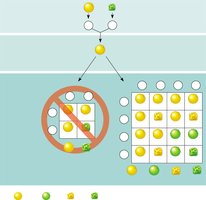
A dihybrid cross involves parents that differ in two characters, each controlled by a different gene. Mendel's experiments with dihybrid crosses led to the discovery of the law of independent assortment.
Example: True-breeding parents (AABB x aabb) produce F1 hybrids (AaBb).
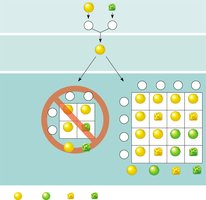
F1 hybrids produce four types of gametes (AB, Ab, aB, ab) if the genes assort independently.
Results of Dihybrid Crosses
The F2 generation from a dihybrid cross shows a phenotypic ratio of 9:3:3:1, supporting the hypothesis of independent assortment. This ratio is only possible if alleles for different genes segregate independently during gamete formation.
Phenotype | Proportion |
|---|---|
Dominant for both traits | 9/16 |
Dominant for one, recessive for other | 3/16 |
Recessive for one, dominant for other | 3/16 |
Recessive for both traits | 1/16 |
Law of Independent Assortment
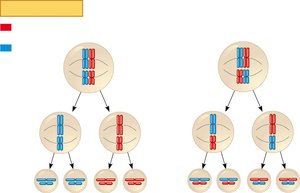
The Law of Independent Assortment states that alleles of genes on different chromosomes assort independently during gamete formation. This is a result of the random orientation of homologous chromosome pairs during metaphase I of meiosis.
Summary Table: Mendel's Laws
Law | Description | Genetic Basis |
|---|---|---|
Law of Segregation | Alleles for a gene separate during gamete formation | Separation of homologous chromosomes in meiosis I |
Law of Independent Assortment | Alleles of different genes assort independently | Random orientation of chromosome pairs in meiosis I |
Applications and Importance
Mendelian genetics provides the foundation for understanding inheritance patterns in all sexually reproducing organisms.
Modern genetics builds on these principles to explore complex traits, genetic disorders, and molecular mechanisms of heredity.
