 Back
Mendel and the Gene Idea: Foundations of Modern Genetics
Study Guide - Smart Notes
 Tailored notes based on your materials, expanded with key definitions, examples, and context.
Chapter 11: Mendel and the Gene Idea
Introduction to Mendelian Genetics
Gregor Mendel's experiments with garden peas established the basic principles of heredity, forming the foundation of classical genetics. His scientific approach allowed him to identify two fundamental laws of inheritance, which remain central to our understanding of genetic transmission.
Mendel's Experimental, Quantitative Approach
Mendel selected pea plants for his studies due to their distinct heritable features and the ability to control their mating. He focused on characters (heritable features such as flower color) and traits (variants of characters, e.g., purple or white flowers).
Cross-Pollination and Hybridization
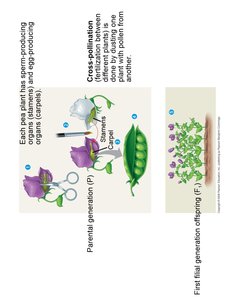
Each pea plant contains both sperm-producing (stamens) and egg-producing (carpels) organs. Mendel performed cross-pollination by transferring pollen from one plant to another, enabling him to breed plants with specific traits. The parental generation (P) produces the first filial generation (F1).
Monohybrid Crosses and Generational Analysis
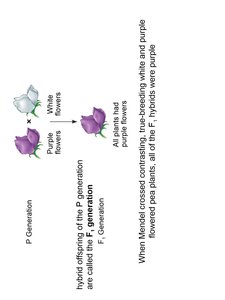
Mendel mated two contrasting, true-breeding varieties, a process called hybridization. The offspring of the P generation are called the F1 generation. When F1 individuals self-pollinate, they produce the F2 generation, where Mendel observed a 3:1 ratio of dominant to recessive traits.
Dominant and Recessive Traits
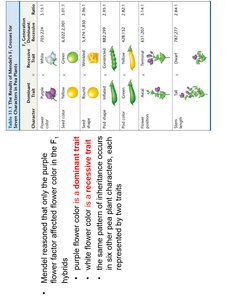
Mendel reasoned that some traits are dominant (expressed in the F1 hybrids) and others are recessive (masked in the F1 but reappear in the F2). He studied several pea plant characters, each represented by two traits.
Mendel's Model of Inheritance
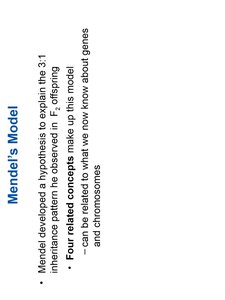
To explain the 3:1 inheritance pattern, Mendel proposed a model based on four related concepts, which can be related to modern knowledge of genes and chromosomes.
Concept 1: Alternative Versions of Genes (Alleles)
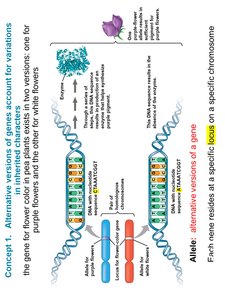
Genes exist in alternative forms called alleles. Each gene resides at a specific locus on a chromosome. For example, the gene for flower color in peas has an allele for purple and an allele for white.
Concept 2: Two Alleles for Each Character
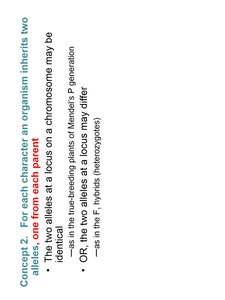
Each organism inherits two alleles for each gene, one from each parent. These alleles may be identical (homozygous) or different (heterozygous).
Concept 3: Dominance and Recessiveness
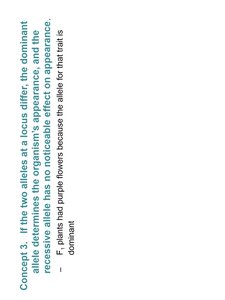
If two alleles at a locus differ, the dominant allele determines the organism's appearance, while the recessive allele has no noticeable effect.
Concept 4: The Law of Segregation
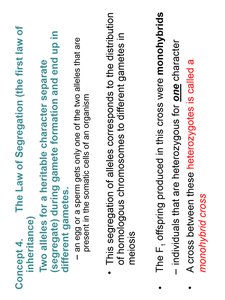
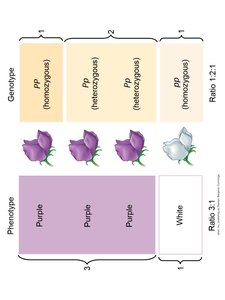
The two alleles for a heritable character segregate during gamete formation and end up in different gametes. This is known as the Law of Segregation, the first law of inheritance. The F1 offspring of a monohybrid cross are called monohybrids.
Punnett Squares and Genetic Terminology
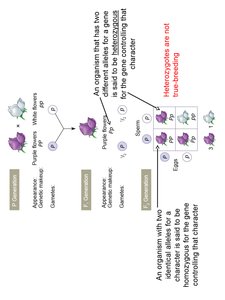
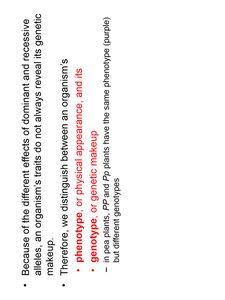
The Punnett square is a diagram that predicts the results of a genetic cross. Organisms with two identical alleles are homozygous, while those with two different alleles are heterozygous. The genotype is the genetic makeup, and the phenotype is the physical appearance.
The Law of Independent Assortment
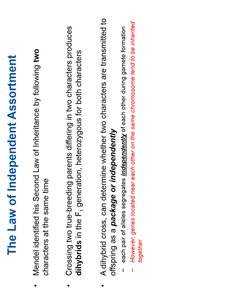
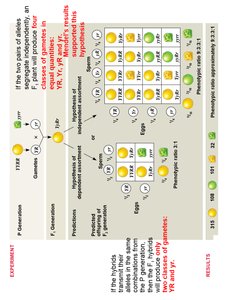
Mendel's second law states that each pair of alleles segregates independently during gamete formation. This law applies to genes on different chromosomes or those far apart on the same chromosome. Dihybrid crosses illustrate this principle.
Complex Patterns of Inheritance
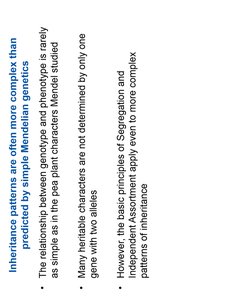
Inheritance patterns can be more complex than predicted by simple Mendelian genetics. Many characters are not determined by only one gene with two alleles, and the basic principles of segregation and independent assortment apply even to more complex patterns.
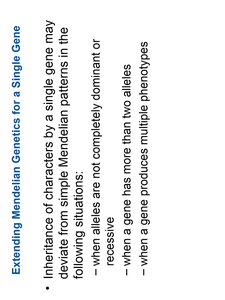
Extending Mendelian Genetics for a Single Gene
Inheritance may deviate from simple Mendelian patterns when alleles are not completely dominant or recessive, when a gene has more than two alleles, or when a gene produces multiple phenotypes.
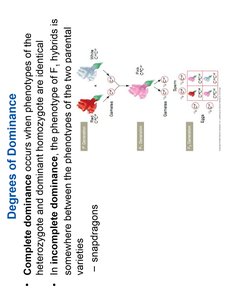
Degrees of Dominance
Complete dominance occurs when the phenotype of the heterozygote and dominant homozygote are identical. Incomplete dominance results in a phenotype that is intermediate between the two parental varieties, as seen in snapdragons.
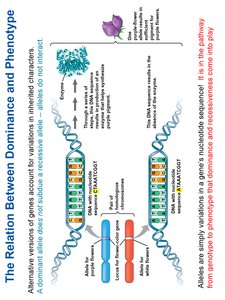
Relation Between Dominance and Phenotype
Dominance does not imply that a dominant allele subdues a recessive allele. Instead, alleles are simply variations in a gene's nucleotide sequence, and dominance reflects the pathway from genotype to phenotype.
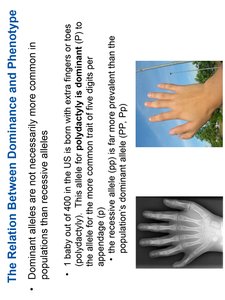
Dominant vs. Recessive Alleles in Populations
Dominant alleles are not necessarily more common in populations than recessive alleles. For example, the allele for polydactyly (extra fingers or toes) is dominant but rare in the population.
Multiple Alleles
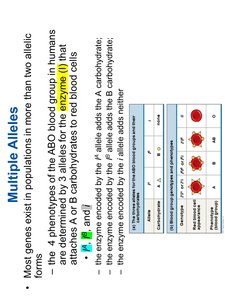
Most genes exist in populations in more than two allelic forms. The ABO blood group in humans is determined by three alleles (IA, IB, i), resulting in four phenotypes.
Pleiotropy
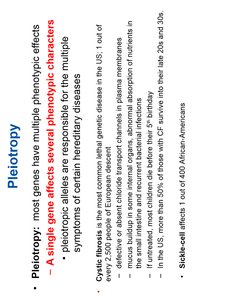
Pleiotropy occurs when a single gene affects multiple phenotypic characters. Examples include cystic fibrosis and sickle-cell disease, where one gene influences several symptoms.
Extending Mendelian Genetics for Two or More Genes
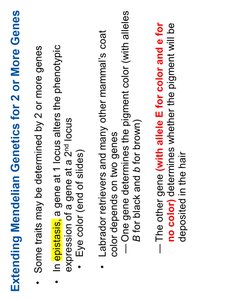
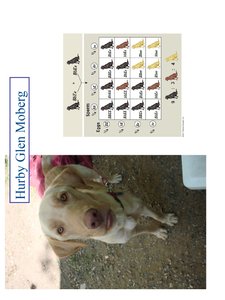
Some traits are determined by two or more genes. In epistasis, a gene at one locus alters the phenotypic expression of a gene at another locus. For example, coat color in Labrador retrievers is controlled by two genes: one determines pigment color, and the other determines whether pigment is deposited in the hair.
Polygenic Inheritance
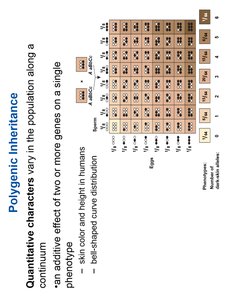
Polygenic inheritance occurs when two or more genes have an additive effect on a single phenotype, resulting in quantitative characters that vary along a continuum, such as skin color and height in humans.
Nature and Nurture: Environmental Impact on Phenotype
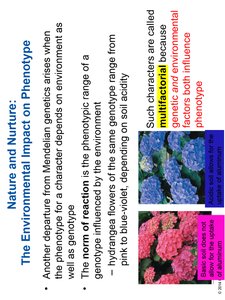
The phenotype for a character can depend on both genotype and environment. The norm of reaction is the phenotypic range influenced by the environment. Characters influenced by both genetic and environmental factors are called multifactorial.
Recessively Inherited Disorders
Many genetic disorders are inherited in a recessive manner, showing up only in individuals homozygous for the allele. Carriers are heterozygous individuals who are phenotypically normal but can pass the allele to offspring.
Example: Albinism
Albinism is a recessive condition characterized by a lack of pigmentation in skin and hair. The inheritance pattern can be illustrated with a Punnett square showing the possible genotypes and phenotypes of offspring from carrier parents.
Additional info: These notes cover the core concepts of Mendelian genetics, including the laws of segregation and independent assortment, extensions to Mendelian inheritance, and the impact of environment and multiple genes on phenotype. Examples and diagrams are provided to reinforce understanding of key principles.
