 Back
BackMendelian Genetics and Patterns of Inheritance: Study Guide
Study Guide - Smart Notes
 Tailored notes based on your materials, expanded with key definitions, examples, and context.
Mendelian Genetics
Monohybrid Crosses and the Law of Segregation
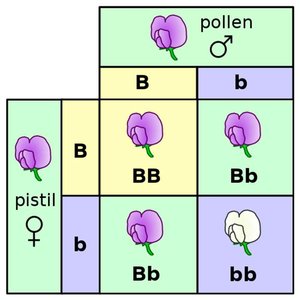
Mendel's experiments with pea plants established the foundation of classical genetics. A monohybrid cross involves a single gene with two alleles, one dominant and one recessive. The law of segregation states that each individual has two alleles for each gene, which segregate during gamete formation so that each gamete carries only one allele.
Key Point 1: Dominant alleles mask the expression of recessive alleles in heterozygotes.
Key Point 2: The typical phenotypic ratio in the F2 generation of a monohybrid cross is 3:1.
Example: Crossing a plant with genotype BB (purple) and bb (white) yields F1 offspring all Bb (purple). F2 generation shows a 3:1 ratio of purple to white.
Dihybrid Crosses and the Law of Independent Assortment
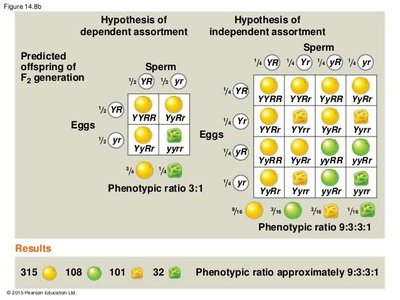
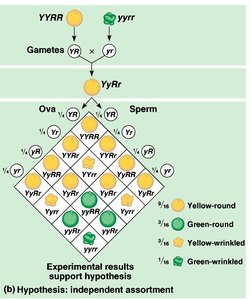
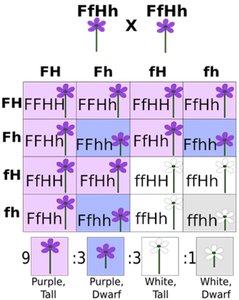
A dihybrid cross examines the inheritance of two different traits simultaneously. Mendel's law of independent assortment states that alleles of different genes assort independently during gamete formation, leading to new combinations in the offspring.
Key Point 1: Traits are inherited independently if genes are on different chromosomes.
Key Point 2: The F2 generation of a dihybrid cross typically shows a 9:3:3:1 phenotypic ratio.
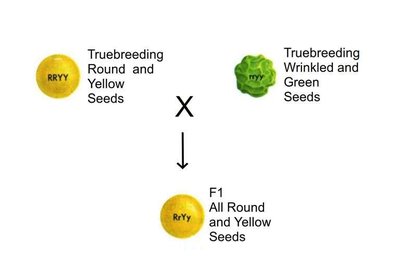
Example: Crossing RRYY (round, yellow) with rryy (wrinkled, green) produces F1 RrYy (all round, yellow). F2 generation shows four phenotypes in a 9:3:3:1 ratio.
Probability in Genetics
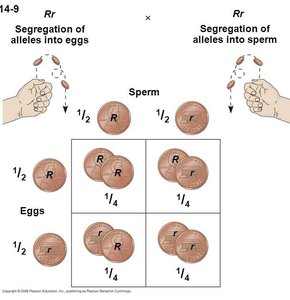
Mendelian inheritance follows the rules of probability. The outcome of allele segregation is analogous to independent events such as coin tosses. The rule of multiplication and the rule of addition are used to calculate genetic probabilities.
Key Point 1: Rule of Multiplication: Probability of two independent events occurring together is the product of their individual probabilities.
Key Point 2: Rule of Addition: Probability of an event occurring in two or more ways is the sum of the probabilities of each way.
Example: Probability of producing a white-flowered offspring from two heterozygotes (Pp) is .
Extensions of Mendelian Genetics
Incomplete Dominance
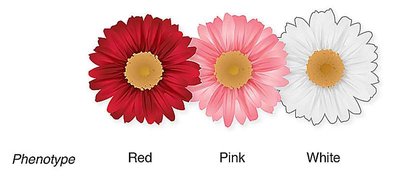
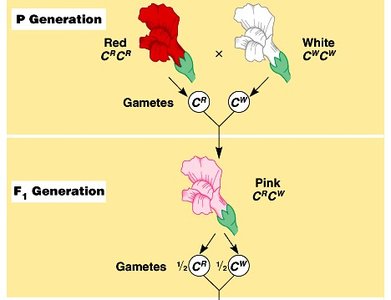
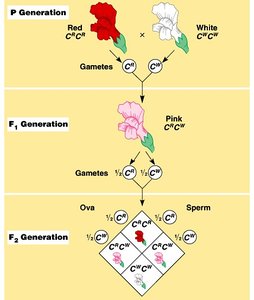
Incomplete dominance occurs when the heterozygote exhibits a phenotype intermediate between the two homozygotes. The phenotypic and genotypic ratios in the F2 generation are both 1:2:1.
Key Point 1: Neither allele is completely dominant; heterozygotes show a blend.
Key Point 2: F2 generation from two heterozygotes yields 1:2:1 ratio for both phenotype and genotype.
Example: Crossing red and white flowers yields pink flowers in the F1 generation.
Codominance
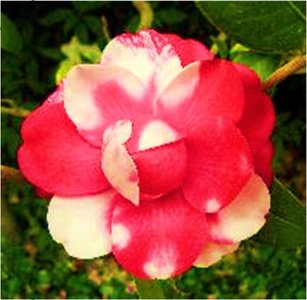
Codominance occurs when both alleles in a heterozygote are fully expressed, resulting in a phenotype that displays both traits distinctly.
Key Point 1: Both alleles contribute equally and visibly to the phenotype.
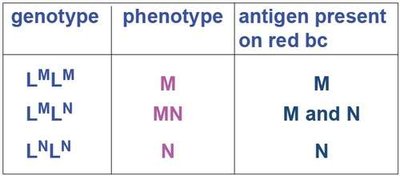
Key Point 2: Example includes human MN blood groups, where both M and N antigens are present in MN individuals.
Example: Flower with red and white patches, or MN blood group in humans.
Dominance Relationships and Phenotype Levels
The dominance or recessiveness of alleles can depend on the level at which the phenotype is examined (organismal, biochemical, molecular). For example, in Tay-Sachs disease, heterozygotes are normal at the organismal level but produce less enzyme at the biochemical level.
Key Point 1: Dominant alleles do not suppress recessive alleles; dominance is a result of the pathway from genotype to phenotype.
Key Point 2: The frequency of dominant alleles in a population is not necessarily higher than recessive alleles.
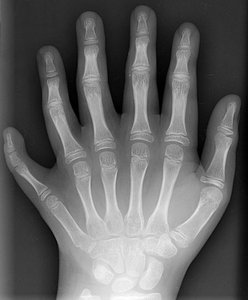
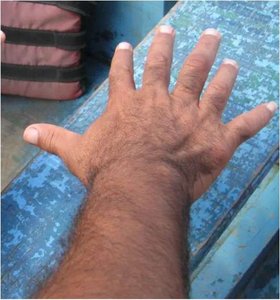
Example: Polydactyly is caused by a dominant allele, but the recessive allele for five digits is more common.
Practice Problems and Applications
Genetic Probability Calculations
Genetic crosses can be analyzed using probability rules to determine the likelihood of specific genotypes and phenotypes in offspring.
Key Point 1: For a plant with genotype AaBbCc, the probability of showing the dominant phenotype for A is .
Key Point 2: The probability of showing the recessive phenotype for all three genes is .
Example: In a tetrahybrid cross (AaBbCcDd), the probability of offspring with genotype AaBBCCdd is .
Punnett Squares and Genetic Analysis
Punnett squares are a visual tool used to predict the outcome of genetic crosses. They help illustrate the segregation and independent assortment of alleles.
Key Point 1: Punnett squares can be used for monohybrid, dihybrid, and more complex crosses.
Key Point 2: They provide a clear representation of expected genotypic and phenotypic ratios.
Summary Table: MN Blood Group Codominance
Genotype | Phenotype | Antigen Present on Red Blood Cells |
|---|---|---|
LM LM | M | M |
LM LN | MN | M and N |
LN LN | N | N |
Additional info: These notes cover Mendelian genetics, probability in inheritance, and extensions such as incomplete dominance and codominance, with relevant examples and visual aids for college-level biology students.
