 Back
BackMendelian Genetics: Principles of Inheritance
Study Guide - Smart Notes
 Tailored notes based on your materials, expanded with key definitions, examples, and context.
Gregor Mendel and the Foundations of Genetics
Introduction to Mendel's Work
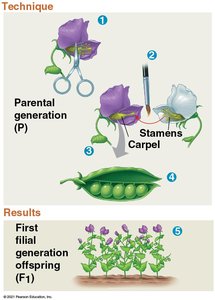
Gregor Mendel, often called the "Father of Genetics," established the basic principles of heredity through his experiments with pea plants. His discoveries laid the groundwork for modern genetics by demonstrating how traits are inherited from one generation to the next.
Key Genetic Terminology
Genes, Alleles, and Loci
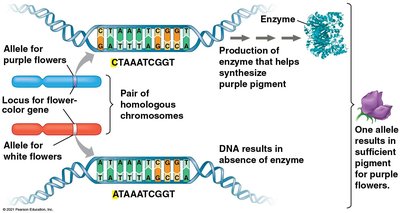
Gene: The basic unit of inheritance; a segment of DNA that encodes a functional product, usually a protein.
Allele: An alternative version of a gene found at the same locus (position) on homologous chromosomes.
Locus (plural: loci): The specific physical location of a gene on a chromosome.
Genotype and Phenotype
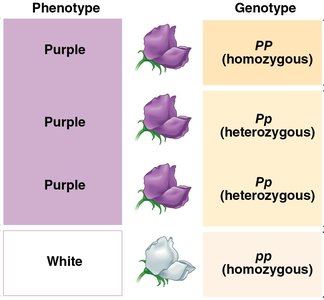
Genotype: The genetic makeup of an organism; the combination of alleles present (e.g., PP, Pp, pp).
Phenotype: The observable traits or characteristics of an organism, resulting from the interaction of its genotype with the environment.
Dominant and Recessive Alleles
Dominant allele: An allele that masks the expression of a recessive allele in a heterozygote (e.g., P for purple flowers).
Recessive allele: An allele whose expression is masked by a dominant allele; only expressed in homozygous individuals (e.g., p for white flowers).
Mendel's Experimental Approach
Selection of Pea Plant Traits
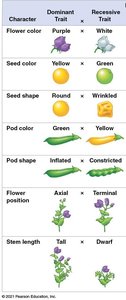
Mendel chose pea plants for their easily observable traits and ability to self- or cross-pollinate. He studied seven contrasting traits, each controlled by a single gene with two alleles.
Monohybrid Crosses and the Law of Segregation
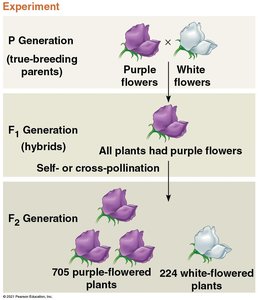
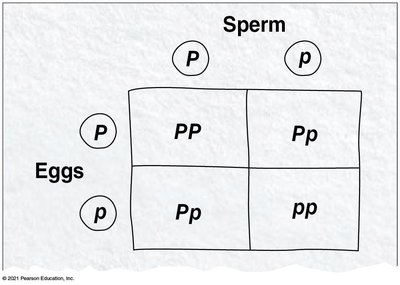
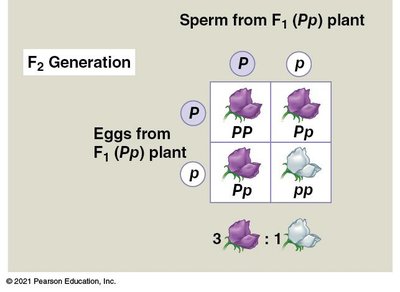
A monohybrid cross examines the inheritance of a single trait. Mendel's first law, the Law of Segregation, states that two alleles for a gene separate during gamete formation and end up in different gametes.
P Generation: True-breeding parents (e.g., PP × pp).
F1 Generation: All offspring are heterozygous (Pp) and display the dominant phenotype.
F2 Generation: Offspring show a 3:1 phenotypic ratio (dominant:recessive) and a 1:2:1 genotypic ratio (PP:Pp:pp).
Physical Basis of Segregation
The separation of alleles occurs during meiosis, when homologous chromosomes are separated into different gametes.
Mendel's Law of Independent Assortment
Dihybrid Crosses
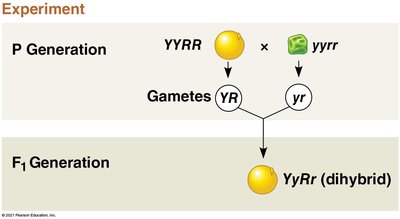
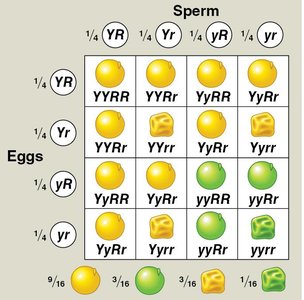
A dihybrid cross examines the inheritance of two different traits simultaneously. Mendel's second law, the Law of Independent Assortment, states that alleles of different genes assort independently during gamete formation, provided the genes are on different chromosomes.
P Generation: True-breeding for two traits (e.g., YYRR × yyrr).
F1 Generation: All offspring are double heterozygotes (YyRr).
F2 Generation: Phenotypic ratio is 9:3:3:1 (for two traits).
Extensions of Mendelian Genetics
Incomplete Dominance
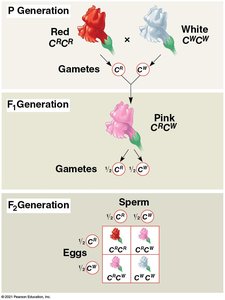
In incomplete dominance, the heterozygote displays a phenotype intermediate between the two homozygotes (e.g., red × white flowers produce pink offspring).
Codominance and Multiple Alleles
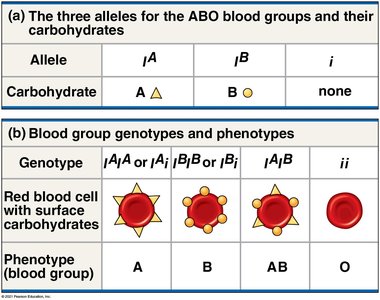
In codominance, both alleles are fully expressed in the heterozygote (e.g., human ABO blood groups). Multiple alleles can exist for a single gene, as seen in the three alleles for blood type: IA, IB, and i.
Chromosomal Basis of Inheritance
Sex Determination in Humans
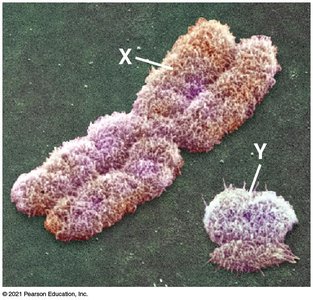
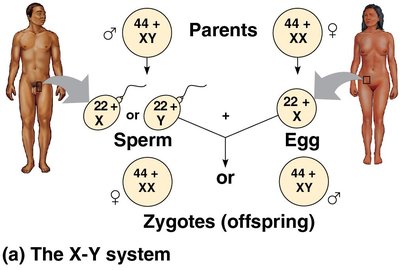
Humans have two types of sex chromosomes: X and Y. Females are XX, and males are XY. The sperm determines the sex of the offspring, as it can carry either an X or a Y chromosome.
Autosomal and Sex-Linked Inheritance
Autosomes: Chromosomes that are not sex chromosomes (humans have 22 pairs).
Sex chromosomes: X and Y chromosomes that determine biological sex.
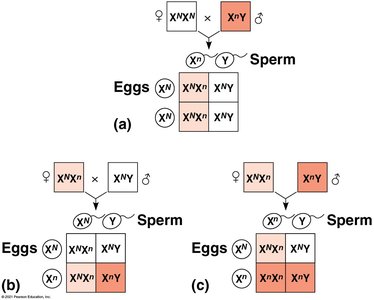
Sex-linked genes: Genes located on the X or Y chromosome; X-linked recessive traits are more likely to appear in males.
Patterns of Inheritance in Humans
Autosomal Recessive Inheritance
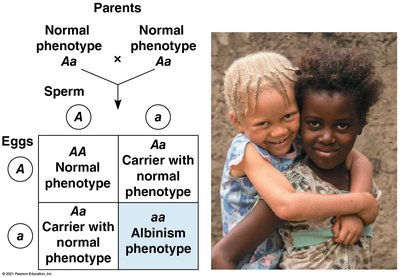
Autosomal recessive disorders require two copies of the mutant allele for the phenotype to be expressed (e.g., albinism).
Autosomal Dominant Inheritance
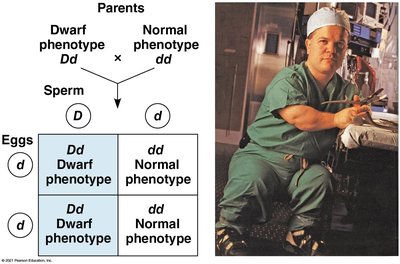
Autosomal dominant disorders require only one copy of the mutant allele for the phenotype to be expressed (e.g., dwarfism).
Pedigree Analysis
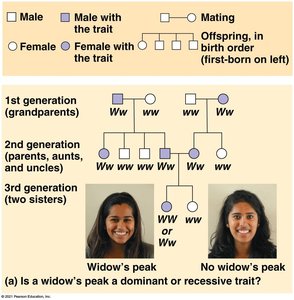
Pedigrees are diagrams that track the inheritance of traits through generations, helping to determine whether a trait is dominant, recessive, autosomal, or sex-linked.
Summary Table: Key Terms and Concepts
Term | Definition |
|---|---|
Gene | Unit of heredity; segment of DNA encoding a trait |
Allele | Alternative form of a gene |
Genotype | Genetic makeup (e.g., PP, Pp, pp) |
Phenotype | Observable trait (e.g., purple or white flowers) |
Dominant | Allele that masks the effect of a recessive allele |
Recessive | Allele masked by a dominant allele |
Homozygous | Two identical alleles (e.g., PP or pp) |
Heterozygous | Two different alleles (e.g., Pp) |
Locus | Location of a gene on a chromosome |
F1, F2 | First and second filial generations |
True-breeding | Organisms that produce offspring identical to themselves |
Additional Concepts
Pleiotropy: One gene influences multiple phenotypic traits (e.g., sickle cell disease).
Polygenic inheritance: Multiple genes contribute to a single trait, resulting in continuous variation (e.g., human skin color).
Example: Human height is a polygenic trait, influenced by several genes, leading to a wide range of phenotypes.
Additional info: These notes cover the core principles of Mendelian genetics, including extensions and human inheritance patterns, as outlined in Chapters 14 and 15 of a typical college biology textbook.
