 Back
BackMendelian Genetics: Principles of Inheritance and Experimental Evidence
Study Guide - Smart Notes
 Tailored notes based on your materials, expanded with key definitions, examples, and context.
Mendelian Genetics and the Foundations of Heredity
Introduction to Mendelian Genetics
Mendelian genetics forms the basis of classical genetics, describing how traits are inherited from one generation to the next. Gregor Mendel's experiments with garden peas established the fundamental laws of inheritance, which remain central to modern biology.
Gregor Mendel and His Experimental System
Background and Scientific Approach
Gregor Mendel was an Augustinian monk who conducted pioneering experiments on inheritance using garden peas (Pisum sativum).
He was influenced by his studies in physics and botany, which encouraged him to apply quantitative and experimental methods to biological questions.
Mendel began breeding peas around 1857, focusing on traits with clear, contrasting forms.
Advantages of Pea Plants for Genetic Studies
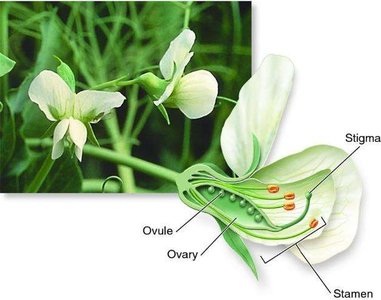
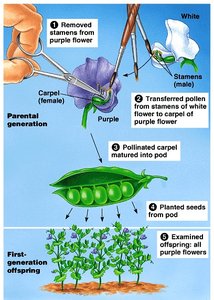
Pea plants possess both male (stamens) and female (carpels) reproductive organs, allowing for controlled self- and cross-fertilization.
They exhibit many easily distinguishable traits (e.g., flower color, seed shape).
Mendel could strictly control mating by transferring pollen between plants.
Experimental Design: Parental, F1, and F2 Generations
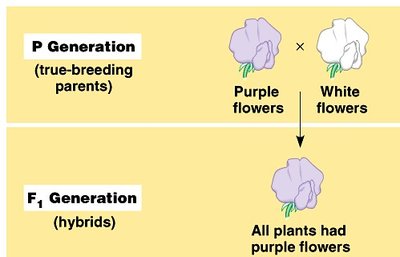
P generation: True-breeding parental plants with contrasting traits.
F1 generation: First filial generation, all hybrids showing the dominant trait.
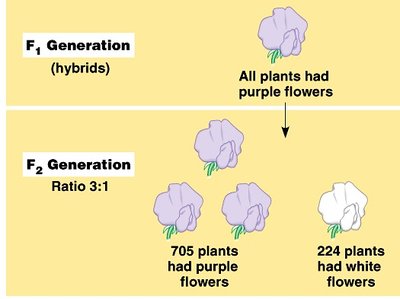
F2 generation: Offspring of self-pollinated F1 plants, showing both dominant and recessive traits in a characteristic ratio.
Key Concepts and Laws Derived from Mendel's Experiments
Monohybrid Crosses and the Law of Segregation
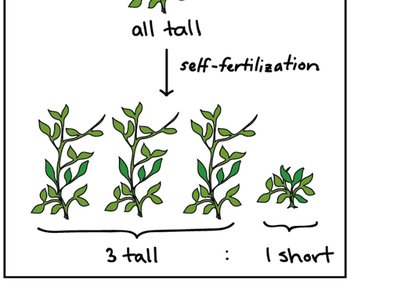
Monohybrid crosses involve tracking a single trait with two contrasting forms. Mendel's analysis of F2 generations revealed a consistent 3:1 ratio of dominant to recessive phenotypes.
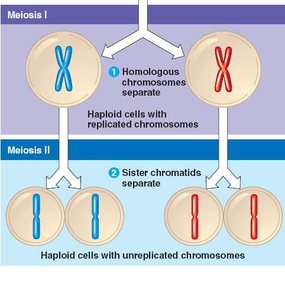
Law of Segregation: The two alleles for a heritable character segregate during gamete formation and end up in different gametes.
This explains why recessive traits can reappear in the F2 generation after being masked in F1 hybrids.
Dominant and Recessive Alleles
Allele: Alternative versions of a gene found at the same locus on homologous chromosomes.
Dominant alleles mask the expression of recessive alleles in heterozygotes.
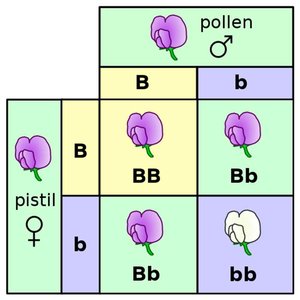
Example: In peas, the allele for purple flowers is dominant over the allele for white flowers.
Mendel's Four-Part Hypothesis
Alternative versions of genes (alleles) account for variations in inherited characters.
Each organism inherits two alleles for each character, one from each parent.
If the alleles differ, the dominant allele determines the organism’s appearance; the recessive allele has no noticeable effect.
The two alleles for each character segregate during gamete formation (law of segregation).
Punnett Squares and Predicting Genetic Crosses
Punnett squares are used to predict the genotypic and phenotypic ratios of offspring from genetic crosses, based on Mendel’s laws.
Experimental Evidence: Data and Ratios
Quantitative Results and the 3:1 Ratio
Mendel observed approximately 3:1 ratios of dominant to recessive phenotypes in F2 generations for multiple traits.
Example: In one cross, 705 F2 plants had purple flowers and 224 had white flowers.
Extension to Multiple Traits
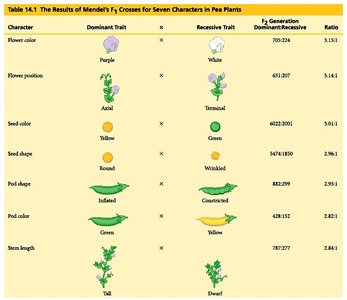
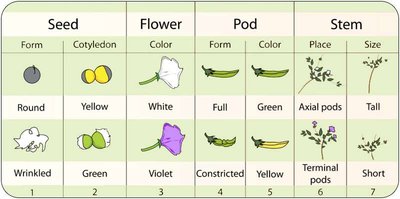
Mendel studied seven different characters, each with two contrasting traits (e.g., seed shape, flower color, pod color).
All showed similar inheritance patterns, supporting the generality of his laws.
Test Crosses and Determining Genotypes
Purpose and Method of a Test Cross
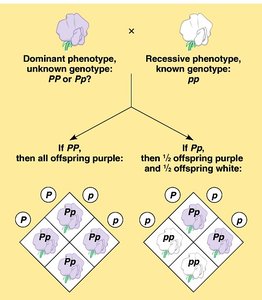
A test cross is used to determine whether an individual with a dominant phenotype is homozygous dominant or heterozygous.
The individual is crossed with a homozygous recessive plant; the offspring phenotypes reveal the unknown genotype.
Practice Problem Example
Sample Problem: Beetle Color Cross
A true-breeding black beetle (BB) is crossed with a true-breeding brown beetle (bb). All F1 offspring are black (Bb).
F1 individuals are self-crossed to produce F2 generation.
Expected F2 genotypic ratio: 1 BB : 2 Bb : 1 bb
Expected F2 phenotypic ratio: 3 black : 1 brown
Punnett Square:
Summary Table: Mendel's Seven Pea Plant Characters
Character | Dominant Trait | Recessive Trait | F2 Generation Dominant:Recessive | Ratio |
|---|---|---|---|---|
Flower color | Purple | White | 705:224 | 3.15:1 |
Flower position | Axial | Terminal | 651:207 | 3.14:1 |
Seed color | Yellow | Green | 6,022:2,001 | 3.01:1 |
Seed shape | Round | Wrinkled | 5,474:1,850 | 2.96:1 |
Pod color | Green | Yellow | 428:152 | 2.82:1 |
Pod shape | Inflated | Constricted | 882:299 | 2.95:1 |
Stem length | Tall | Dwarf | 787:277 | 2.84:1 |
Key Terms and Definitions
Gene: A unit of heredity that encodes information for a specific trait.
Allele: One of two or more alternative forms of a gene.
Homozygous: Having two identical alleles for a gene.
Heterozygous: Having two different alleles for a gene.
Genotype: The genetic makeup of an organism.
Phenotype: The observable traits of an organism.
Monohybrid cross: A cross between individuals heterozygous for a single trait.
Punnett square: A diagram used to predict the outcome of a genetic cross.
Additional info:
Mendel’s work laid the foundation for the chromosomal theory of inheritance, connecting genes to specific loci on chromosomes.
His principles apply to many organisms and traits, though exceptions exist (e.g., incomplete dominance, codominance, polygenic inheritance).
