 Back
BackMendelian Inheritance: Principles, Patterns, and Extensions
Study Guide - Smart Notes
 Tailored notes based on your materials, expanded with key definitions, examples, and context.
Mendelian Inheritance
Introduction to Mendelian Genetics
Mendelian genetics forms the foundation of classical genetics, describing how traits are inherited from one generation to the next. Gregor Mendel's experiments with pea plants led to the discovery of fundamental laws governing heredity, which remain central to our understanding of genetics today.
Gregor Mendel and His Experiments
Gregor Mendel is known as the "father of genetics" for his pioneering work with Pisum sativum (pea plants).
He used a scientific approach to study heredity, focusing on traits with clear, contrasting forms.
Mendel's experiments involved crossing true-breeding plants and analyzing the resulting generations.
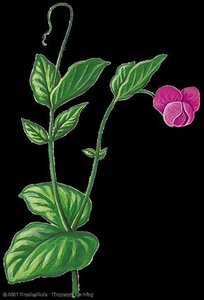
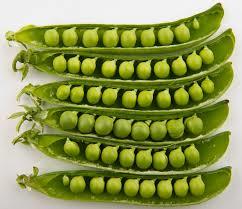
Why Pea Plants?
Pea plants have easily distinguishable traits (e.g., flower color, seed shape).
They have short generation times and produce many offspring.
They can self-fertilize or be cross-fertilized, allowing controlled breeding experiments.
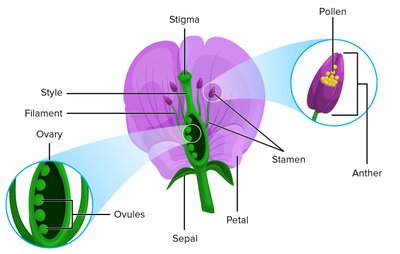
Sexual Reproduction in Pea Plants
Pea plants reproduce sexually, with each flower containing both male (stamens) and female (carpel) reproductive organs. This structure allows for both self-fertilization and cross-fertilization.
Stamens: Produce pollen (sperm cells).
Carpel (Pistil): Contains the stigma, style, and ovary (with ovules/egg cells).
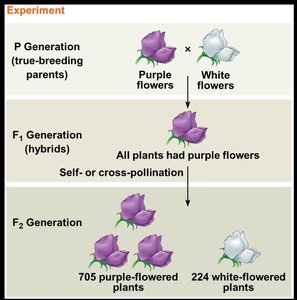
Mendel's Experimental Design and Results
Parental, F1, and F2 Generations
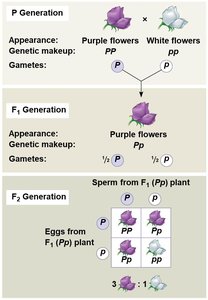
Mendel crossed true-breeding plants with contrasting traits (e.g., purple vs. white flowers). The first generation (F1) all showed the dominant trait, while the second generation (F2) revealed a consistent ratio of dominant to recessive phenotypes.
P Generation: True-breeding parents (e.g., purple × white flowers).
F1 Generation: All hybrids showed the dominant trait (purple flowers).
F2 Generation: Both traits reappeared in a 3:1 ratio (dominant:recessive).
Dominant and Recessive Alleles
Mendel concluded that traits are determined by discrete units (now called genes), which exist in different forms (alleles). The dominant allele masks the effect of the recessive allele in heterozygotes.
Dominant allele: Expressed in the phenotype when present (e.g., purple flower color).
Recessive allele: Only expressed when two copies are present (e.g., white flower color).
Genotype vs. Phenotype
Genotype: The genetic makeup (combination of alleles) for a trait (e.g., PP, Pp, pp).
Phenotype: The observable trait (e.g., purple or white flowers).
Homozygous: Two identical alleles (PP or pp).
Heterozygous: Two different alleles (Pp).
Mendel's Laws of Inheritance
Law of Segregation
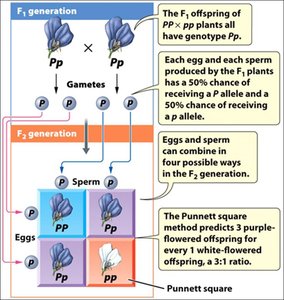
The law of segregation states that two alleles for a trait separate during gamete formation, so each gamete carries only one allele for each gene. This explains the 3:1 ratio observed in the F2 generation.
Each parent contributes one allele to the offspring.
Alleles segregate during meiosis, resulting in gametes with different genetic combinations.
Punnett Squares and Probability
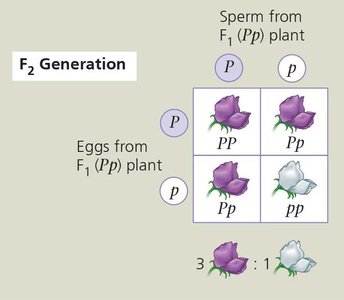
Punnett squares are used to predict the probability of genotypes and phenotypes in offspring from specific crosses.
Each box represents a possible genotype for the offspring.
Ratios can be calculated for both genotype and phenotype outcomes.
Law of Independent Assortment
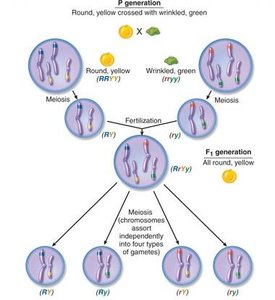
The law of independent assortment states that genes located on different chromosomes are inherited independently of each other. This means the inheritance of one trait does not affect the inheritance of another.
Applies to genes on different chromosomes or those far apart on the same chromosome.
Explains the variety of genetic combinations seen in offspring.
Extensions and Complexities of Mendelian Genetics
Beyond Simple Dominance
Not all traits follow simple Mendelian patterns. Some traits are influenced by multiple alleles, incomplete dominance, codominance, or polygenic inheritance.
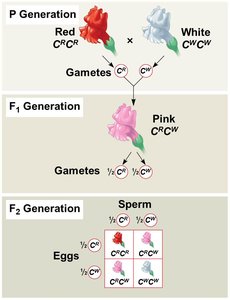
Incomplete dominance: Heterozygotes show a blend of traits (e.g., red × white flowers produce pink flowers).
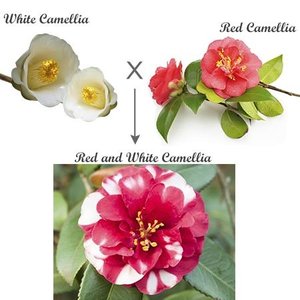
Codominance: Both alleles are fully expressed in heterozygotes (e.g., red and white patches).
Multiple alleles: More than two possible alleles exist for a gene (e.g., blood types in humans).
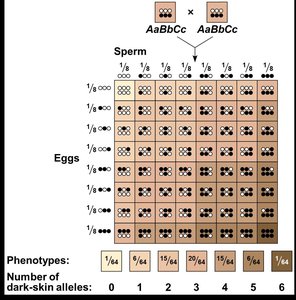
Polygenic inheritance: Traits are controlled by multiple genes (e.g., skin color, height).
Genetic Disorders and Inheritance Patterns
Dominant and Recessive Disorders
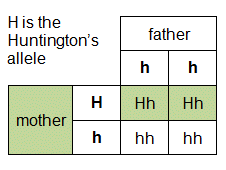
Dominant disorders (less common): Only one copy of the faulty allele is needed for the disorder to be expressed (e.g., Huntington's disease).
Recessive disorders (more common): Two copies of the faulty allele are needed for the disorder to be expressed (e.g., albinism, cystic fibrosis, Tay-Sachs disease).
Key Terminologies in Mendelian Genetics
Heredity: Transmission of traits from parents to offspring.
Trait: A specific characteristic of an organism.
Gene: A unit of heredity that encodes information for a trait.
Locus: The specific location of a gene on a chromosome.
Allele: Different forms of a gene.
Dominant allele: Expressed when present.
Recessive allele: Expressed only when two copies are present.
Phenotype: Observable traits.
Genotype: Genetic makeup.
Homozygous: Two identical alleles.
Heterozygous: Two different alleles.
P, F1, F2 generation: Parental, first filial, and second filial generations.
Law of segregation: Alleles separate during gamete formation.
Law of independent assortment: Genes on different chromosomes assort independently.
Incomplete dominance: Blending of traits in heterozygotes.
Codominance: Both alleles expressed in heterozygotes.
Multiple alleles: More than two alleles for a gene.
Polygenic inheritance: Trait controlled by multiple genes.
Summary Table: Mendel's F2 Crosses for Seven Characters in Pea Plants
Character | Dominant Trait | Recessive Trait | F2 Generation Dominant:Recessive | Ratio |
|---|---|---|---|---|
Flower color | Purple | White | 705:224 | 3.15:1 |
Seed color | Yellow | Green | 6,022:2,001 | 3.01:1 |
Seed shape | Round | Wrinkled | 5,474:1,850 | 2.96:1 |
Pod shape | Inflated | Constricted | 882:299 | 2.95:1 |
Pod color | Green | Yellow | 428:132 | 3.24:1 |
Flower position | Axial | Terminal | 651:207 | 3.14:1 |
Stem length | Tall | Dwarf | 787:277 | 2.84:1 |
Additional info: This summary includes expanded academic context and definitions to ensure the notes are self-contained and suitable for exam preparation.
