 Back
BackNervous Systems: Structure, Function, and Evolution in Animals
Study Guide - Smart Notes
 Tailored notes based on your materials, expanded with key definitions, examples, and context.
Nervous Systems: Overview and Evolution
Introduction to Nervous Systems
The nervous system is a complex network responsible for coordinating sensory input, integration, and motor output in animals. Its structure and complexity vary widely across the animal kingdom, reflecting evolutionary adaptations to different lifestyles and environments.
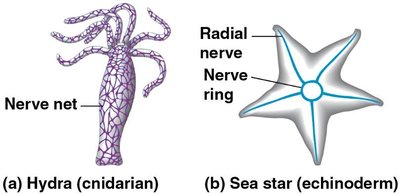
Simple animals (e.g., cnidarians) possess nerve nets—diffuse networks of interconnected neurons.
Complex animals (e.g., vertebrates) have centralized nervous systems with bundled axons forming nerves.
Evolution of Nervous Systems
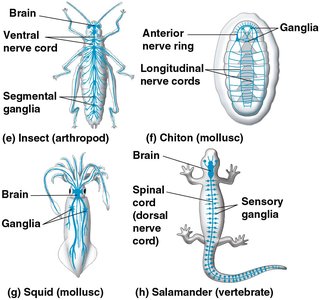
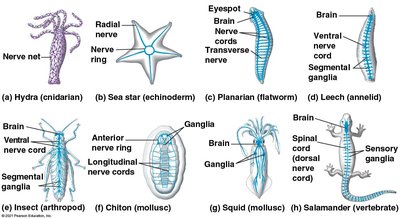
Nervous systems have evolved from simple nerve nets to highly centralized and specialized structures in vertebrates. This evolutionary trend is associated with increased behavioral complexity and sensory processing.
Nerve nets: Found in cnidarians, allow basic responses to stimuli.
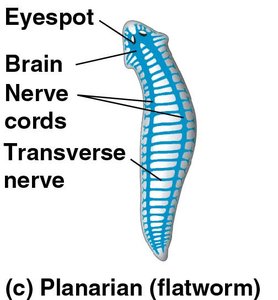
Centralization: Flatworms and more complex animals show clustering of neurons into ganglia and brains.
Cephalization: The development of a head region with concentrated sensory organs and neural processing centers.
Structure and Function of the Vertebrate Nervous System
Central Nervous System (CNS)
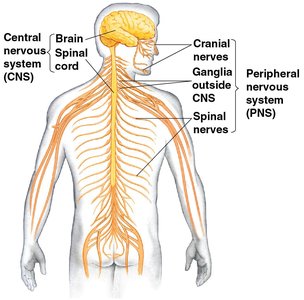
The vertebrate CNS consists of the brain and spinal cord. It develops from a hollow, dorsal nerve cord and is responsible for processing information and generating responses.
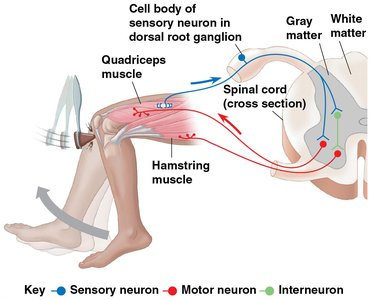
Spinal cord: Conveys information to and from the brain; generates patterns of locomotion and produces reflexes (automatic responses to stimuli).
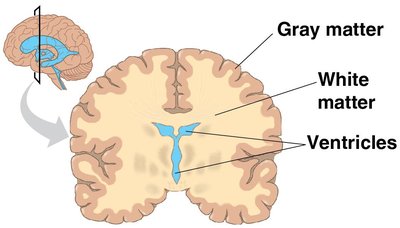
Gray matter: Contains neuron cell bodies, dendrites, and unmyelinated axons.
White matter: Composed of myelinated axons that facilitate rapid signal transmission.
Peripheral Nervous System (PNS)
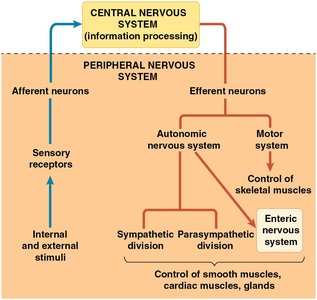
The PNS connects the CNS to the rest of the body and is divided into sensory (afferent) and motor (efferent) components.
Afferent neurons: Transmit sensory information to the CNS.
Efferent neurons: Carry signals away from the CNS to effectors (muscles and glands).
Motor system: Controls voluntary and involuntary movements of skeletal muscles.
Autonomic nervous system: Regulates involuntary functions of smooth and cardiac muscles, and glands.
Autonomic Nervous System: Sympathetic and Parasympathetic Divisions
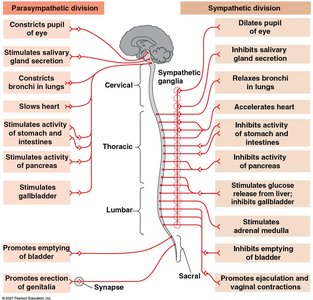
The autonomic nervous system is subdivided into the sympathetic and parasympathetic divisions, which have antagonistic effects on target organs.
Sympathetic division: Prepares the body for energy expenditure and stress ("fight-or-flight" response).
Parasympathetic division: Promotes calming and maintenance activities ("rest-and-digest" functions).
Glial Cells
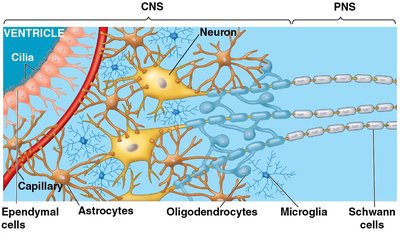
Glia are non-neuronal cells that support, nourish, and regulate neurons. They play essential roles in maintaining homeostasis, forming myelin, and providing support and protection for neurons.
Astrocytes: Support and regulate the extracellular environment.
Oligodendrocytes (CNS) and Schwann cells (PNS): Form myelin sheaths around axons.
Microglia: Act as immune cells in the CNS.
Vertebrate Brain Structure and Function
Major Brain Regions
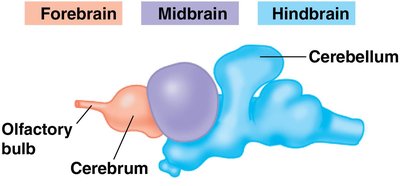
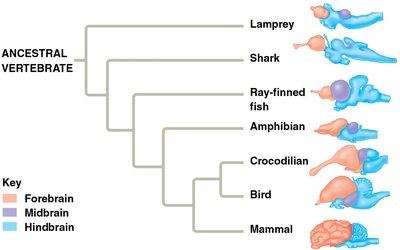
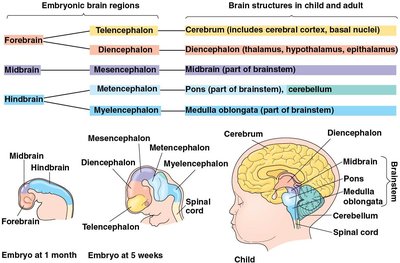
The vertebrate brain is divided into several major regions, each with specialized functions. These regions develop from embryonic brain vesicles and undergo significant changes during evolution and development.
Forebrain: Includes the cerebrum and diencephalon (thalamus, hypothalamus, epithalamus).
Midbrain: Involved in processing sensory information and coordinating movement.
Hindbrain: Includes the cerebellum, pons, and medulla oblongata; controls vital functions and motor coordination.
Cerebrum and Cerebral Cortex
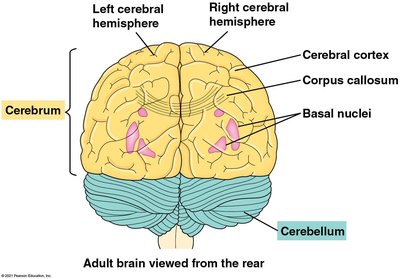
The cerebrum is the largest part of the human brain and is responsible for higher cognitive functions, voluntary movement, and sensory perception. The cerebral cortex is the outer layer of the cerebrum and is highly folded to increase surface area.
Left and right hemispheres: Connected by the corpus callosum; each hemisphere controls the opposite side of the body.
Basal nuclei: Involved in the control of movement.
Diencephalon, Cerebellum, and Brainstem
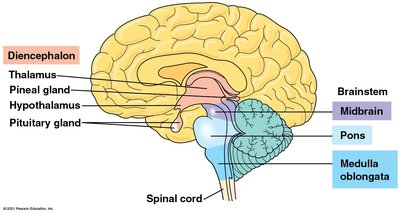
The diencephalon contains the thalamus (sensory relay), hypothalamus (homeostasis and endocrine regulation), and other structures. The cerebellum coordinates movement and balance. The brainstem (midbrain, pons, medulla oblongata) controls basic life functions.
The Cerebral Cortex: Information Processing and Cognition
Regional Specialization of the Cortex
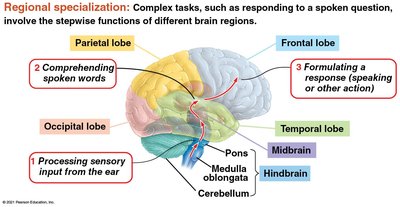
The cerebral cortex is divided into lobes, each with specialized functions. Complex tasks, such as responding to spoken language, involve the coordinated activity of multiple regions.
Frontal lobe: Planning, decision making, voluntary movement, speech production.
Parietal lobe: Sensory processing, spatial orientation.
Temporal lobe: Auditory processing, language comprehension.
Occipital lobe: Visual processing.
Language and Lateralization
Language processing is localized to specific areas in the cortex. Lateralization refers to the specialization of certain functions in one hemisphere.
Broca's area: Speech production; damage impairs speaking but not comprehension.
Wernicke's area: Language comprehension; damage impairs understanding but not speech production.
Left hemisphere: Dominant for language, math, and logic.
Right hemisphere: Dominant for spatial relations, pattern recognition, and nonverbal thinking.
Evolution of Cognition in Vertebrates
The size and complexity of the cerebral cortex have increased during vertebrate evolution, supporting advanced cognitive abilities such as reasoning, planning, and abstract thought.
Example: The case of Phineas Gage illustrates the role of the prefrontal cortex in temperament and decision making.
Summary Table: Organization of the Nervous System
Component | Main Structures | Primary Functions |
|---|---|---|
Central Nervous System (CNS) | Brain, Spinal Cord | Information processing, integration, reflexes |
Peripheral Nervous System (PNS) | Cranial and spinal nerves, ganglia | Transmission of signals to/from CNS |
Somatic (Motor) System | Motor neurons | Voluntary and involuntary control of skeletal muscles |
Autonomic System | Sympathetic, Parasympathetic, Enteric divisions | Involuntary control of smooth/cardiac muscle, glands |
Additional info: This guide integrates foundational concepts from Ch. 48 (Neurons, Synapses, and Signaling) and Ch. 49 (Nervous Systems) of a typical college biology curriculum, providing a comprehensive overview suitable for exam preparation.
