 Back
BackPlant Form and Function: Structure, Diversity, and Growth
Study Guide - Smart Notes
 Tailored notes based on your materials, expanded with key definitions, examples, and context.
Plant Form and Function
Overview of Plant Body Structure
Plants are composed of two main organ systems: the shoot system and the root system. These systems work together to support growth, reproduction, and survival in diverse environments.
Shoot System: Includes stems, leaves, and reproductive structures (flowers).
Root System: Anchors the plant, absorbs water and minerals, and stores energy.
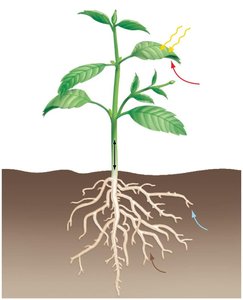
Surface Area to Volume Relationships
The efficiency of resource absorption and transport in plants is influenced by the surface area to volume ratio. Roots and leaves are adapted to maximize surface area for absorption and photosynthesis.
Root System
Functions and Diversity of Roots
The root system anchors the plant, absorbs water and nutrients, and stores carbohydrates. Root morphology varies widely among species and environments, contributing to plant survival and adaptation.
Anchorage: Roots stabilize plants in the soil.
Absorption: Uptake of water and minerals (e.g., nitrogen, phosphorus, potassium).
Storage: Some roots store carbohydrates for later use.
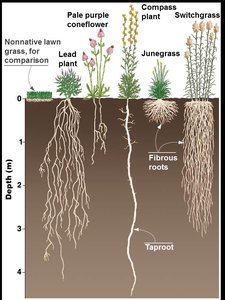
Morphological Diversity: Prairie plants exhibit diverse root structures; perennial roots can survive fire.
Phenotypic Plasticity: Root form can change in response to environmental conditions.
Modified Roots
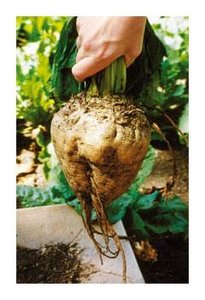
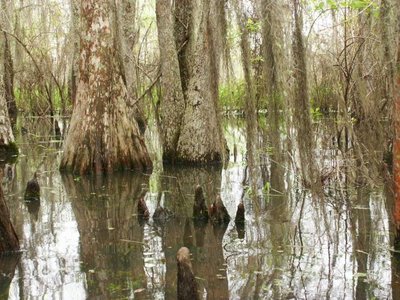
Roots can be specialized for storage, support, or gas exchange, depending on the plant's habitat and needs.
Storage Roots: Modified taproots store carbohydrates (e.g., sugar beets, carrots, turnips, sweet potatoes).
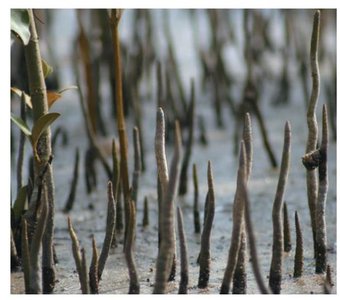
Air Roots (Pneumatophores): Facilitate gas exchange in waterlogged soils.
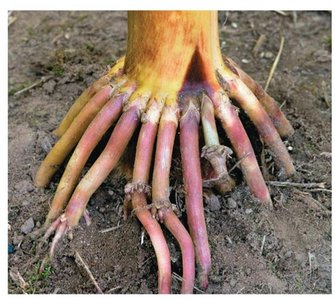
Prop Roots: Provide additional support for tall or top-heavy plants.
Shoot System
Structure and Function of Stems and Leaves
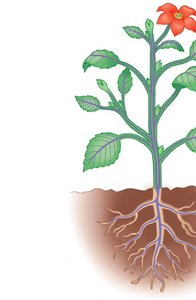
The shoot system supports leaves and flowers, facilitates transport, and enables photosynthesis. Key components include nodes, internodes, apical buds, axillary buds, blades, and petioles.
Stems: Support leaves and flowers; contain nodes (attachment points) and internodes (stem segments between nodes).
Apical Bud: Undeveloped shoot at the apex, responsible for vertical growth.
Axillary Buds: Undeveloped shoots at nodes, can develop into branches.
Leaves: Blade (site of photosynthesis) and petiole (attaches blade to stem).
Morphological Diversity and Phenotypic Plasticity in Shoots
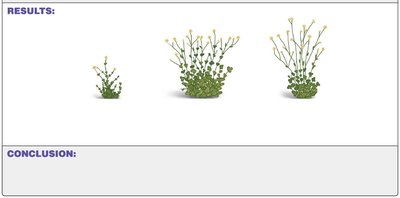
Plant shoot morphology varies with species and environmental conditions. Phenotypic plasticity allows plants to alter growth form in response to habitat.
Experiment: Clones from different elevations grown in various habitats show that both environment and genetics influence plant morphology.
Modified Stems
Stems can be specialized for reproduction, storage, or water conservation.
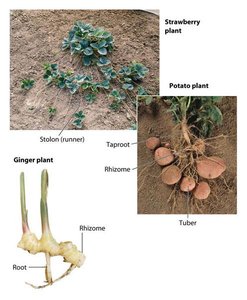
Stolon: Horizontal stem growing along the ground, enables asexual reproduction.
Rhizome: Horizontal underground stem, stores food and enables asexual reproduction.
Tuber: Enlarged end of a rhizome, stores food (e.g., potatoes).
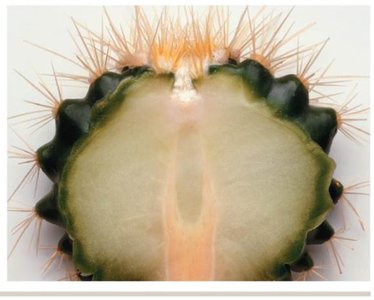
Water Storage Stems: Adapted for arid environments.
Modified Leaves
Leaves can be adapted for climbing, defense, storage, or trapping prey.
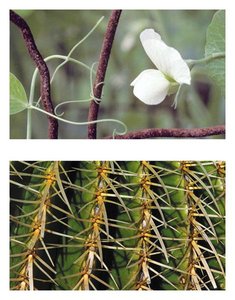
Tendrils: Help plants climb (e.g., pea plants).
Spines: Provide defense and shade (e.g., cacti).
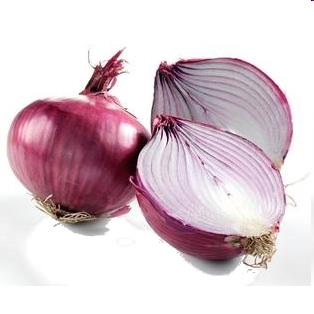
Bulbs: Store carbohydrates (e.g., onions).
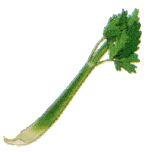
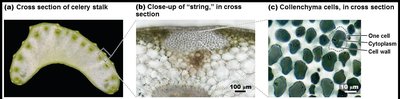
Enlarged Petioles: Store water or nutrients (e.g., celery).
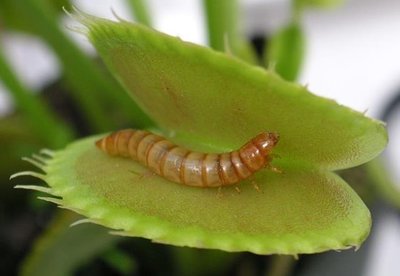
Traps: Capture prey for nutrient acquisition (e.g., Venus flytrap).
Plant Cells and Tissues
Unique Features of Plant Cells
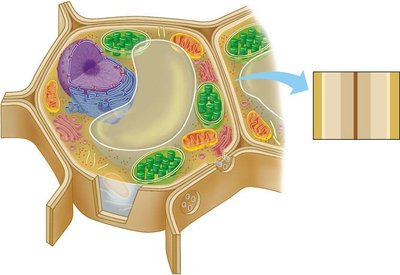
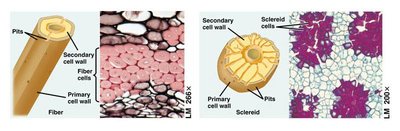
Plant cells differ from animal cells by having a rigid cell wall, large central vacuole, and plastids (e.g., chloroplasts). Some plant cells have a two-part cell wall: primary and secondary walls, with a sticky middle lamella holding cells together.
Primary Cell Wall: Flexible, allows growth.
Secondary Cell Wall: Rigid, provides support.
Middle Lamella: Sticky layer between cells.
Pits: Thin areas in cell walls for water movement.
Plasmodesmata: Channels connecting adjacent cells for communication.
Three Tissue Systems in Plants
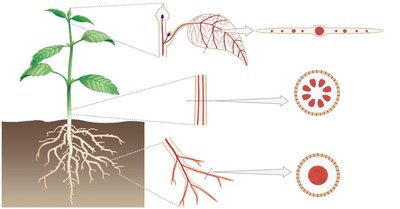
Plant organs are composed of three main tissue systems: dermal, ground, and vascular tissues. Each system has specialized cell types and functions.
Dermal Tissue System: Protective outer layer (epidermis, cuticle, stomata, trichomes).
Ground Tissue System: Bulk of plant tissue (parenchyma, collenchyma, sclerenchyma).
Vascular Tissue System: Transport of water, nutrients, and sugars (xylem, phloem).
Dermal Tissue System
The dermal tissue system protects the plant and regulates interactions with the environment.
Epidermis: Outer layer of tightly packed cells.
Cuticle: Waxy layer preventing water loss and defending against pathogens.
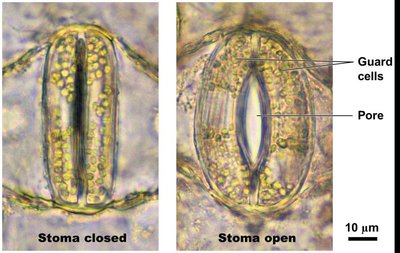
Stomata: Pores surrounded by guard cells, regulate gas exchange.
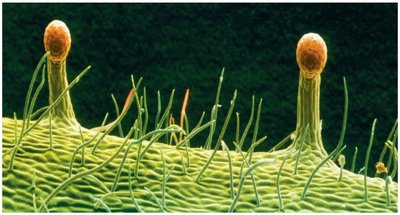
Trichomes: Hair-like structures that reflect sunlight, limit transpiration, and deter herbivores.
Ground Tissue System
The ground tissue system performs photosynthesis, stores nutrients, and provides structural support.
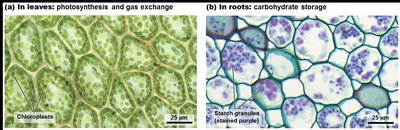
Parenchyma: Thin primary cell wall, most abundant, perform metabolic functions, can differentiate.
Collenchyma: Thickened primary walls with pectin, provide flexible support in growing regions.
Sclerenchyma: Thick secondary walls with lignin, support mature regions, cells are dead at maturity.
Vascular Tissue System
The vascular tissue system transports water, nutrients, and sugars throughout the plant and provides structural support.
Xylem: Transports water, composed of tracheids and vessel elements, cells dead at maturity, lignified walls.
Phloem: Transports sugars, composed of sieve-tube members and companion cells, cells alive at maturity.
Vascular Tissue | Main Cell Types | Function |
|---|---|---|
Xylem | Tracheids, Vessel Elements | Water transport, support |
Phloem | Sieve-tube Members, Companion Cells | Sugar transport |
Plant Growth and Meristems
Types of Plant Growth
Plants exhibit indeterminate growth (continuous growth throughout life) or determinate growth (growth stops at a certain size). Growth occurs at meristems, regions of actively dividing cells.
Indeterminate Growth: Most plants, continuous growth.
Determinate Growth: Most animals, some plant organs (leaves, flowers).
Meristems: Apical (tips of roots and shoots), lateral (increase width).
Primary Growth
Primary growth increases the length of roots and shoots, forming the plant body. It is produced by apical meristems and occurs in both herbaceous and woody plants.
Zones of Growth in Roots:
Zone of cell division: New cells produced.
Zone of elongation: Cells elongate, pushing root into soil.
Zone of maturation: Cells differentiate into tissue systems.
Apical Dominance: Apical bud inhibits growth of axillary buds; removal allows lateral shoots to develop.
Secondary Growth
Secondary growth increases the width of woody stems and roots, produced by lateral meristems (vascular cambium and cork cambium).
Vascular Cambium: Produces secondary xylem (wood) and secondary phloem.
Cork Cambium: Produces cork, forming part of the bark.
Annual Growth Rings: Each year, a new ring of wood forms, allowing age determination.
Bark: Includes cork, cork cambium, and secondary phloem; protects stem and is shed periodically.
Heartwood: Old, non-conducting secondary xylem.
Sapwood: Secondary xylem that still conducts water and minerals.
Review and Application
Major Plant Parts and Their Functions
Roots: Anchorage, absorption, storage.
Stems: Support, transport, storage, reproduction.
Leaves: Photosynthesis, gas exchange, storage, defense.
Functions of Tissue Systems and Cell Types
Dermal Tissue: Protection, water regulation.
Ground Tissue: Metabolism, storage, support.
Vascular Tissue: Transport, support.
Primary vs. Secondary Growth
Growth Type | Meristem Responsible | Tissues Produced | Plant Types |
|---|---|---|---|
Primary | Apical Meristem | Primary tissues (dermal, ground, vascular) | All plants |
Secondary | Lateral Meristem (Vascular & Cork Cambium) | Secondary xylem, phloem, cork | Woody plants |
Phenotypic Plasticity
Genetically identical plantlets grown in different environments may show different phenotypes due to phenotypic plasticity, demonstrating the influence of environmental conditions on plant form.
Key Terms and Definitions
Apical Meristem: Region of cell division at tips of roots and shoots.
Vascular Cambium: Lateral meristem producing secondary xylem and phloem.
Cork Cambium: Lateral meristem producing cork.
Parenchyma: Metabolically active ground tissue cells.
Collenchyma: Flexible support cells in ground tissue.
Sclerenchyma: Rigid support cells with lignified walls.
Tracheids & Vessel Elements: Water-conducting cells in xylem.
Sieve-tube Members & Companion Cells: Sugar-conducting cells in phloem.
Equations and Formulas
Surface area to volume ratio is important for absorption and transport:
Additional info: These notes expand on the original content by providing definitions, examples, and tables for comparison, ensuring a comprehensive and self-contained study guide for college-level biology students.
