 Back
Topic7A Plant Growth and Transport: Physiology and Cell Biology Study Notes
Study Guide - Smart Notes
 Tailored notes based on your materials, expanded with key definitions, examples, and context.
Topic7A Plant Growth and Transport
Introduction to Plant Growth and Transport
Plant growth and transport are fundamental aspects of plant physiology and cell biology. Understanding how plants grow in height and thickness, and how they transport water, minerals, and sugars, is essential for comprehending plant adaptation and survival on land.
Why Are Some Plants Small and Others Tall?
Primary vs. Secondary Growth
Plants exhibit two main types of growth: primary growth (increase in length) and secondary growth (increase in thickness). Primary growth is driven by apical meristems, while secondary growth is driven by lateral meristems.
Primary Growth: Responsible for elongation of roots and shoots.
Secondary Growth: Responsible for thickening of stems and roots, mainly in woody plants.


Example: Sequoia sempervirens can grow over 100 meters tall due to extensive secondary growth, while mosses remain small due to the absence of vascular and supportive tissues.
Adaptations to Life on Land
Advantages and Disadvantages
Transitioning to terrestrial life provided plants with new opportunities and challenges.
Advantages:
Abundant sunlight for photosynthesis
Greater availability of CO2 and O2
Disadvantages:
Water scarcity and risk of desiccation
Need for structural support against gravity
Separation of resources (water/nutrients in soil, gases in air)
Challenges in gamete dispersal
Key Adaptations:
Development of vascular tissues (xylem and phloem)
Regulated stomata to control water loss
Thicker cell walls with lignin for support
Protective structures for reproduction (seeds, pollen)
Primary Growth: Growing Tall
Apical Meristems
Primary growth occurs at the tips of roots and shoots due to the activity of apical meristems, which are regions of undifferentiated, actively dividing cells.
Shoot Apical Meristem: Produces new cells for stem and leaf elongation.
Root Apical Meristem: Produces new cells for root elongation.

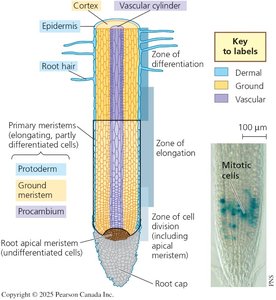
Root Apical Meristem: Structure and Function
The root tip contains several zones:
Root Cap: Protects the meristem as the root pushes through soil.
Zone of Cell Division: Includes the apical meristem and primary meristems (protoderm, ground meristem, procambium).
Zone of Elongation: Cells elongate, pushing the root tip forward.
Zone of Differentiation: Cells mature into specialized tissues (dermal, ground, vascular).

Shoot Apical Meristem: Structure and Function
The shoot apical meristem is responsible for the upward growth of stems and the formation of leaves and axillary buds.
Leaf Primordia: Small outgrowths that develop into leaves.
Axillary Bud Meristems: Can give rise to branches or flowers.
Apical Dominance
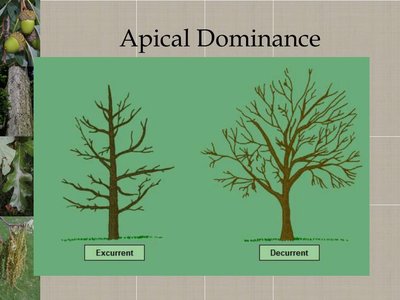
Apical dominance is the phenomenon where the main, central stem of the plant is dominant over (i.e., grows more strongly than) other side stems; this is regulated by plant hormones such as auxin.
Excurrent Growth: Strong apical dominance, resulting in a single, tall trunk (e.g., conifers).
Decurrent Growth: Weaker apical dominance, resulting in a more branched form (e.g., many angiosperms).

Secondary Growth: Growing Thick
Lateral Meristems
Secondary growth increases the thickness of stems and roots and is driven by two types of lateral meristems:
Vascular Cambium: Produces secondary xylem (wood) and secondary phloem.
Cork Cambium: Produces cork cells, contributing to the bark.


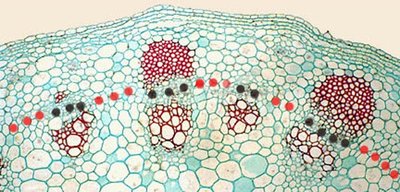
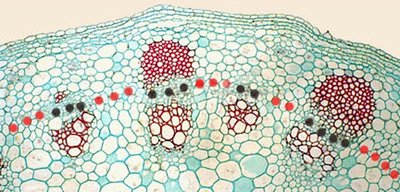
Structure of Woody Stems
Woody stems show distinct layers due to secondary growth:
Secondary Xylem: Forms the bulk of wood.
Secondary Phloem: Part of the bark, transports sugars.
Cork and Phelloderm: Protective outer layers.
Tree Rings and Dendrochronology
Annual rings in wood are formed due to seasonal variations in growth rate, with early wood (spring) being lighter and late wood (summer/fall) being denser. The study of these rings is called dendrochronology and is used to determine the age of trees and past climate conditions.
Vascular vs. Non-Vascular Plants
Key Differences
Feature | Vascular Plants | Non-Vascular Plants (e.g., Mosses) |
|---|---|---|
Vascular Tissue | Present (xylem & phloem) | Absent |
Support | Lignin in cell walls | Only cellulose |
Size | Can grow tall | Remain small |
Water Transport | Efficient, long-distance | Short-distance, by diffusion |
Example: Mosses lack vascular tissue and lignin, limiting their size and ability to transport water efficiently.
Water and Sugar Transport in Plants
Water Transport
Water is absorbed by roots and transported upward through the xylem, driven by transpiration (evaporation from leaves) and water potential gradients.
Xylem: Conducts water and minerals from roots to shoots.
Transpiration: Loss of water vapor from leaves, creating a pull that draws water upward.
Sugar Transport
Sugars produced in leaves (source) are transported to other parts of the plant (sink) via the phloem.
Phloem: Conducts sugars and other organic molecules throughout the plant.
Source to Sink: Movement from areas of production (leaves) to areas of storage or use (roots, fruits).

Summary Table: Primary vs. Secondary Growth
Growth Type | Location | Meristem | Result |
|---|---|---|---|
Primary Growth | Root and shoot tips | Apical meristem | Increase in length |
Secondary Growth | Stems and roots (woody plants) | Lateral meristems (vascular & cork cambium) | Increase in thickness |
Key Terms
Meristem: Region of undifferentiated cells capable of division and growth.
Apical Meristem: Located at tips of roots and shoots; responsible for primary growth.
Lateral Meristem: Includes vascular and cork cambium; responsible for secondary growth.
Xylem: Vascular tissue that transports water and minerals.
Phloem: Vascular tissue that transports sugars and organic nutrients.
Auxin: Plant hormone involved in apical dominance and growth regulation.
Dendrochronology: Study of tree ring patterns to determine age and environmental history.
