 Back
BackPlant Structure, Growth, and Development: Study Notes
Study Guide - Smart Notes
 Tailored notes based on your materials, expanded with key definitions, examples, and context.
Plant Body Plan and Organization
Basic Plant Structure
The plant body is organized into a repetitive sequence of organs and tissues, which are genetically determined and subject to natural selection. Plants exhibit greater diversity in body forms compared to animals, and their structure is composed of organs, tissues, and cells.
Organ: A structure composed of different tissues that performs specific functions.
Tissue: A group of cells of one or more types working together for a specialized function.
Cell: The fundamental unit of life, possessing both form and function.
Root and Shoot Systems
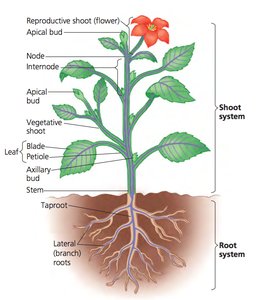
Plants are divided into two main systems: the root system and the shoot system. The root system anchors the plant, absorbs water and minerals, and stores carbohydrates. The shoot system includes stems, leaves, and flowers, and is responsible for photosynthesis and reproduction.
Taproot system: Main vertical root with lateral roots; common in tall, erect plants.
Fibrous root system: Network of roots in small or trailing plants.
Root hairs: Increase surface area for absorption.
Mycorrhizal associations: Symbiotic fungi enhance mineral absorption.
Stem: Elongates and orients the shoot for maximum photosynthesis.
Nodes: Attachment points for leaves.
Internodes: Stem segments between nodes.
Apical bud: Located at shoot tip, causes elongation.
Axillary bud: Can form lateral branches, thorns, or flowers.
Modified Stems and Leaves
Stems and leaves can be modified for specialized functions.
Rhizomes: Horizontal underground stems.
Stolons: Horizontal stems along the surface for asexual reproduction.
Tubers: Enlarged ends of rhizomes or stolons for food storage.
Tendrils: Modified leaves for support.
Spines: Modified leaves for defense (e.g., cactus).
Storage leaves: Bulbs for food storage.
Reproductive leaves: Produce plantlets for independent establishment.
Plant Tissue Systems
Overview of Tissue Systems
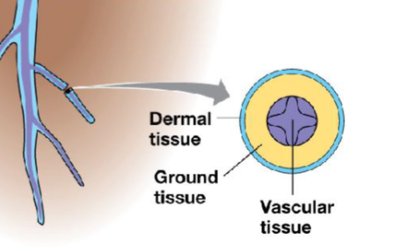
All plant organs are composed of three main tissue systems: dermal, vascular, and ground tissue. Each system has distinct functions and structural characteristics.
Dermal tissue: Outer protective covering; includes cuticle and periderm.
Vascular tissue: Transport system; includes xylem (water/minerals) and phloem (sugars).
Ground tissue: Functions in storage, photosynthesis, support, and short-distance transport.
Vascular Tissue Arrangement
Vascular tissue forms a central cylinder in roots (vascular cylinder), vascular bundles in shoots, and veins in leaves. Ground tissue internal to vascular tissue is called pith; external is cortex.
Types of Plant Cells
Parenchyma Cells
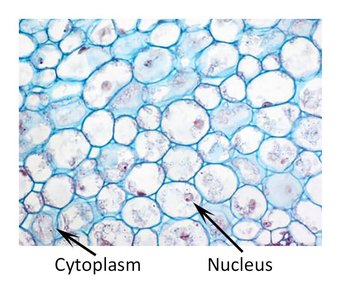
Parenchyma cells are the most common plant cells, with thin, flexible walls and large vacuoles. They perform metabolic functions and retain the ability to divide and differentiate.
Metabolic functions: Photosynthesis, storage, and tissue repair.
Structure: Thin primary walls, lack secondary walls.
Collenchyma Cells
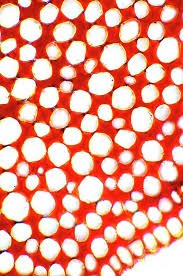
Collenchyma cells provide flexible support without restraining growth. They have unevenly thickened cell walls and are living at maturity.
Support: Found in young stems and petioles.
Structure: Uneven cell wall thickness.
Sclerenchyma Cells
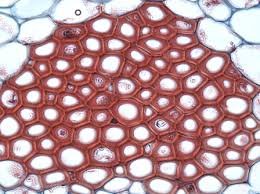
Sclerenchyma cells are rigid due to thick secondary walls containing lignin. They are dead at maturity and provide structural support.
Sclereids: Boxy, irregular cells with thick walls (e.g., nut shells).
Fibers: Long, slender, tapered cells grouped in strands.
Water-Conducting Cells of the Xylem
Xylem cells are tubular, elongated, dead, and lignified at maturity. They include tracheids and vessel elements, which transport water and minerals.
Tracheids: Long, thin cells with tapered ends; water moves through pits.
Vessel elements: Wider, shorter cells aligned end-to-end; water flows through perforation plates.
Sugar-Conducting Cells of the Phloem
Phloem cells are alive at maturity and transport sugars. In angiosperms, sieve-tube elements form chains with sieve plates for fluid flow, assisted by companion cells.
Sieve cells: Found in seedless vascular plants and gymnosperms.
Sieve-tube elements: Chains of cells in angiosperms; lack organelles, rely on companion cells.
Plant Growth and Meristems
Indeterminate and Determinate Growth
Plants can grow throughout their life (indeterminate growth), enabled by meristems—regions of undifferentiated cells. Some organs exhibit determinate growth, ceasing at a certain size.
Meristems: Perpetually dividing tissues; apical meristems at tips, lateral meristems for secondary growth.
Primary growth: Increase in length from apical meristems.
Secondary growth: Increase in girth from lateral meristems (vascular cambium and cork cambium).
Primary and Secondary Growth
Primary growth produces parts of the root and shoot systems, while secondary growth increases stem and root diameter in woody plants.
Apical meristems: Located at root and shoot tips; responsible for primary growth.
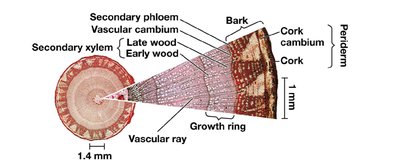
Vascular cambium: Adds secondary xylem (wood) and secondary phloem.
Cork cambium: Replaces epidermis with periderm.
Root Structure and Development
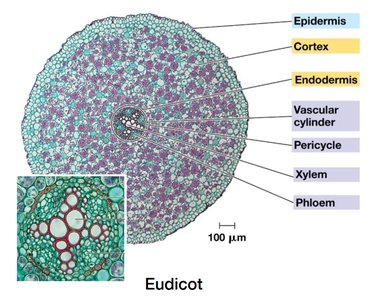
The root tip is protected by a root cap. Growth occurs in three zones: cell division, elongation, and differentiation. The endodermis regulates passage of substances into the vascular cylinder.
Stele: Vascular cylinder in angiosperm roots.
Lateral roots: Arise from the pericycle.
Shoot Structure and Development
Shoot apical meristems are dome-shaped masses of dividing cells. Leaves develop from leaf primordia. Axillary buds are dormant due to apical dominance but can form lateral shoots if the apical bud is removed.
Leaf Structure
Leaves contain stomata for gas exchange, regulated by guard cells. Mesophyll is specialized for photosynthesis, with palisade and spongy layers. Veins are vascular bundles enclosed by bundle sheath cells.
Secondary Growth and Wood Formation
Vascular Cambium and Cork Cambium
Secondary growth is characteristic of gymnosperms and many eudicots. The vascular cambium forms a cylinder of meristematic cells, producing secondary xylem (wood) and secondary phloem. Cork cambium produces protective cork cells.
Secondary xylem: Tracheids, vessel elements, fibers; lignified walls provide strength.
Tree rings: Formed by early and late wood; used to estimate age.
Heartwood: Older, non-functional xylem.
Sapwood: Newer, functional xylem.
Bark: All tissues external to vascular cambium, including secondary phloem and periderm.
Lenticels: Allow gas exchange in periderm.
Additional Topics from Chapters 29-31
Soil and Plant Nutrition
Soil can become deficient in nitrate due to negative charge repulsion. Low soil pH increases toxic aluminum ion availability, stunting growth. Photosynthesis produces most of the dry mass of a plant.
Xylem transport: Fastest under negative pressure potential in leaf mesophyll.
Reproduction and Hormones
One microsporocyte produces four pollen grains. Auxin concentration higher than cytokinin in a callus induces root formation. Cytokinins are used to keep cut flowers fresh. Only the shoot epidermis produces a waxy cuticle.
Summary Table: Plant Cell Types
Cell Type | Main Function | Wall Structure | Living/Dead at Maturity |
|---|---|---|---|
Parenchyma | Metabolism, storage, repair | Thin, flexible primary walls | Living |
Collenchyma | Flexible support | Unevenly thickened walls | Living |
Sclerenchyma | Rigid support | Thick, lignified secondary walls | Dead |
Xylem (Tracheids/Vessel Elements) | Water/mineral transport | Lignified walls | Dead |
Phloem (Sieve-tube Elements) | Sugar transport | Primary walls | Living |
Key Equations
Water potential: Where is water potential, is pressure potential, and is solute potential.
Additional info: Academic context was added to clarify cell types, tissue functions, and growth processes. Table entries and explanations were expanded for completeness.
