 Back
BackPlant Structure, Growth, and Transport in Vascular Plants
Study Guide - Smart Notes
 Tailored notes based on your materials, expanded with key definitions, examples, and context.
Plant Structure and Growth
Overview of Plant Structure
Vascular plants are complex organisms composed of various tissues, organs, and organ systems that enable them to acquire resources, grow, and reproduce. Understanding the organization and function of these structures is fundamental to plant biology.
Tissue: A group of cells (of one or more cell types) grouped together for a specialized function.
Organ: Several tissue types working together to carry out a function.
Organ System: Multiple organs working together to perform major plant functions.
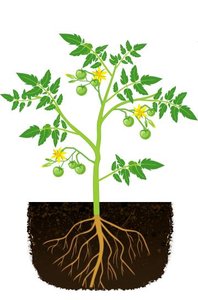
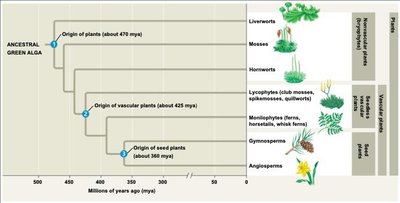
Vascular vs. Avascular Plants
Plants are classified as vascular or avascular based on the presence of vascular tissue. Most modern-day plants are vascular, which allows for efficient transport of water and nutrients and supports larger growth forms.
Vascular tissue: Specialized tissue (xylem and phloem) for transport of water, minerals, and sugars.
Avascular plants: Lack vascular tissue; typically smaller and include mosses and liverworts.
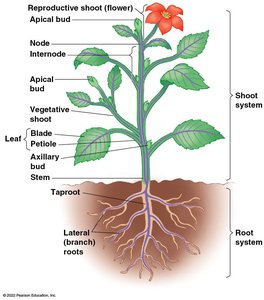
Major Organs of Vascular Plants
Vascular plants have three primary organs: roots, stems, and leaves. These organs are organized into two main systems:
Root system: All the plant's roots, responsible for anchorage, absorption, and storage.
Shoot system: Stems, leaves, and flowers (if present), responsible for support, photosynthesis, and reproduction.
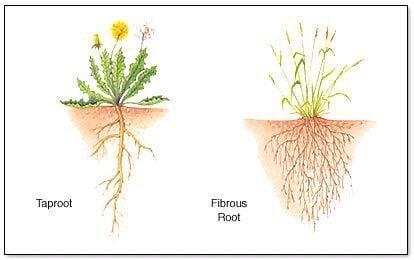
Root Systems
Roots anchor the plant, absorb water and minerals, and store carbohydrates. There are two main types of root systems:
Taproot system: Characteristic of tall, erect plants; consists of a main vertical root (taproot) with lateral roots branching off. Provides deep anchorage and storage.
Fibrous root system: Found in small or trailing plants; consists of many thin roots spreading out below the soil surface. Provides extensive surface area for absorption and prevents soil erosion.
Root Hairs
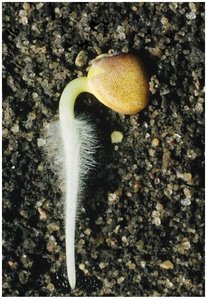
Root hairs are microscopic extensions of epidermal cells that greatly increase the surface area for water and mineral absorption.
Stems
Stems support leaves and reproductive structures, and serve as conduits for transport between roots and shoots. Key features include:
Nodes: Points of leaf attachment.
Internodes: Stem segments between nodes.
Apical bud: Located at the shoot tip; responsible for elongation.
Axillary bud: Found in the angle between leaf and stem; can form lateral branches, thorns, or flowers.
Leaves
Leaves are the main photosynthetic organs of plants. They also function in gas exchange, heat dissipation, defense, and storage. Typical leaf structure includes:
Blade: The flattened portion of the leaf.
Petiole: The stalk that joins the leaf to the stem.
Plant Tissue Systems
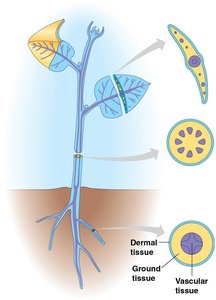
Plant organs are composed of three major tissue systems, each with distinct functions:
Dermal tissue: The outer protective covering (epidermis in nonwoody plants; may have a waxy cuticle).
Vascular tissue: Conducts water, minerals, and sugars (xylem and phloem).
Ground tissue: Functions in photosynthesis, storage, and support; includes pith (internal to vascular tissue) and cortex (external to vascular tissue).
Vascular Tissue: Xylem and Phloem
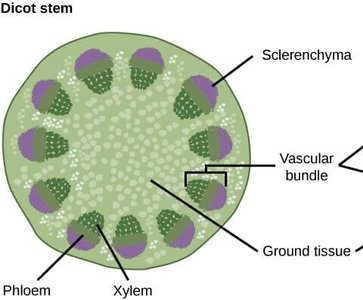
The vascular tissue system is essential for long-distance transport and structural support.
Xylem: Conducts water and minerals upward from roots to shoots. Composed of dead, lignified cells called tracheids and vessel elements (in angiosperms).
Phloem: Transports sugars and other organic nutrients in both directions. Composed of living cells called sieve-tube elements, supported by companion cells.

Xylem Structure and Function
Tracheids: Tubular, elongated cells with thick, lignified walls; dead at maturity. Water moves through pits (thin areas in the cell wall) between adjacent tracheids.
Vessel elements: Shorter, wider cells with perforated end walls (in angiosperms); align end-to-end to form vessels.
Phloem Structure and Function
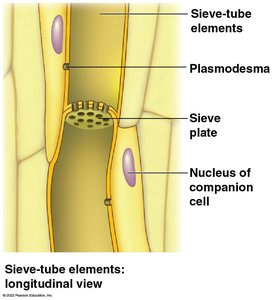
Sieve-tube elements: Chains of cells lacking nuclei and most organelles; allow efficient flow of phloem sap.
Companion cells: Non-conducting cells adjacent to sieve-tube elements; provide metabolic support.
Plant Growth: Meristems and Growth Types
Plant growth can be indeterminate (continuous) or determinate (ceases at a certain size). Growth is enabled by meristems—regions of undifferentiated cells capable of division.
Apical meristems: Located at tips of roots and shoots; responsible for primary growth (elongation).
Lateral meristems: Responsible for secondary growth (thickness); include vascular cambium and cork cambium.
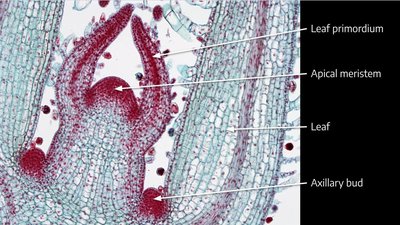
Stem Cells and Differentiation
Initial (stem) cells: Remain in the meristem, perpetually divide, and are unspecialized.
Derivative cells: Displaced from the meristem and differentiate into specialized cell types.
Primary vs. Secondary Growth
Primary growth: Elongation of roots and shoots via apical meristems.
Secondary growth: Increase in thickness via lateral meristems (vascular cambium adds secondary xylem and phloem; cork cambium produces periderm).
Transport in Vascular Plants
Short-Distance Transport: Apoplastic and Symplastic Pathways
Substances can move within plants via two main compartments:
Apoplast: Everything external to the plasma membrane, including cell walls and intercellular spaces.
Symplast: The cytosol of all living cells, connected by plasmodesmata.
Three transport mechanisms:
Apoplastic route: Through cell walls and extracellular spaces.
Symplastic route: Through the cytosol via plasmodesmata.
Transmembrane route: Across cell membranes and cell walls.
Membrane Potential and Cotransport in Plants
Plant cells establish membrane potentials using proton pumps (H+), which create electrochemical gradients used for cotransport of solutes (e.g., H+/sucrose transporter).
Water Potential and Osmosis
Osmosis is the diffusion of free water across a membrane. The direction of water movement is determined by water potential (Ψ), which combines solute concentration and pressure:
Water flows from regions of higher water potential to lower water potential.
Cells placed in solutions with higher solute concentration lose water (plasmolysis); in pure water, they gain water and become turgid.
Equation for water potential:
Where is total water potential, is solute potential, and is pressure potential.
Bulk Flow: Long-Distance Transport
Bulk flow is the movement of fluid driven by pressure differences, independent of solute concentration. It is much faster than diffusion and occurs in hollow, dead cells (xylem) or sieve tubes (phloem).
Xylem: Bulk flow of water and minerals (xylem sap) occurs via transpiration, explained by the cohesion-tension hypothesis.
Phloem: Bulk flow of sugars (phloem sap) is called translocation.
Transpiration and Leaf Structure
Transpiration is regulated by stomata, which are flanked by guard cells. Leaf tissue is organized to facilitate gas exchange and photosynthesis:
Palisade mesophyll: Upper layer, tightly packed cells for photosynthesis.
Spongy mesophyll: Lower layer, loosely arranged cells for gas circulation.
Comparison of Transport Mechanisms
Mechanism | What is transported | How it is transported | Distance |
|---|---|---|---|
Apoplastic | Water, minerals | Through cell walls and intercellular spaces | Short |
Symplastic | Water, solutes | Through cytosol via plasmodesmata | Short |
Transpiration (xylem) | Water, minerals | Bulk flow via cohesion-tension | Long |
Translocation (phloem) | Sugars, organic molecules | Bulk flow via pressure differences | Long |
Additional info: The above notes integrate foundational concepts from plant anatomy and physiology, including the structure and function of tissues, organs, and transport mechanisms, as covered in introductory college biology courses.
