 Back
BackPopulation Genetics and the Hardy-Weinberg Principle
Study Guide - Smart Notes
 Tailored notes based on your materials, expanded with key definitions, examples, and context.
Population Genetics and Evolution
Genetic Variation and Evolution
Genetic variation within a population is the foundation for evolutionary change. Evolution occurs when the frequency of alleles (gene variants) in a population changes over generations. However, the presence of genetic variation alone does not guarantee that evolution will occur; some mechanism must alter allele frequencies.
Genetic Variation: Differences in DNA sequences among individuals in a population.
Allele Frequency: The proportion of a specific allele among all alleles for a given gene in a population.
Evolution: A change in allele frequencies in a population over time.
Population Structure and Isolation
Populations are groups of individuals of the same species that live in the same area and interbreed. Populations may be physically or behaviorally isolated from one another, exchanging genetic material only rarely. Isolation can occur due to geographic barriers or behavioral differences, but not all populations are completely isolated. Members of a population typically breed with each other more often than with members of other populations.
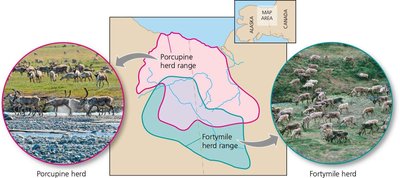
Allele and Genotype Frequencies
Calculating Allele Frequencies
Allele frequencies can be calculated using the number of copies of each allele in the population. For example, consider a population of 500 wildflowers with two alleles for a flower color gene: CR (red) and CW (white). These alleles show incomplete dominance, so heterozygotes have a distinct phenotype (pink flowers).
Homozygous: Having two identical alleles for a gene (e.g., CRCR or CWCW).
Heterozygous: Having two different alleles for a gene (e.g., CRCW).

Suppose there are 320 red-flowered plants (CRCR), 160 pink-flowered plants (CRCW), and 20 white-flowered plants (CWCW). Since these are diploid organisms, the total number of alleles is 1,000 (500 plants × 2 alleles each). The frequency of the CR allele is calculated as follows:
Number of CR alleles = (320 × 2) + (160 × 1) = 800
Allele frequency of CR = 800 / 1,000 = 0.8 (80%)
The Hardy-Weinberg Principle
Definition and Importance
The Hardy-Weinberg principle provides a mathematical model to study genetic variation in populations. It predicts genotype frequencies under the assumption that no evolutionary forces are acting. If allele frequencies remain constant from generation to generation, the population is said to be in Hardy-Weinberg equilibrium.
Hardy-Weinberg Equilibrium: The condition in which a population's allele and genotype frequencies remain constant across generations in the absence of evolutionary influences.
Null Model: A hypothesis of no change, used as a baseline for detecting evolution.
Hardy-Weinberg Equation
For a gene with two alleles, CR and CW, with frequencies p and q respectively, the Hardy-Weinberg equation is:
Where:
= frequency of homozygous dominant (CRCR)
= frequency of heterozygotes (CRCW)
= frequency of homozygous recessive (CWCW)
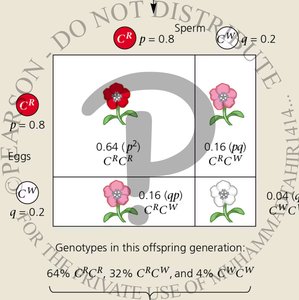
Visualizing Hardy-Weinberg Proportions
Random mating in a large population can be visualized using probability trees or Punnett squares. For example, if the frequency of CR is 0.8 and CW is 0.2, the expected genotype frequencies are:
for CRCR
for CRCW
for CWCW
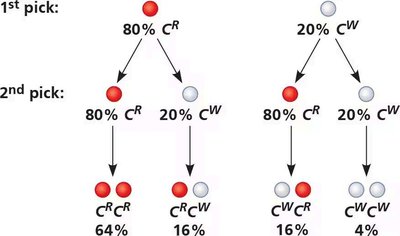
Assumptions of Hardy-Weinberg Equilibrium
For a population to remain in Hardy-Weinberg equilibrium, five conditions must be met:
No mutations: The gene pool is not modified by mutations.
Random mating: Individuals pair by chance, not according to their genotypes or phenotypes.
No natural selection: All genotypes have equal chances of survival and reproduction.
Extremely large population size: Genetic drift (random changes in allele frequencies) is negligible.
No gene flow: No migration of individuals into or out of the population.
Applications and Importance
Using the Hardy-Weinberg Model
The Hardy-Weinberg model is used as a baseline to detect evolutionary change. If observed genotype frequencies differ from those predicted by the model, it suggests that one or more of the equilibrium conditions are not met, and evolution may be occurring.
Example: If a population shows more heterozygotes than expected, it may indicate non-random mating or gene flow.
Summary Table: Hardy-Weinberg Equilibrium Conditions
Condition | Description |
|---|---|
No mutations | No new alleles are introduced into the gene pool |
Random mating | Individuals mate randomly with respect to genotype |
No natural selection | All genotypes have equal fitness |
Large population size | Reduces the impact of genetic drift |
No gene flow | No migration of alleles into or out of the population |
Additional info: The Hardy-Weinberg principle is foundational for understanding how populations evolve and for identifying the forces that can cause evolutionary change, such as selection, drift, mutation, and migration.
